

Rising Together – Teaching with Hope and Strength
Serhii Petrenko, TESOL-Ukraine, Ukraine
Building resilience and community
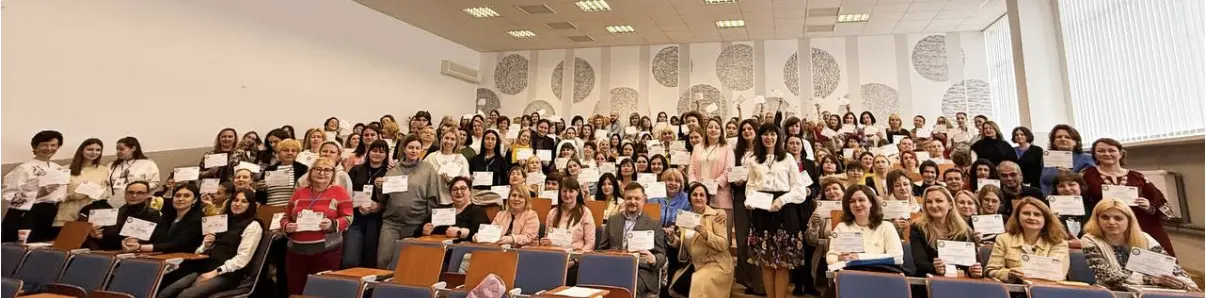
Even amid wartime disruption, Ukrainian educators try to address students’ evolving emotional and academic needs, and maintain their dedication to teaching under conditions of trauma, displacement, and uncertainty (Penton Herrera & Chugai, 2024; Petrenko and Zuyenok, 2025; Westerlund et al., 2023). TESOL-Ukraine’s work unites educators across the country for peer support, resources, and professional development so they can teach with confidence and care (Figure 1).
Figure 1
Participants of the 2025 TESOL-Ukraine National Convention in Ivano-Frankivsk, Ukraine
Innovative professional development
TESOL-Ukraine’s event calendar has stayed full despite the war. Each year, we hold an annual convention, summer and winter professional development institutes, workshops, and webinars. At these events, hundreds of teachers share research, and lesson ideas. We run institutes and webinars on cutting-edge topics. Some recent programs have covered blended learning with Canvas, AI tools in education, trauma-informed pedagogy, social-emotional learning, English as a Medium of Instruction (EMI) basics, storytelling, and creative writing. These sessions, led by Ukrainian and international experts, have given educators clear strategies for adapting to hybrid classrooms, and meeting the evolving student needs.
The TESOL-Ukraine National Convention is a vital part of why we are resilient. The 2025 event, Rising Together—Teaching with Hope and Strength, hosted by Vasyl Stefanyk Precarpathian National University in Ivano-Frankivsk, brought together around 300 educators despite no external funding. As one attendee shared, ‘It didn’t matter that we had to pay our own way: the chance to learn from each other and feel part of this community is priceless.’ The program featured plenaries on digital tools, mentorship, trauma-informed pedagogy, innovative assessment, etc.
A cornerstone of this work is the TESOL-Ukraine Summer Institute, where teachers from across the country gather for a week of intensive training and collaboration. The 2025 Word Magic Institute in Lviv invited about 40 teachers to explore imaginative writing in English. Poet Cecilia Woloch (USA) and Business English trainer Mark Powell (UK) joined Ukrainian educators to lead sessions on creative writing, poetry, and storytelling. Teachers practiced micro-memoirs, first-person narratives rooted in place, and even dice-driven creative prompts (Figure 2). Such activities have encouraged teachers to see language learning not just as skill acquisition, but as meaning-making, and identity building. Workshops also integrate Ukrainian cultural heritage. For example, storytelling exercises often use folk motifs, local history, and crafts, allowing teachers and students to affirm their roots while practicing English. In wartime, this cultural dimension becomes a source of resilience: it connects learners to a sense of continuity and hope. Teachers can take these creative methods back to their classrooms, using them to nurture empathy, curiosity, and joy in their students.
Figure 2
Dice-driven activity at 2025 TESOL-Ukraine Summer Institute, Word Magic

Another innovative initiative is the EMI Basics Course for subject teachers. In many Ukrainian universities, non-language faculty are now required to deliver courses in English. This rapid shift presents challenges: instructors may be experts in economics, engineering, or medicine but lack confidence in English as the language of instruction. TESOL-Ukraine has designed and piloted a practical training course that supports these lecturers in planning lessons, scaffolding language, and motivating learners. The program combines online modules with interactive workshops. Participants can take advantage of linguistic support, such as conversation clubs with native speakers, and pedagogical strategies, such as workshops led by experienced English for specific purposes (ESP) practitioners. As a result, subject specialists feel more prepared to teach effectively in English, while students gain access to global academic discourse.
Equally transformative is the TESOL-Ukraine’s Mentorship Program, launched as a pilot in early 2025. This initiative pairs experienced English teachers with early-career colleagues for a six-month cycle of guidance, reflection, and collaborative projects. Mentors provide feedback on lesson plans, help mentees set professional goals, and share strategies for classroom challenges from assessment to trauma-sensitive teaching. Both mentors and mentees report that the program boosts confidence, alleviates isolation, and encourages a culture of mutual support. With overwhelmingly positive feedback, TESOL-Ukraine plans to expand the mentorship scheme into an international model, ensuring that new teachers are supported, and senior teachers have opportunities to grow as leaders.
International collaboration and outreach
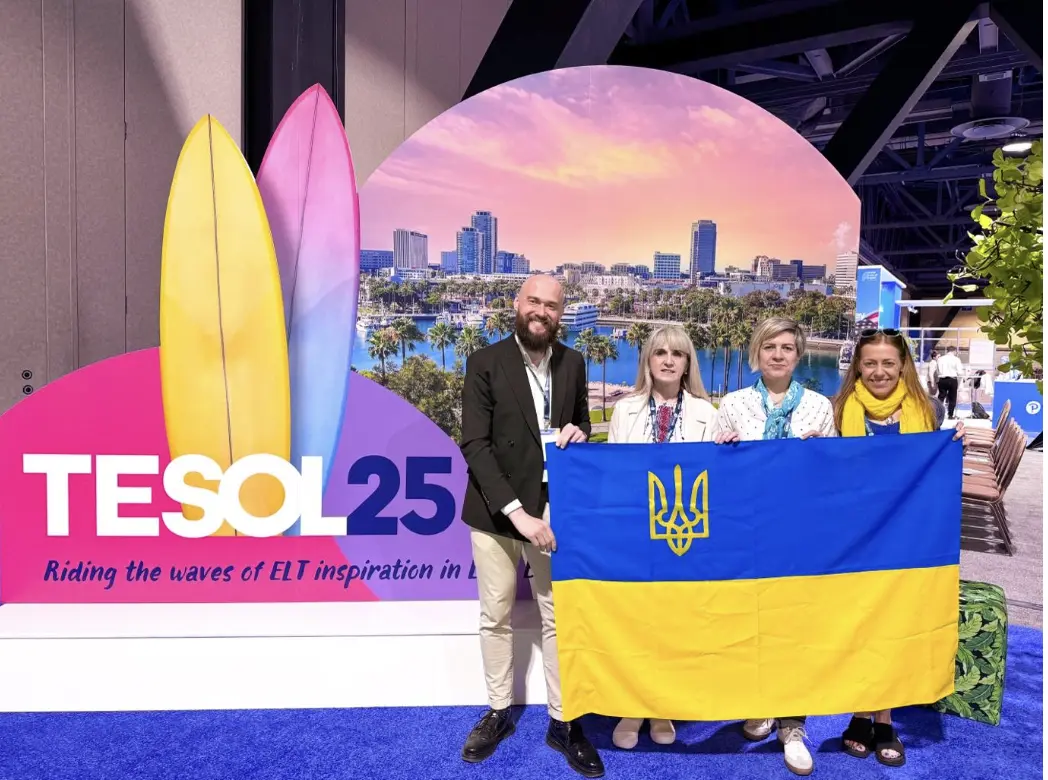
TESOL-Ukraine is also active on the global stage. In 2023-2025, we participated in the TESOL International Conventions (USA) and IATEFL Conference (UK). There, Ukrainian educators presented projects on social-emotional learning, student-led projects, ESP and EMI challenges, and the mentorship pilot program. Our Board members engaged with leaders of other affiliates, discussing would-be joint programs (Figure 3).
Figure 3
TESOL-Ukraine members at the 2025 TESOL International Convention in Long Beach, California, USA
TESOL-Ukraine members have also contributed to regional collaborations, such as conferences organized by TESOL affiliates in Turkey, Hungary, Italy, and Poland, strengthening bonds across borders. These collaborations amplify our work, ensuring that teachers in Ukraine benefit from international expertise and solidarity. They also position Ukrainian voices at the center of global discussions about resilience, multilingual education, and the future of English language teaching (ELT).
Looking ahead
TESOL-Ukraine will continue advocating for our projects. We plan to institutionalize the mentorship program, expand the EMI teacher training course, and develop new online courses that reach more teachers across Ukraine. Above all, we remain committed to teaching with hope and strength. We are confident that by rising together, we will help Ukraine’s English teachers and learners blossom in times of peace, and post-war reconstruction.
TESOL-Ukraine experience offers insights that may resonate with other affiliates to build resilient professional communities, prioritize teacher well-being and social-emotional learning, and maintain continuity through various flexible formats.
References
Pentón Herrera, L., & Chugai, O. (2024). A mixed-methods analysis of EFL teachers’
attitudes toward socio-emotional learning and well-being: insights from Poland and Ukraine. Advanced Education, 12(25), 56–78. https://doi.org/10.20535/2410-8286.309139
Petrenko, S., & Zuyenok, I. (2025). Adapting approaches of ESP teaching and learning to the
reality of wartime. In R. M. Senyshyn & A. E. Lypka (Eds.), Voices of courage and vulnerability: teaching English in a society at war (Ukraine 2022-2023) (pp. 76–87). Sunshine TESOL Press.
Westerlund, R., Chugai, O., Petrenko, S., & Zuyenok, I. (2023). Teaching and learning
English at higher educational institutions in Ukraine through pandemics and wartime. Advanced Education, 22, 12–26. https://doi.org/10.20535/2410-8286.283353
 Serhii Petrenko, Ph.D., Associate Professor at the Department of Foreign Languages at Taras Shevchenko National University of Kyiv (Ukraine), TESOL-Ukraine International Coordinator, teacher trainer, and mentor. He holds Cambridge DELTA, has presented at international conferences, workshops, and webinars (e.g., TESOL, IATEFL, TESOL-Ukraine, etc.), has organized and facilitated multiple projects, e.,g. British Euro-Atlantic Language Training for Ukrainian civil servants (British Council, 2024-2025), Holistic Language Pedagogies Project (Childhood Education International, 2023-2024), Teaching in a New Context for English teachers of grades 5-9 (British Council, 2022-2023), United Business Community (2022), English as a Medium of Instruction for university subject teachers (TESOL-Ukraine, 2021-2025), Developing Teaching Skills in ESP for university ESP teachers (British Council, 2021-2022), etc. He gave guest lectures to students and educators of Cluster University of Jammu (India, 2024), American University of Kuwait (2024), and Duzce University (Turkey, 2016). At his alma mater, he has been teaching ESP, EAP, and Academic Writing to students of political science, public administration, history, archival science, archaeology, philosophy, sociology, psychology, and military specialties.