

Stronger Together: Advocating For Multilingual Learners of English in Uncertain Times
Melanie Schneider, Wisconsin Teachers of English to Speakers of Other Languages (WITESOL)
In these uncertain times, it’s easy to feel overwhelmed and powerless in supporting multilingual learners of English (MLEs), their families, and their teachers. While this reaction is understandable, individuals can support MLEs and challenge opposing views in a concrete way through advocacy. In this article, we briefly review what advocacy means and then introduce advocacy efforts at the state (affiliate) level and at the international level (TESOL).
Simply put, advocacy refers to organized action in support of an idea or a cause. It involves establishing ongoing and trusting relationships with elected officials or others on important issues. Although advocacy does not necessarily result in quick fixes, regular contact and information exchanges with elected officials and school administrators serve to keep issues alive. A key takeaway is that everyone can advocate, although the forms of advocacy may differ.
State Level Advocacy
Legislative Days
At the state level, WITESOL members have participated in two main efforts: 1) Legislative Days and 2) Advocacy Book Club. Legislative Days participants select an issue in their state or affiliate area that affects MLEs, and then, through online discussion and consensus, determine one or more positions on the issue (the asks). Under the guidance of the Advocacy Chair, the advocacy group then creates two documents, a more detailed version for advocates who meet with their legislators and an abbreviated version to leave behind for the legislators. These two documents contain six sections: welcome and introductions, setting the scene on the issue (background information), the asks and rationales for them, questions/comments, and closing. Legislative Day participants later contact their state legislators and meet with them virtually or in person to advocate for those positions. It is especially important to leave time for questions/comments as this opens the door for legislators to commit to the asks or negotiate changes. In 2024 and 2025, our advocacy centered on changes to Act 20, Wisconsin’s Early Literacy law (2023), which were beneficial to MLEs. We asked for four changes to the law. As an example, our first ask was Revise Act 20 so that multilingual/dual language/English as a second language learners can have their literacy skills assessed in the language in which they are being instructed (e.g., Spanish).
Advocacy Book Club
The second state-level advocacy event, Advocacy Book Club, occurs monthly during the school year and is open to WITESOL members and other interested persons. Book club members choose one or more professional books to read and discuss over several months. Due to everyone’s busy schedules, we generally read only a few chapters or a section of a book at a time. Members take turns leading discussions on the assigned reading. In 2024-25, our book club read two books: If you only knew: Letters from an immigrant teacher (Francis, 2022) and Language of identity, language of access: Liberatory learning for multilingual classrooms (Benegas & Benjamin, 2025). The first book tells Emily Francis’s story growing up in Guatemala and immigrating to the U.S. as an undocumented minor through letters she writes to former students whose stories echo her own in some way. In the second book, Benegas and Benjamin introduce their liberatory approach to language learning and teaching that emphasizes how to incorporate cultural identity topics into the curriculum, engender a critical perspective on language, and access English as an additional language through an introduction to functional language instruction and its practical applications in the classroom.
International Advocacy
At the heart of advocacy at the (inter)national level, are TESOL Advocacy Action Days and TESOL’s Advocacy Action Center website (TESOL, n.d.), which serves as a clearinghouse for advocacy efforts. Advocacy Action Days (AADs) take place twice a year, virtually and in-person in Washington, D.C., and feature presentations by national figures in education and immigration in preparation for visits with participants’ U.S. legislators (Figure 1). Virtual AADs typically take place in February and in-person AADs occur in June. TESOL provides participants of virtual and in-person AADs with extensive talking points (positions), webinars, and other resources to support their positions as well as websites that help participants tailor TESOL’s talking points to their home states to better make their case.
All TESOL members can access advocacy information at the Advocacy Action Center website (see above) and sign up to receive advocacy alerts on legislative or policy issues that affect the education of MLEs of all ages, their teachers, and their families. Members are then urged to contact their U.S. legislators to advocate for these priorities. While these advocacy alerts are U.S.-based, internationally based TESOL members can create similar advocacy alert systems that prioritize the education of MLEs in their own countries.
In closing, we emphasize that everyone can learn to advocate and that advocacy can take place anywhere and anytime, not just in person. Results may not be immediate, but by joining together with others on issues of mutual concern, the impact of advocacy becomes ever stronger.
Figure 1
2025 TESOL Advocacy Action Days
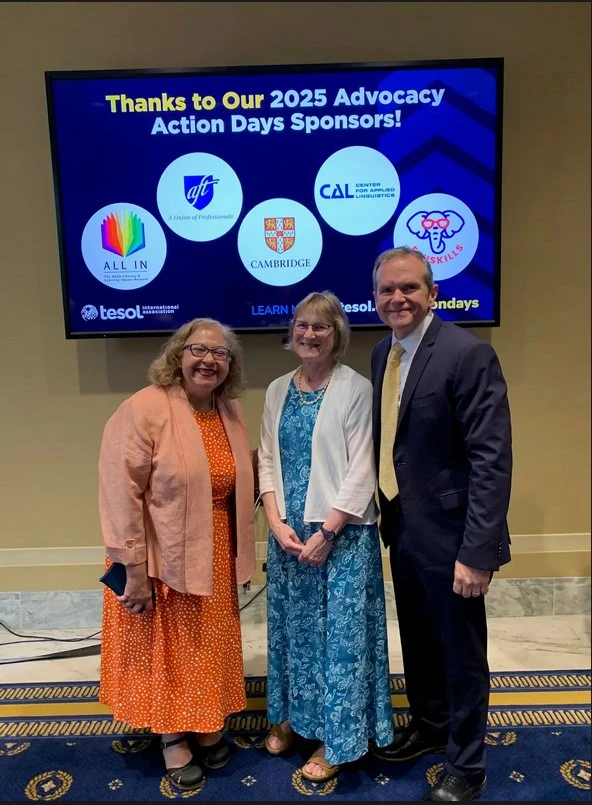
Giselle Lundy-Ponce (AFT), Melanie Schneider, Jeff Hutcheson (Director, TESOL Advocacy & Policy) at 2025 TESOL Advocacy Action Days, Washington, D.C.
References
Benegas, N. & Benjamin, N. (2024). Language of identity, language of access: Liberatory learning for multilingual classrooms. Corwin.
Francis, E. (2022). If you only knew: Letters from an immigrant teacher. Seidlitz Education, LLC.
TESOL Advocacy Action Center. (n.d.). https://www.tesol.org/advocacy/advocacy-action-center/.
 Melanie Schneider is Professor Emerita at the University of Wisconsin - Whitewater, where she coordinated the ESL and Bilingual Education Licensure Program and advised the Student Teaching Program in Mexico. She is interested in promoting advocacy skills that lead to professional growth among ESL/bilingual dual language teachers, university students, and university faculty. Additionally, she is committed to advocating for multilingual students, their teachers, and their families.