

Supporting the Journey of English Learners After Trauma
Linda Molin-Karakoc, University College London, London, United Kingdom
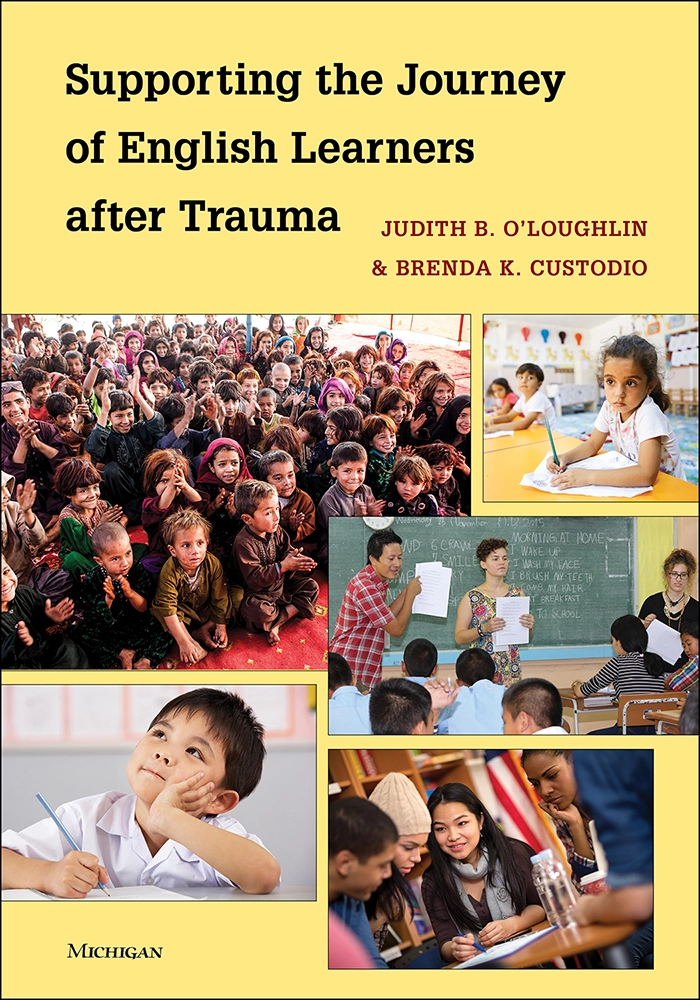
Photo caption: Cover image of Supporting the Journey of English Learners After Trauma
In recent years, trauma-informed pedagogy has become a prominent topic in teacher education and professional development, yet many resources remain general rather than context-specific. Judith O’Loughlin and Brenda K. Custodio’s book Supporting the journey of English learners after trauma fills this important gap by offering a focused, practitioner-oriented exploration of trauma and its unique effects on immigrant-background learners, particularly those with refugee experiences. I first encountered this book after attending Judith O’Loughlin’s session at the 2024 CATESOL conference. The work provides a thoughtful, research-based, and accessible approach to supporting educators working with diverse English learners.
The authors’ central contribution is their careful unpacking of what “trauma” actually means in educational contexts. Rather than treating trauma as a monolithic or purely psychological construct, they distinguish among types, timelines, and manifestations. Importantly, they frame trauma not only as something that may occur before migration, but alsoduring migration and after arrival, challenging a common simplification in educational conversations that positions trauma-related experiences solely in terms of pre-migration adversities. This expanded framing is one of the book’s most valuable additions, as it encourages educators to recognize that adjustment stress, uncertainty, and systemic barriers in host societies can be equally significant sources of distress to students. The broader lens offered by the book also entails the authors’ critique of the dominant reliance on Adverse Childhood Experiences (ACE)frameworks in trauma-informed training. While ACE research has contributed substantially to understanding long-term effects of childhood adversity, O’Loughlin and Custodio argue that it cannot fully capture the sociopolitical, linguistic, and displacement-related dimensions shaping refugee and immigrant learners’ experiences. For educators who, like myself, have completed university-based courses on trauma-informed pedagogy centering primarily on ACE indicators, this book provides a much-needed expansion. It demonstrates that trauma-responsive teaching for immigrant-background learners requires attention not only to psychological histories but also to migration trajectories, language barriers, acculturation stress, and shifting family roles.
Another strength of the book lies in its discussion of how trauma often manifests in students’ classroom behavior. The authors emphasize that reactions vary widely: some learners may appear withdrawn, others hyperactive or unable to move or act. By presenting these responses as adaptive rather than problematic, the text helps educators reinterpret student behavior that might otherwise be misread as disengagement or defiance. This reframing supports more empathetic and pedagogically sound responses, aligning with asset-based approaches advocated in TESOL.
Crucially, the book does not stop at theory. Each chapter concludes with reflection questions, checklists, and practical planning tools, making it immediately usable for teachers, curriculum designers, and teacher educators. These interactive features distinguish the text from more abstract treatments of trauma-informed practice. They invite readers to apply concepts directly to their own instructional contexts, encouraging reflective teaching and actionable change rather than passive reading. Among the most useful practical frameworks presented is the resilience-building model “I Have, I Am, I Can” introduced by the authors as based on Grotberg’s (1995) work.The model guides educators in supporting students’ recognition of their resources (“I have”), strengths (“I am”), and capabilities (“I can”). Its simplicity makes it accessible, while its grounding in research gives it evidence-based credibility. The model also aligns well with my own work supporting refugee students, especially their digital literacies, from strength-based perspectives (Molin-Karakoç, 2025). Similarly, strategies such as mood meters provide concrete ways to monitor the emotional classroom climate and reduce the likelihood that traumatic memories will be unintentionally triggered during instruction. These tools are presented not as quick fixes but as components of a broader commitment to culturally-responsive trauma-informed pedagogy.
The structure and length (134 pages) of the book further enhance its usability. Organized into five chapters with supplementary narratives and resources provided in an appendix, it balances conceptual explanation with illustrative examples. The inclusion of personal migration and resilience narratives at the end of the book is particularly effective, as it underscores the importance of considering students’ lived experiences, reminding readers that trauma-informed teaching is ultimately about building relationships and trust between people while preserving dignity.
The authors’ expertise lends authority to the text. Both O’Loughlin and Custodio have extensive backgrounds in ESL/TESOL, multilingual education and teacher professional development, and their familiarity with classroom realities is evident throughout the book. They write in clear, accessible prose, avoiding unnecessary jargon while still engaging meaningfully with research. This stylistic choice broadens the book’s audience, making it suitable for teachers, curriculum developers, program coordinators, researchers and graduate students preparing to work with English learners who have experienced trauma. The book is especially useful for TESOL professionals working with newcomers, particularly students with interrupted or limited formal education (SLIFE), as well as for teacher educators designing professional learning on trauma-responsive instruction. In addition, it would serve well as a text in MA TESOL programs or Applied Linguistics courses addressing socio-emotional learning (SEL) in refugee education contexts.
Within the growing body of literature on trauma-informed education, Supporting the journey of English learners after trauma stands out for its specificity, practicality, and educator-oriented perspective. Rather than proposing a radically new approach, the book refines and extends existing scholarship by integrating trauma studies, language education, and migration research into a coherent framework for classroom practice. In this sense, its contribution lies less in novelty than in synthesis and applicability — qualities that are particularly valuable for practitioners seeking evidence-based guidance that they can realistically implement. Overall, O’Loughlin and Custodio offer a thoughtful, practical, and deeply humane resource that broadens educators' understanding of trauma and strengthens their capacity to respond constructively. For teachers striving to create classrooms that are not only linguistically supportive but also emotionally safe and empowering, this book is a highly recommended addition to their professional library.
References
Grotberg, E. (1995). A guide to promoting resilience in children: Strengthening the human spirit (Early childhood development: Practice and reflections, No. 8). Bernard van Leer Foundation. https://bibalex.org/baifa/Attachment/Documents/115519.pdf
Molin-Karakoç, L. (2025). Exploring the digital literacies of refugees from a funds-of-knowledge perspective. Journal of Ethnic and Cultural Studies, 12(2), 200–230. https://doi.org/10.29333/ejecs/2236
O’Loughlin, J., & Custodio, B. K. (2021). Supporting the journey of English learners after trauma. University of Michigan Press. https://doi.org/10.3998/mpub.11393698
 Linda Molin-Karakoc, PhD, is an early-career impact and engagement fellow and postdoctoral researcher at University College London. With over a decade of international teaching experience across the U.S., the U.K., Thailand, Ukraine, and Finland, she works at the intersection of research, policy, and practice in language education. Her research interests include computer-assisted language learning, multilingual education, and inclusive pedagogies that support refugee and immigrant-background learners. Drawing on collaborative design methods, her research examines how emerging technologies can be used to strengthen language and literacy development for culturally and linguistically diverse students.