

Cognitive Approaches to Pedagogical Grammar of English
Tsun Sing Hung, Lingnan University, Hong Kong SAR, China
Pedagogical Grammar: Background and Issues
Grammar is widely acknowledged as a vital block of language knowledge for L2 development, hence its high importance in L2 teaching. As Burton (2023) suggested, pedagogical grammar provides grammatical descriptions for L2 learners and is incorporated in teaching materials. However, pedagogical grammar, in terms of grammatical description, remains obscure and incomplete despite contributions of formal and functional grammatical theories (e.g., Chomskyan Generative Grammar and Hallidayan Systemic Functional Grammar). As Larsen-Freeman and Celce-Murcia (2015) commented, grammar items such as prepositions are notoriously difficult as they often differ from learners’ native counterparts. In Cantonese and Mandarin Chinese, for example, prepositions are optional in many cases, and some (such as the equivalent of “to” and “at”) behave as verbs or adverbs. This renders it inadequate to explain their features and use with traditional approaches. To address these challenges, this article seeks to discuss how cognitive approaches to pedagogical grammar can enhance learners’ language awareness. The article targets prepositions, modal verbs, and conditionals as they are deemed challenging and have received significant attention in the existing (applied) cognitive linguistic literature (e.g., Dolgova Jacobsen, 2018; Liu & Qin, 2024; Tyler et al., 2018).
Cognitive Linguistics: A Brief Overview
Emerged in the early 1970s, cognitive linguistics is a school of linguistic theory that studies the intersections between language and human cognition. In brief, this field comprises numerous areas that can be broadly categorized into cognitive semantics and cognitive approaches to grammar (Evans & Green, 2006). The former is the study of linguistic meaning as a manifestation of human conceptualization, while the latter studies how language is mentally structured. In the following section, key cognitive linguistic concepts including image schemas (i.e., mental patterns of perceptual experience with the world), polysemy (i.e., a phenomenon in which a word has distinct yet related meanings), and conceptual metaphors (i.e., a way of understanding a concept in terms of another) are applied to explaining the three targeted grammatical items for more effective L2 learning and teaching.
Applying Cognitive Linguistics to L2 Pedagogical Grammar
Grammar Item (1): Prepositions
From the cognitive linguistic perspective, the literal meanings of prepositions are spatial meanings derived from one’s sensory experiences in the real world. For example, the core spatial meaning of “through” is typically conceptualized through the experience of walking through a tunnel (or any similar confined structures). In the L2 classroom, teachers should visualize such meanings by schematic means to help learners understand the spatial relations between entities, which are known as trajectors (TR) and landmarks (LM) in cognitive terms.
The following figure shows two schematic diagrams of the preposition “over” for illustration:
Figure 1
Schematic Diagrams of Selected Spatial Meanings of the Preposition “Over”
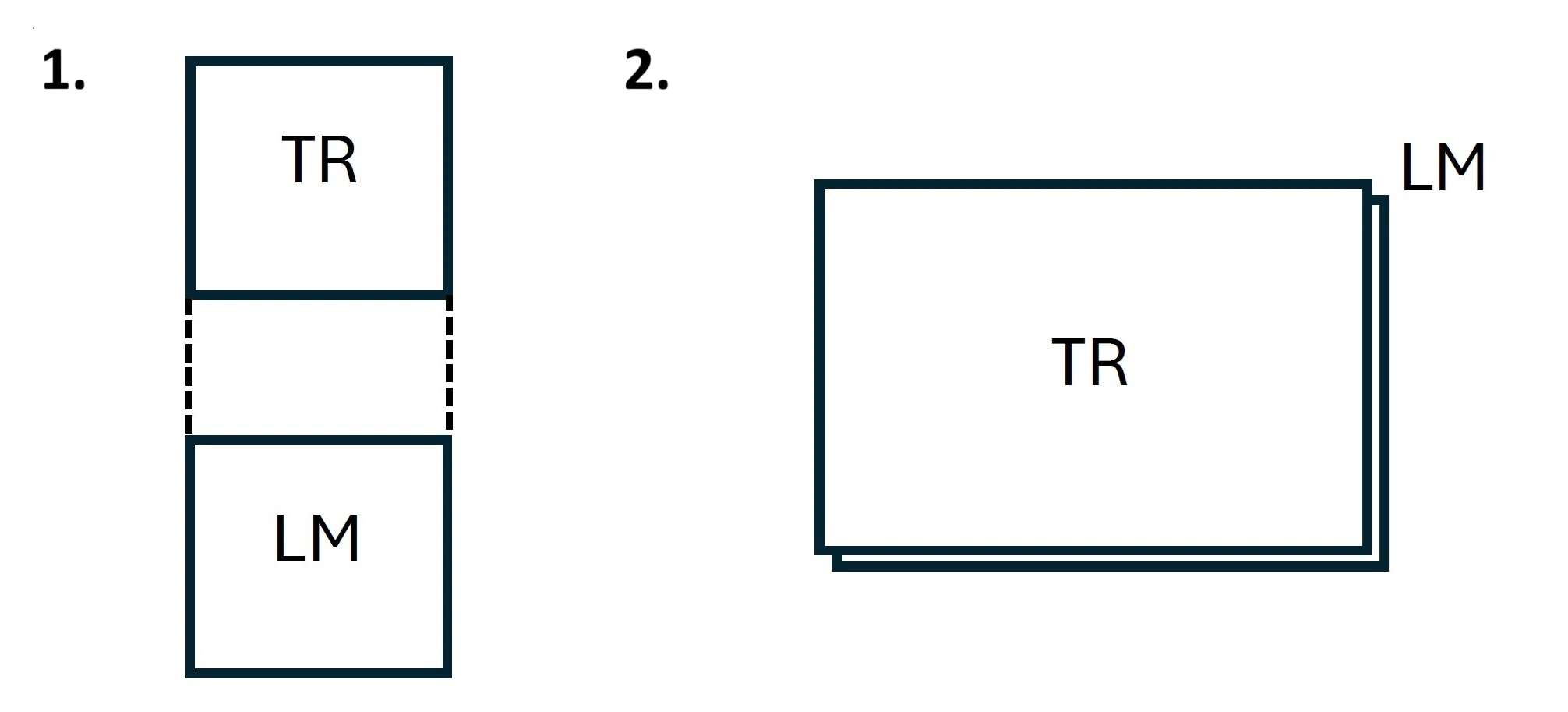
The first schematic diagram depicts a spatial meaning in which the TR (i.e., the highlighted or moving entity) is above the LM (i.e., the background or static entity) with some distance in between (i.e., a non-covering sense), as in “the bridge over the road” while the second diagram shows no such spatial distance (i.e., a covering sense), as in “the jacket over his shoulder.” Another spatial meaning of the preposition “over” can be observed in the following sentence: “The boy jumped over the paper box.” In the sentence, “the boy” (as the moving entity) moved from one side to another of “the paper box” (as the static entity), for which he was temporarily above the paper box (in a non-covering sense) when jumping.
To make it even more complicated, prepositions often, as well, express non-literal meanings, which require understanding through conceptual metaphors. For example, the noun phrase “my power over you” is metaphorical as “power” cannot be literally above a person. The reason for using “over” above is that power differences, which are abstract, are conceptualized in English in terms of vertical distance (POWER is HEIGHT), which is concrete and perceivable.
Figure 2
Conceptual Metaphor of “POWER is HEIGHT”
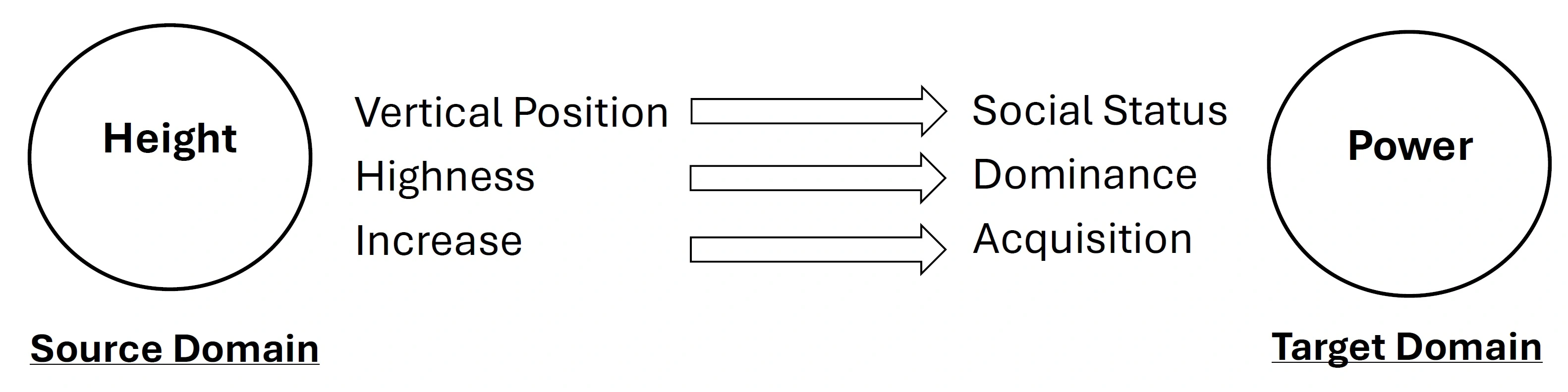
To help L2 learners better understand the usage of English prepositions, teachers should focus on explaining the spatial relations of entities in relevant examples of literal prepositional meanings and their non-literal counterparts in figurative expressions. It would also be helpful to incorporate more engaging visuals, such as drawings or pictures, for demonstration.
Grammar Item (2): Modal Verbs
L2 learners often struggle with using modal verbs despite the small number. Langacker’s (1986) Cognitive Grammar classifies modal verbs into two categories: epistemic modality and deontic modality. The first category expresses the possibility or likelihood of an event or state (e.g., “can”, “could”, “may”, and “might”), while the second category expresses obligation and permission (e.g., “should” and “must”). While such categorization is straightforward, modal verbs may express either modality across contexts, as exemplified in pairs (a and b) below:
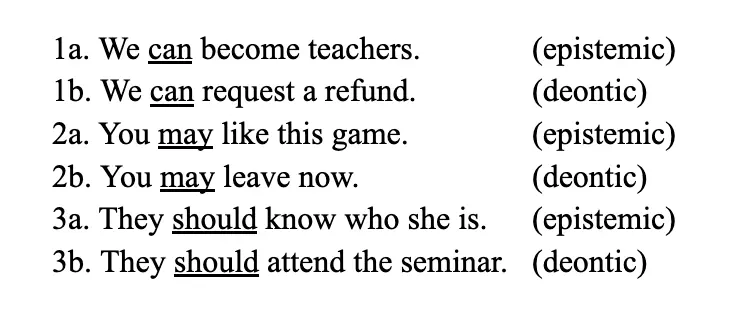
Apart from the epistemic-deontic dichotomy, a cognitive account of polysemy contributes to explaining the complexity in meanings of modal verbs. For instance, the modal verb “will” is polysemous, expressing varying meanings across contexts including the following:
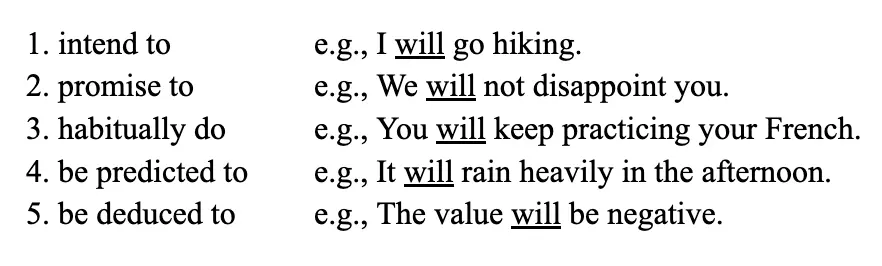
Despite the seeming differences, the core meaning of “will” is “be predicted to,” and the rest are, in essence, its extensions. Therefore, it is important that L2 teachers introduce the core meaning of each modal verb to learners and explain the relations between its meanings for effective conceptual development.
Grammar Item (3): Conditionals
Conditionals are challenging as they require different tenses, aspects, and modal verbs. In formal grammar, the speech-event-reference (SER) system explains Type 0 and Type 1 conditionals in terms of speech time (S) (the time of speaking), event time (E) (the time of event occurrence), and reference time (R) (the time referred to in the speaker’s utterances) as follows:
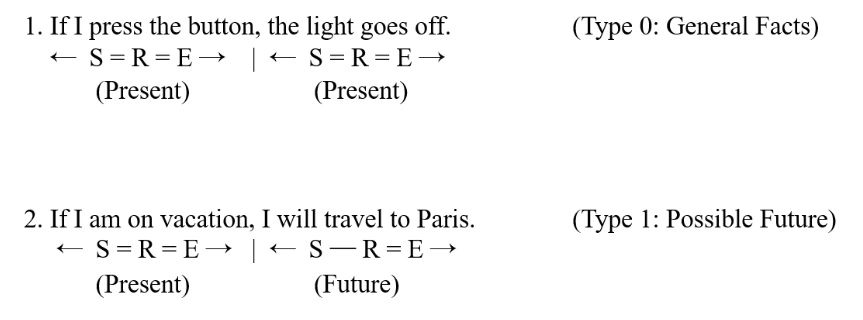
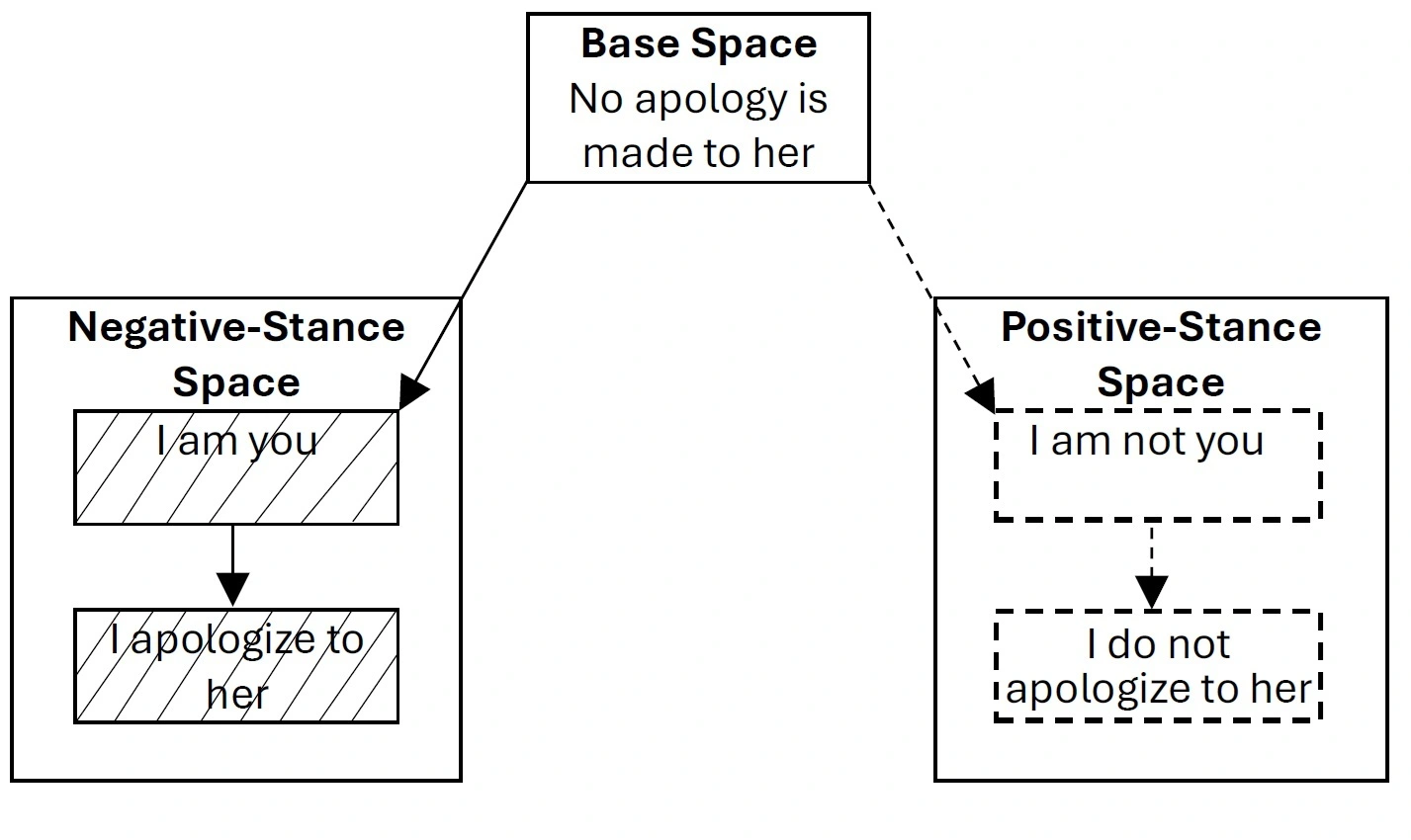
However, the SER system does not effectively apply to Type 2 and Type 3 conditionals as the event time is precluded in hypothetical and counterfactual conditions, and the reference time does not correspond to the tense or aspect of each clause. Comparatively, cognitive semantics explains how unreal situations are structured with different mental spaces: base space (reality), negative-stance space (the speaker’s disbelief), and positive-stance space (the speaker’s certainty) (Dancygier & Sweetser, 2005). Examples are given below for illustration:
|
3. If I were you, I would apologize to her. |
(Type 2: Hypothetical Future) |
Figure 3
Mental Spaces of the Conditional—If I were you, I would apologize to her.
|
4. If I had studied, I would have passed the test. |
(Type 3: Counterfactual Past) |
Figure 4
Mental Spaces of the Conditional—If I had studied, I would have passed the test.
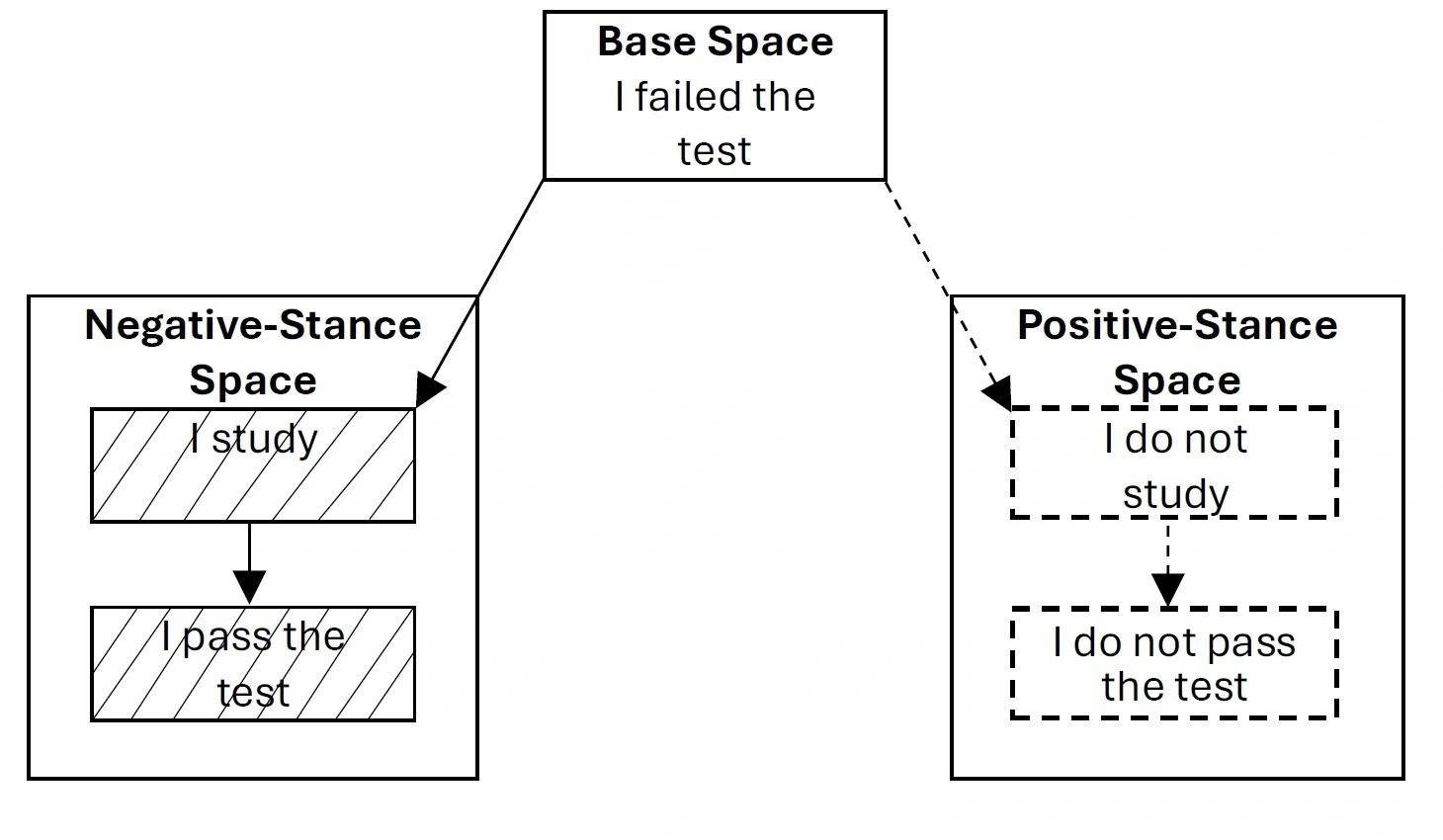
As illustrated in the diagrams, the fact that “no apology is made to her” and that “I failed the test” serves as the foundation of the two conditionals, respectively. Both speakers have negative stances towards the unreal conditions, which, if true, would have resulted in the two imagined consequences. Contrastingly, the two speakers have positive stances towards the lack of true conditions in the real present and past, which bar the consequences from happening in the real future and later past, respectively. In the classroom, teachers may check learners’ understanding of conditions and consequences with true-or-false questions or classroom activities (e.g., philosophical chairs) depending on learners’ age, level, and learning preferences.
Final Thoughts
Cognitive linguistics offers L2 teachers and learners an alternative account of these challenging aspects of English grammar beyond the scope of traditional approaches. Theoretical concepts, including image schemas, polysemy, and conceptual metaphors, should be incorporated into teacher-fronted instruction and learner-centered activities. Teachers are also recommended to explore further applications of cognitive linguistics to inform their teaching and better support learners’ L2 conceptual development. Recommended resources for L2 grammar pedagogy include the International Cognitive Linguistics Association (ICLA)’s online resources (https://www.cognitivelinguistics.org/en/publications-and-resources) and scholarly readings such as Littlemore’s (2023) Applying Cognitive Linguistics to Second Language Learning and Teaching. Future works in applied linguistics and TESOL could also focus on integrating cognitive linguistics with compatible pedagogical frameworks such as Vygotskyan Sociocultural Theory for L2 grammar instruction.
References
Burton, G. (2023). Grammar in ELT and ELT materials: Evaluating its history and current practice. Multilingual Matters. https://doi.org/10.21832/9781800415287
Dancygier, B., & Sweetser, E. (2005). Mental spaces in grammar: Conditional constructions. Cambridge University Press. https://doi.org/10.1017/CBO9780511486760
Dolgova Jacobsen, N. (2018). The best of both worlds: Combining cognitive linguistics and pedagogic tasks to teach English conditionals. Applied Linguistics, 39(5), 668–693. https://doi.org/10.1093/applin/amw030
Evans, V., & Green, M. (2006). Cognitive linguistics: An introduction. Routledge. https://doi.org/10.4324/9781315864327
Langacker, R. W. (1986). An introduction to cognitive grammar. Cognitive Science, 10(1), 1–40. https://doi.org/10.1207/s15516709cog1001_1
Larsen-Freeman, D., & Celce-Murcia, M. (2015). The grammar book: Form, meaning, and use for English language teachers (3rd ed.). National Geographic Learning; Heinle Cengage Learning.
Littlemore, J. (2023). Applying cognitive linguistics to second language learning and teaching. Palgrave Macmillan Cham. https://doi.org/10.1007/978-3-031-39796-7
Liu, D., & Qin, J. (2024). The effectiveness of cognitive linguistics‐inspired language pedagogies: A systematic review. The Modern Language Journal, 108(4), 794–814. https://doi.org/10.1111/modl.12959
Tyler, A., Huang, L., & Jan, H. (Eds.). (2018). What is applied cognitive linguistics? Answers from current SLA research. De Gruyter Mouton. https://doi.org/10.1515/9783110572186
 Tsun Sing Hung is Lecturer in the Department of English at Lingnan University, Hong Kong. He teaches a wide range of courses in areas of theoretical and applied linguistics, teaching English to speakers of other languages (TESOL), and English for academic/specific purposes in higher education.