

From Vision to Impact: Co-chairing the Africa ELTA 9th International Conference
Kessia Kiwia, Secretary General – Tanzania English Language Teachers Association (TELTA)
Introduction
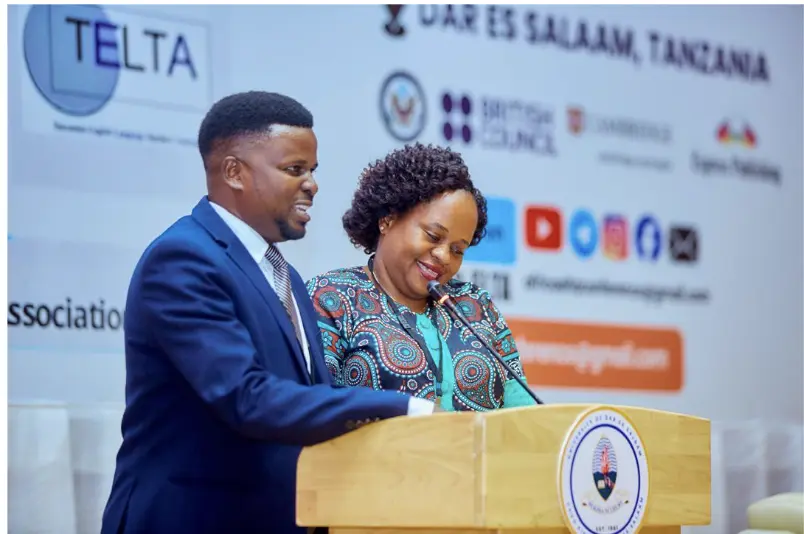
On June 20, 2025, the University of Dar es Salaam campus came alive as the Africa ELTA 9th International Conference opened its doors. Months of planning and collaboration had culminated in three days of rich professional exchange. As co-chair representing my teacher association (TELTA), I stepped into the library conference venue with both anticipation and pride, ready to see our collective vision unfold (Figure 1).
Figure 1
Co-chairs from the host country, Ms Kessia Kiwia and Mr Mahamba Sebastian, pledge their welcoming note during the opening ceremony
Preparing for Glocalization
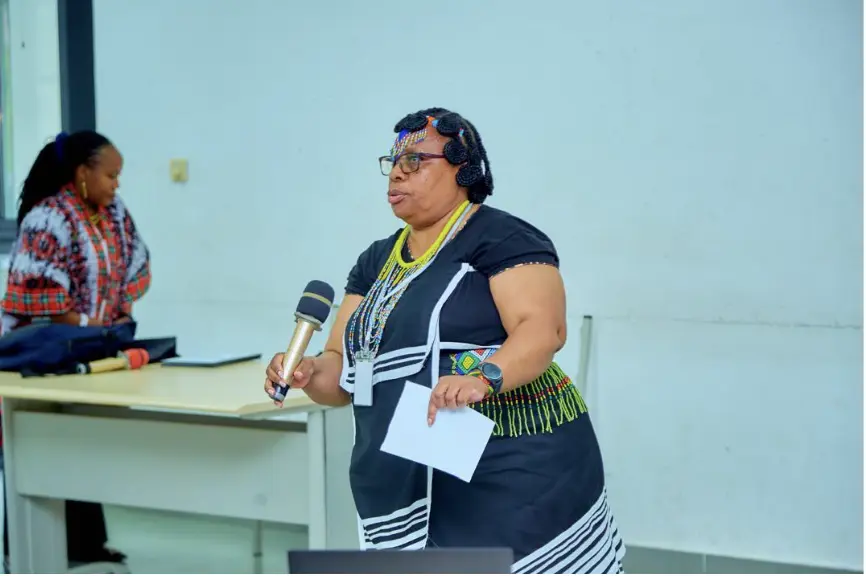
The journey to this moment highlighted that successful glocalization in English Language Teaching (ELT) begins well before the first keynote. Our planning committee: educators from Tanzania, Kenya, Nigeria, Ghana, South Africa, and Cameroon worked across borders, time zones, and cultural perspectives to create an event that celebrated local contexts while engaging global ELT practices. This cross-border collaboration embodied the very principles we hoped to showcase. The closing ceremony, led by the AfricaELTA President, brought these efforts to a powerful conclusion (Figure 2).
Figure 2
The AfricaELTA President presented during the closing ceremony with her cultural outfit on the conference's third day.
One of our most significant decisions was choosing the theme “Innovating ELT in Africa” which reflected our genuine commitment to balance cultural authenticity with international standards. We sought speakers who embodied this principle: from Tanzanian teachers integrating storytelling traditions into English classrooms to international researchers collaborating with African institutions.
Conference logistics were equally instructive. We learned to blend modern conference technology with local infrastructure realities. When budget constraints limited interpretation services, linguistics students stepped in as volunteers, thereby transforming a challenge into a valuable professional growth opportunity.
Three Transformative Days
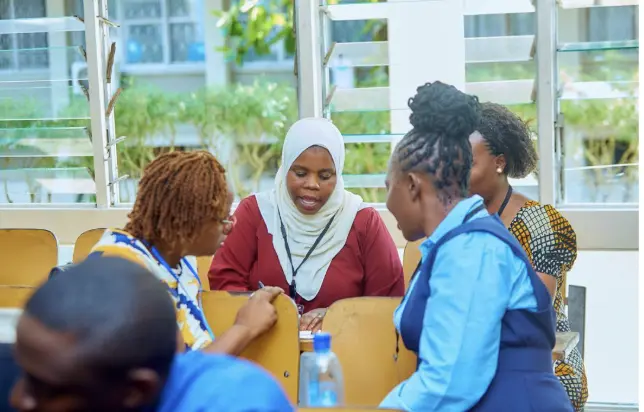
The conference welcomed 380 participants in total, with presenters from twelve African countries, namely: Tanzania, Uganda, Kenya, Ethiopia, Madagascar, Rwanda, Cameroon, Nigeria, Ghana, Senegal, Egypt, and South Africa. There were also presenters from six countries outside Africa, namely: Greece, Canada, Qatar, the UAE, the UK, and the USA. The event united schoolteachers, university lecturers, doctoral students, and policy leaders from across the African continent and beyond (Figure 3 and Figure 4). The diversity in the hall was impressive as one could observe local primary school teachers sitting alongside seasoned professionals from Europe and America.
Figure 3
One of the presentations from Ethiopia.
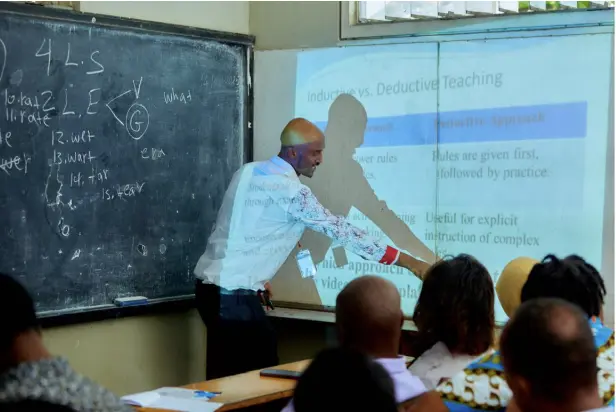
Figure 4
The picture shows how authentic group discussion occurs during different presentations.
The opening keynote by Medadi Ssentanda (Makerere University, Uganda) on “The Place and Use of English in Africa’s Multilingual Schools”challenged us to re-examine whose voices shape curricula and how African languages can coexist with English in meaningful ways. His session was a reminder of how teachers could honor African languages and cultures and at the same time embrace technology in transformative ways.
Sessions throughout the conference brought glocalization to life: A presentation on "The African English Language Classroom as a “Vehicle for Resilience”. A panel discussion done with six presenters became a celebration of African English varieties, which invariably reframed local accents as assets. A Kenyan teacher showcased SMS-based lessons for students without internet access, which is a classic case of innovation born of necessity with global relevance. Nipael Mrutu (Aga Khan University, Tanzania) delivered a keynote on “Exploring Transformative Possibilities: Innovative Approaches to English Language Teaching in Tanzania”, emphasizing teachers’ central role in language development.
Peer networking proved especially impactful. A Tanzanian teacher and a U.S. TESOL leader Yilin Sun exchanged WhatsApp contact and began planning a virtual classroom exchange. A Nigerian university lecturer discovered that her research on storytelling mirrored work being done in Ghana and other East African countries, leading to plans for collaborative research. These connections ensured that the conference’s influence would extend far beyond the three days.
Culture and Policy in Action
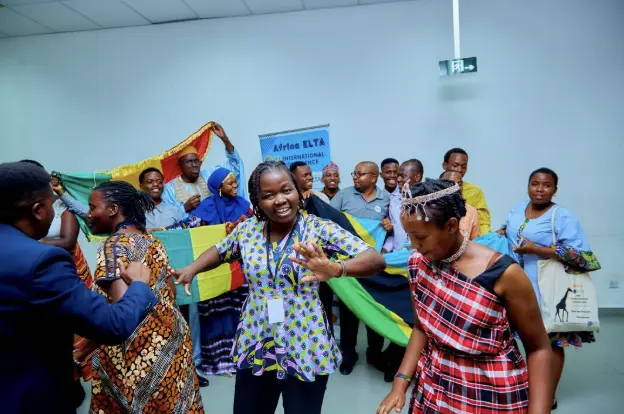
Cultural sustainability took center stage during the community engagement session, where educators performed traditional dances accompanied by English and local language narration. The dancers are from Tanzania, where teachers showcased how Maasai ladies and Morani can dance in different cultures. occasion, the dance from Cameron, Uganda, Ethiopia and Kenya (Figure 5). This powerful display of cultural heritage illustrated how English can serve as a bridge without eroding cultural heritage.
Policy-focused sessions showcased practical approaches to multilingual education. Delegates from Cameroon and South Africa shared real-world examples of language policy innovation, grounding discussions in lived classroom realities rather than abstract debates. For example, a Cameroonian delegate described how their language policies had evolved, while a South African educator explained their innovative approaches to maintaining Zulu alongside English instruction.
Figure 5
A colourful dance floor for all nations, during the traditional and cultural exhibition
Beyond the Conference
In the weeks that followed, the conference WhatsApp group evolved into a vibrant professional community. Teachers shared classroom successes, researchers coordinated publications, and new funding opportunities emerged for cross-border projects. These were made possible by the networking opportunities that the conference provided.Momentum continued with the announcement that the next Africa ELTA International Conference will take place in Nairobi, Kenya, hosted by the English Language Professional Association of Kenya (ELPAK) at Zetech University.Personally, I carried forward the spirit of the conference at the 60th Anniversary of the Institute of Adult Education in Dar es Salaam, where I presented on “From Algorithms to Actions: AI for Lifelong Learning.” I shared insights on integrating artificial intelligence into ELT, advocating for communicative, play-based approaches to grammar instruction instead of rule memorization.
Lessons for TESOL Worldwide
The Africa ELTA 9th International Conference underscored key lessons for the global TESOL community:
- Cultural sustainability requires genuine partnership, not token inclusion. The most successful sessions were those where local voices led the conversation, and not where international experts spoke about local contexts.
- Innovation thrives under constraint, with resource-limited teachers often leading the way. Some of the most inspiring presentations came from teachers working with limited resources who had developed creative solutions that could benefit educators worldwide
- Peer-to-peer learning is as transformative as keynote addresses. While keynote speakers provided important frameworks, the real transformation happened in smaller groups where practitioners shared practical strategies and honest challenges. Creating such spaces for organic exchange are vital in any conference.
Looking Ahead
Reflecting on June 20–22, 2025, one truth stands out: culturally sustaining, glocalized ELT is not theoretical, it is happening now in African classrooms, policies, and professional communities. The conference not only showcased best practices but also generated new ones through collaboration.
For TESOL affiliates globally, the message is clear: trust local wisdom, prioritize authentic peer exchange, and remember that the most lasting impact comes not from perfect logistics or star speakers, but from educators learning and growing together. As the sun set on Dar es Salaam, it rose on countless classrooms where ideas from the conference are now shaping practice; a true measure of its success in glocalizing ELT in Africa.
 Kessia Kiwia is a distinguished English language teacher with over 20 years of experience in Tanzania's public school system. She serves as Secretary General of TELTA, TESOL ANPC 2024/25 board member, and co-chair of Africa ELTA 2025 International conference. Kessia holds a master’s degree in education and is an IVLP alumnus. A passionate advocate for quality education, she champions environmental conservation and women's empowerment, supervises online learning platforms, and founded initiatives supporting female English teachers' professional development and growth.