
Using Linguistic Diversity to Enrich the Classroom: Insights from a Virtual U.S.-Filipino Undergraduate Experience
Kelly Deutsch, Emily Wolfe, Adelphi University, New York, NY, USA
Introduction
In today’s increasingly interconnected world, understanding the diverse experiences of people from different cultural and social backgrounds is more important than ever. This is why we chose to engage in a conversation with our Filipino virtual exchange partners about how our daily lives differ. By exploring these differences, we aim to gain deeper insights into each other’s cultures, routines, values and perspectives. This dialogue serves not only to build mutual understanding but also to foster empathy, curiosity and global awareness among students.
Our inquiry was guided by the following questions such as: Can you share an experience where understanding someone else’s daily life or culture helped you connect with them better, either in or outside of the classroom? What role do you think linguistic diversity plays in education? How can teachers incorporate students' different languages and dialects into their lessons to create a more inclusive learning environment? How can knowing the differences in students' daily lives and cultural backgrounds help teachers create more effective and engaging lessons?
The Roadmap
Organization and time management were key to our success with virtual exchange. In the Philippines, internet blackouts are common, and this issue significantly impacted our ability to meet early on. However, with patience and mutual understanding, we were finally able to connect and begin working together.
In our first meeting, we introduced ourselves and shared fun facts about our lives. We also discussed the types of educational fields we were interested in. Some of us wanted to become educators, while others had different career paths in mind. Still, we all agreed that the best learning environment is one that feels safe, inclusive, and supportive. A diverse and caring environment encourages students to express themselves and makes learning enjoyable.
By the second meeting, we had begun developing questions for a podcast episode, which we will collaborate on as the culminating activity of our virtual exchange. This was one of the most enjoyable parts of the project—everyone contributed unique ideas, and we collaborated to select the best ten questions. Jo (pseudo name) inspired the group with his explanation as to how he wants to incorporate religion into his education. It taught him to live with kindness, humility, and a deep sense of purpose. As an aspiring Marist Brother, he aims to bring these values into teaching by making learning more compassionate and supportive. When we found out Kelly was very artistic and created an eye-catching cover for our podcast. Everyone expressed how impressed they were with her work.
In our third meeting, we finalized the script and completed the organizing sheet to ensure all required components were included. We also discussed each section of the podcast and agreed that if anyone wanted to change or add something, they could do so freely and respectfully. We wanted our podcast environment to reflect the same open, comfortable atmosphere we believed was essential in education.
During our fourth meeting, we began recording the podcast. Unfortunately, one of our Filipino group members lost connection partway through. At first, we weren’t sure how to proceed, but we worked together to reach out and arranged another time to finish the recording. With the 3 different parts of the podcast Kelly and Jo edited the clips so that it could become one. Finally, the podcast was ready to be shared with the class.
This experience taught all of us valuable lessons in flexibility, teamwork, and problem-solving. There is always a solution if you're willing to adapt and work together.
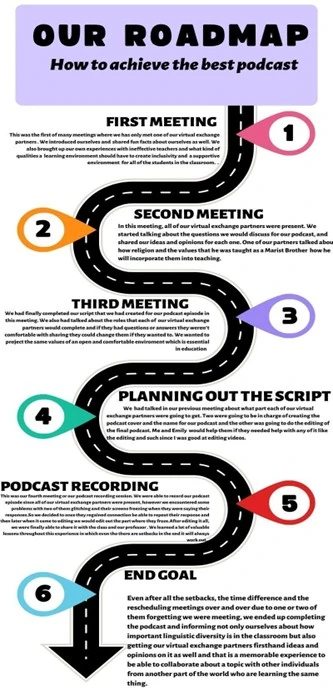
Photo caption:Our roadmap for our podcast
The Story of Our Mini Action Research Project
We chose to center our project on daily life and linguistic diversity because language, for us and our virtual exchange partners, isn’t just academic—it’s lived. Whether we’re texting friends, helping our families, or moving between school and home, we use our full linguistic repertoires in fluid and meaningful ways. Traditional classrooms often treat languages as separate and ranked, but as Wei and García (2022) argue, students don’t operate with multiple isolated languages—they draw from “one linguistic repertoire” (p. 4). This idea of translanguaging helped us name what we already do: mix, switch, and create meaning beyond standardized norms. By exploring daily life, we’re not just sharing routines—we’re engaging in what Wei and García call a “decolonizing project” (p. 3), one that resists language hierarchies and affirms the legitimacy of how we actually speak.
Crossing the First Obstacle
Our virtual exchange with our virtual exchange partners, designed to foster cross-cultural dialogue, was initially hindered by technical and logistical challenges. Frequent power outages, unstable internet connections, and time zone misunderstandings led to several failed attempts to meet via Zoom. These setbacks not only caused frustration but also highlighted the infrastructural disparities that can complicate international collaboration in educational settings. However, after multiple delays, we were finally able to connect, and the experience quickly became meaningful. Despite the distance, we discovered many shared values and similarities. One particularly resonant moment came when one of our virtual exchange partners spoke about his involvement with the Marist Brothers, a religious group that significantly shapes his life and identity. His story reminded us that routines are not just schedules, but reflections of culture, belief, and personal meaning. This exchange illustrated the power of dialogue to bridge global gaps and deepen mutual understanding, transforming what began as a technical challenge into a valuable and humanizing learning experience.
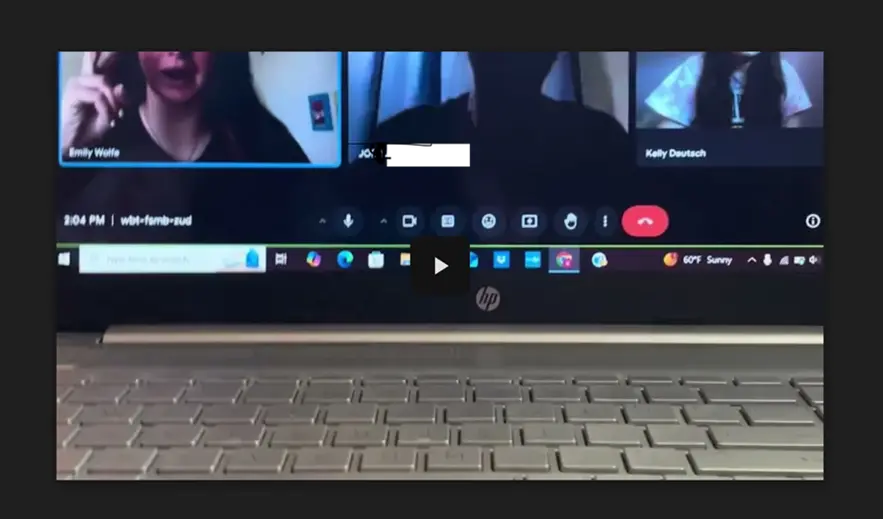
Photo caption: Coming together in a virtual space
Second and Third Virtual Exchange and Planning for Podcast
During our second meeting with our virtual exchange partners, we engaged in a comparative discussion focused on our respective daily schedules and linguistic practices. For example, while both groups balance academic responsibilities and extracurricular activities, differences in school hours, family routines, and leisure time underscored the diverse contexts in which we live. We also explored the languages commonly used in our daily interactions, noting how language choice shifts with context—for example, English in academic settings versus native or regional languages in informal or family environments. One striking example was the Filipino term barangay—the smallest administrative division in the Philippines, akin to a village, district, or neighborhood—which carries cultural nuances that broadened our understanding. This discussion fostered a deeper understanding of how language functions as both a practical tool and a cultural marker. In our subsequent third meeting, we transitioned into planning our collaborative podcast project. We established a clear division of responsibilities by assigning specific roles to each participant, including scriptwriting, audio editing, music selection, and voice recording. This structured approach ensured an equitable distribution of tasks and promoted effective teamwork across cultural and geographical boundaries.
Victory in the End
After overcoming a series of unexpected challenges—from persistent technical glitches to sudden power blackouts—we finally managed to complete our podcast with our virtual exchange partners, and the sense of accomplishment was incredibly rewarding. Despite the setbacks, our determination paid off, and it felt amazing to see our ideas come together across borders and screens. What made the experience even more meaningful was the opportunity to amplify our voices on an issue we deeply care about: the value of linguistic diversity in the classroom. Through our podcast, we were able to express how embracing multiple languages can empower both teachers and students, fostering more inclusive, engaging, and culturally responsive learning environments (Spotify, n.d.).
The Road Forward
Looking forward, the knowledge gained through both our collaborative work and current scholarship offers a strong foundation for promoting linguistic diversity as a pedagogical strength in classrooms. Naia Toke, in her article “Linguistic Diversity: What Is It, How To Encourage It, And Why Is It Important,” emphasizes that acknowledging and incorporating students’ home languages not only affirms their cultural identities but also enhances educational outcomes. As she notes, “when students see their languages and cultures reflected in the classroom, they are more engaged, confident, and motivated to learn” (Toke, 2023). This understanding underscores the importance of creating instructional environments that treat multilingualism as a resource rather than a challenge. Applying this perspective, educators can implement strategies such as multilingual instructional materials, culturally responsive teaching methods, and opportunities for students to share their linguistic backgrounds.
Our research questions—centered on how daily routines reflect cultural and linguistic identities, and how these differences can inform inclusive education—aligned with course objectives that emphasize critical thinking, student agency, and intercultural understanding. By engaging in authentic conversations, we learned how linguistic diversity can be harnessed not as a barrier but as a powerful asset for equity and belonging in the classroom. This experience showed us how to make learning more culturally responsive and relevant, and in the future, we envision using this approach to co-create inclusive spaces in education where students' lived experiences and full linguistic repertoires are not just acknowledged, but celebrated and integrated into everyday teaching and learning.
References
Spotify. (n.d.). Everyday differences in the classroom [Audio podcast episode]. https://open.spotify.com/episode/63meTWSJHqrLGyr79xE3Ls?si=N83s6EwRTC2pL2DpNH_cXg&nd=1&dlsi=50ed05ceb7f541ee
Toke, N. (2023, January 26). Linguistic diversity: What is it, how to encourage it, and why is it important. Diversity for Social Impact. https://diversity.social/linguistic-diversity/
Wei, L., & García, O. (2022). Not a first language but one repertoire: Translanguaging as a decolonizing project. RELC journal, 53(2), 313-32.
 Kelly Deutsch is an undergraduate student at Adelphi University, majoring in Biology. Her interest in education was sparked through extensive volunteer work during her youth, including helping at summer camps and engaging in other community service activities. Kelly is bilingual, fluent in both English and German.
 Emily Wolfe is an undergraduate student at Adelphi University, majoring in Mathematics. She has a strong passion for helping others, which has inspired her to pursue a career in education. Emily is also a member of the university’s softball team.