
Multilingual And Multicultural Pathways to Science Learning in Middle School Classrooms
Araceli Enriquez-Andrade, RESET, Houston, Texas, USA,
Zhenjie Hou, Yonglin Ruan, Jie Zhang, University of Houston, Texas, USA
May JadAllah, Independent Researcher, Amman, Jordan
Immigrant students and Emergent Bilinguals (EBs) encounter three challenges in school. First, they endure normalized language separation ideologies in school textbooks and pedagogical approaches. Second, they are burdened by deficit beliefs about their academic ability. Third, science lessons do not mirror their daily lives, which disconnects science from their experiences. To overcome these challenges, “Relevant Experiences in Science Education through Translanguaging” (RESET), a four-year National Science Foundation grant-supported project, was developed as a research-practice partnership. RESET partnered with a diverse urban school district in the Southern U.S.A. The district is home to numerous immigrant communities where more than 100 languages are spoken and 61% of students are classified as EBs. To support teachers who work with EB and immigrant students, RESET provides in-person professional development and hybrid collaborative curricular design sessions throughout the academic year, and a two-week summer institute. RESET addresses linguistic ideologies rooted in social, historical, and political discourses to challenge compartmentalized language ideologies. While EBs and immigrant students develop their linguistic identities at home by using their home language and English, they are hardly able to do so in science classes. RESET works with teachers to integrate formative assessments that enable students to utilize their full communicative resources to demonstrate their science understanding. Lastly, RESET centers on contextualizing science lessons to engage students in science that applies to their lived experiences.
Over the past two years, RESET has involved science teachers (grades 6-8) and specialists in collaborative curricular design with researchers in science and bilingual education. RESET’s objective is to co-adapt units of science instruction using five RESET guiding principles: (1) translanguaging, (2) contextualized science inquiry, and (3) science discourse, while also developing (4) teachers’ asset-oriented views of students and (5) multilingual and multicultural classroom norms. At the time of writing this newsletter, the project has completed its second year. We present three examples, each focusing on a teacher or a student from each grade level, emphasizing the range of approaches adopted by teachers and students to incorporate their multilingual and multicultural heritage in science education. These approaches transcend the limitations of science textbooks, emphasizing an authentic engagement with scientific concepts. In each case, funds of cultural knowledge, funds of language, and funds of youth identity are featured.
A RESET investigation carried out by Hou and Zhang (submitted) featured Xiao Lu, a sixth-grade Chinese immigrant student, in a food web lesson. Xiao Lu employed his heritage wisdom to challenge the conventional classification of organisms as either decomposers or producers. He questioned the notion that the cycle of life applies only to biotic elements, excluding abiotic elements from the process. He utilized a combination of translanguaging and multimodal tools, speaking in Chinese and gesturing, to express reservations about classifying mushrooms as mere decomposers. He argued that both mushrooms and plants can serve as a source of energy for other consumers. Informed by ancient Chinese Taoist philosophy, Xiao Lu challenged the direction of energy flow in a two-dimensional linear diagram of a food web. In drawing, he postulated that energy moves cyclically, transitioning from an increase to a decrease, from a rise to a fall, and from prosperity to decline. This cyclical concept also encompasses the sun, which undergoes a similar trajectory from dawn to dusk, and even from life to death. Xiao Lu's ability to demonstrate an advanced comprehension of complex ecological relationships, which deviates from conventional textbook descriptions of organismal interactions within ecological systems, was enabled by translanguaging and modelling. Had he been constrained to using English in his engagement with science concepts and district tests, his performance would have been adversely affected.
The second example comes from seventh-grade lessons on energy flow within trophic levels in energy pyramids. In the “Engage” part of a 5E lesson, Ms. Estrada shares that every year, on her birthday, she asks her mother to cook her favorite meal, Mole, a Mexican dish that she describes as “chicken with chocolate sauce.” Then she invites students to share their favorite meal from home. She encourages her EBs to speak their home language, Spanish, Chinese, and Vietnamese, while completing the assignment. She models translanguaging by speaking Spanish with some students. Grouping students strategically in collaborative pairs enables them to engage in multilingual conversations and employ multimodal tools, including drawings and diagrams (Pierson, Clark & Brady, 2021). Students draw on their funds of knowledge and language (JadAllah, Zhang & Enriquez-Andrade, 2025) to describe traditional meals from home or resort to their everyday experiences, such as choosing pizza. In this lesson, students trace the source of energy of each ingredient in their meals to the Sun as the primary source of energy. They discuss whether each of the organisms involved is a producer (e.g., rice, corn) or a consumer (e.g., cow from which beef is taken). They compare their diagrams, noting the position of the Sun, producers, and the loss of energy and the number of consumers from one trophic level to the next. One group chose spaghetti with tomato sauce and meatballs. The students easily traced tomatoes and meatballs but were challenged to identify what spaghetti was made of. By connecting science concepts to students’ cultural practices, teachers established a relevant context for students to make sense of energy flow within trophic levels in food pyramids. As students seamlessly and flexibly used their home and school language they made sense of science topics and related them to their everyday experiences.
A third RESET study, by Ruan et al. (submitted), examined Ms. Ngo, an eighth-grade bilingual Vietnamese American teacher, implementing an energy transformation unit. Ms. Ngo utilized students' knowledge to establish a third space that integrates students’ cultural heritage and discourse with energy transformation and transfer principles (Moje, 2004). A notable aspect of Ms. Ngo’s teaching was the end-of-unit assessment. Ms. Ngo drew on her experience as a child during the Mid-Autumn Festival, a Southeast Asian harvest festival celebrated during the eighth lunar month. Students were captivated by the Hello Kitty lantern, which she used to take to the temple as a child. The Hello Kitty lantern was used to demonstrate five types of energy transformations: chemical, electrical, sound, light, and thermal. To leverage students' funds of personal identities (JadAllah, Zhang, & Enrique-Andrade, 2025), she invited the students to demonstrate energy flow and transformation in cultural celebrations. The objective of this assessment was to illustrate energy transfer and transformation concepts that students had learned in previous lessons. The examples demonstrated a range of cultural elements, from a Vietnamese Lunar New Year festival to Christmas, among others, each of them showcasing the flow of energy and its transformations. One student, Jack, chose a Mexican festival. He drew the Mexican flag, colorful lights, and people dancing to music. The energy transformations he observed were of mechanical, electrical, light, thermal, and kinetic. Near a dancing figure, he wrote, “mechanical --> dancing (kinetic).” Despite the successful integration of out-of-school experiences and discourses with school science, the experience brought to light naïve conceptions. For example, Jack considered that dancing in response to music signifies the conversion of sound energy into mechanical energy, on the grounds that the act of dancing is prompted by music. While naïve conceptions like these were few, they were still troubling to Ms. Ngo. However, she felt that the contextualized co-designed unit helped students apply what they had learned in class to their daily experiences and think about who they are.
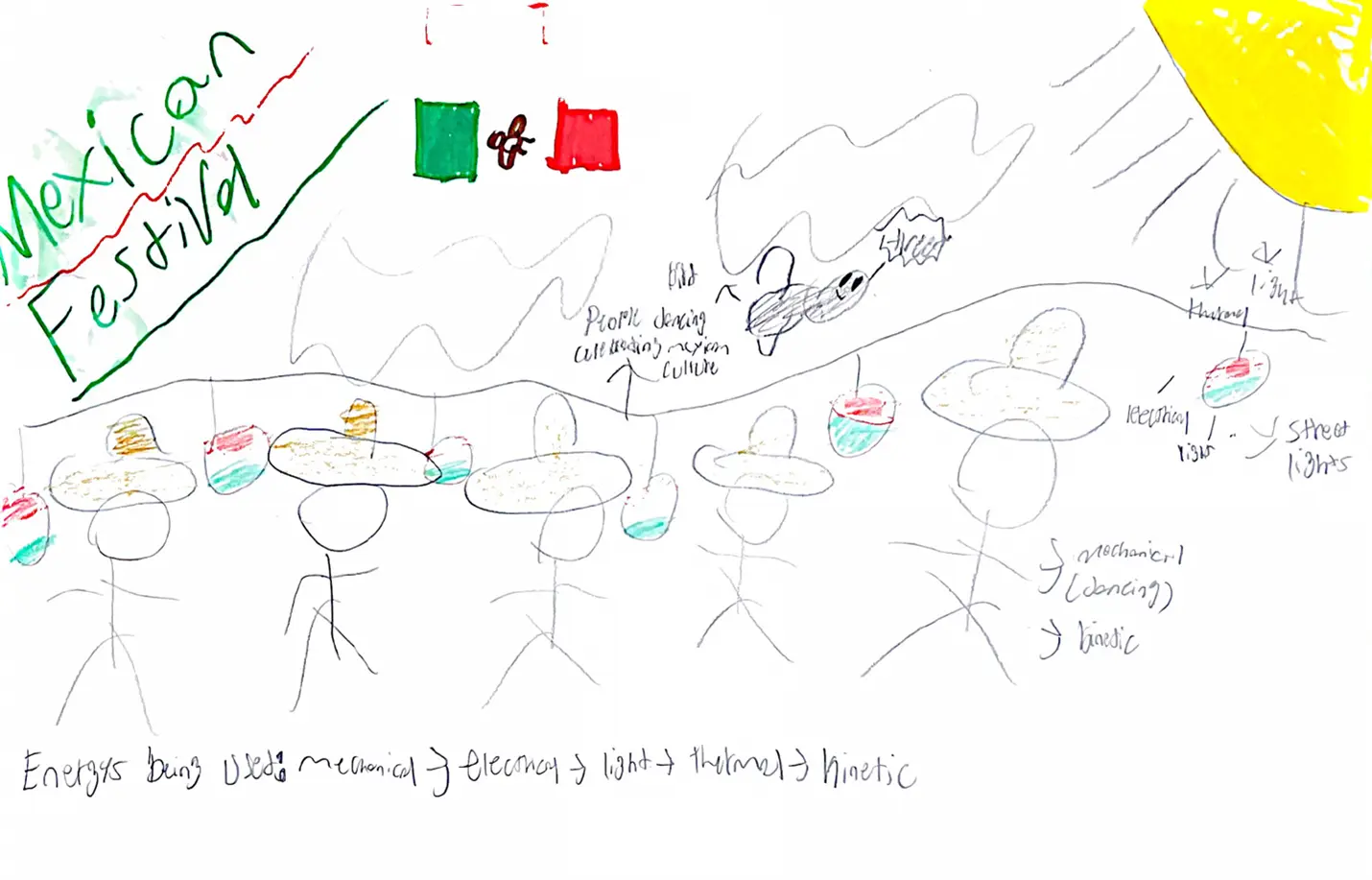
Photo caption: Jack’s cultural project on energy transfer and transformation
As a pedagogical framework, RESET aims to transform ideologies surrounding language separation and deficit-based assumptions that EBs and immigrant students encounter. By challenging these assumptions, RESET shifts the perception of multilingual students to a more positive an asset-based outlook. The development of contextualized science lessons by educators serves to establish a bridge between the students’ cultural and lived experiences and science curriculum. As RESET enters its third year, participating teachers’ classrooms are becoming flexible third spaces where multilingualism is valued, students’ cultural backgrounds are celebrated, and thought-provoking science content is being learned.
References
Hou, Z., Zhang, J. (submitted for review). Heteroglossia and Heterogeneity: A Critical Discourse Analysis of a Chinese Newcomer Student Making Sense of Energy Transfer and Transformation [Paper presentation]. Proposal sent to AERA 2026 Convention, Los Angeles, CA, United States.
JadAllah, M., Zhang, J., &; Enriquez-Andrade, A. (2025). Leveraging Students' Funds of Knowledge, Language, and Identity: A Case for STEM Education in the United States. In L. Liu, N. Mohamed, C. Lin, C. Bauler, & K. Kapur (Eds.), Funds of Knowledge in Teacher Education: Sustaining Local Diversity Amidst Global Standards (pp. 367-384). IGI Global Scientific Publishing.
Moje, E. B., Ciechanowski, K. M. Kramer, K., Ellis, L. Carrillo, R. & Collazo, T. (2004). Working toward third space in content area literacy: An examination of everyday funds of knowledge and Discourse. Reading Research Quarterly, 39(1), 38-70.
Ruan, Y., JadAllah, M., Zhang, J., Kim, H. (submitted for review). Constructing a third space: A science teacher's understanding of multilingual learners’ lived experiences [Paper presentation]. Proposal sent to AERA 2026 Convention, Los Angeles, CA, United States.
Pierson A. E., Clark D. B., & Brady C. E. (2021). Scientific modeling and translanguaging: A multilingual and multimodal approach to support science learning and engagement. Science Education, 105, 776–813.
 Araceli Enriquez-Andrade holds a Ph.D. in Curriculum and Instruction from the University of Houston with a specialization in science education. Her research focuses on sociolinguistics and science education. Araceli is an elementary teacher working with EBs.
 Zhenjie Hou is a research assistant and doctoral student in the Bilingual Education program at the University of Houston. Her interests include bilingual vocabulary development and translanguaging.
 Yonglin Ruan is a research assistant and doctoral student in the Bilingual Education program at the University of Houston. She previously worked as a secondary ESOL teacher.
 Jie Zhang is a Professor of Bilingual-English as a Second Language Education in the Department of Curriculum and Instruction at the University of Houston. She is the PI of the RESET project. Her research focuses on the integration of language, literacy, and culture in disciplinary instruction for multilingual learners.
 May JadAllah is a freelance research consultant collaborating with RESET. May holds a Ph.D. in Educational Psychology and formerly worked at Illinois State University.