
Teaching the Pharyngeal ’Ayn in Arabic: A Practical Guide for L1 English Speakers
Mahdi Duris, Iowa State University, Ames, Iowa, USA
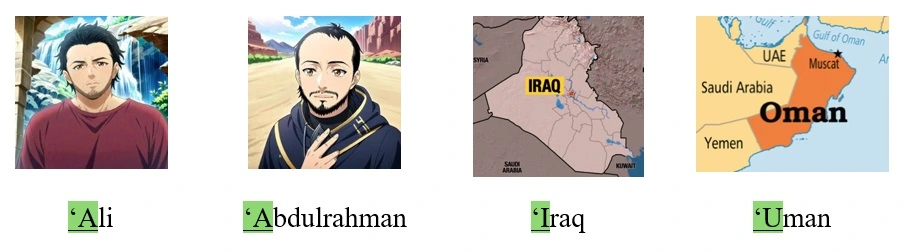
‘Ali or Ali? The unique ʿAyn (ع) poses a persistent challenge for English-speaking learners of Arabic. This article outlines an integrated approach to teaching the challenging Arabic consonant ʿAyn (ع) to L1 English speakers. Emphasizing listening discrimination and controlled production, the guide details training techniques using minimal pairs and controlled repetition drills that address the common tendency of substituting ʿAyn with the much easier and familiar glottal stop Hamza (ء).
Introduction
The Arabic consonant ʿAyn (/ʕ/) presents unique articulatory challenges to L1 English speakers, as its production involves a deep pharyngeal constriction absent in English phonetics. This unfamiliar sound leads many learners to substitute ʿAyn with the much easier and familiar glottal stop Hamza (/ʔ/). In doing so, learners obscure the phonemic contrast critical for meaning in Arabic.
One of the first known dictionaries of language, attributed to Al-Farahidi, is titled Kitāb al-'Ayn (The book of ‘Ayn), highlighting the importance of the consonant in the Arabic language (Sara, 2013). Given the importance of accurate pronunciation for effective communication, this article proposes a structured instructional approach that begins with listening discrimination training before progressing to controlled production practice. By first developing learners’ ability to detect subtle acoustic differences—such as those between ʿAyn and Hamza—through targeted perceptual exercises like minimal pair listening tasks, educators can create a robust foundation for subsequent production training. The main goal of this two-step methodology is to help learners overcome the beginner’s tendency to substitute ʿAyn with Hamza, thereby helping achieve more intelligible Arabic speech.
Why ‘Ayn is challenging for English learners
Arabic features several consonants that are spoken in English. The consonant ʿAyn is particularly problematic because its production involves a constriction in the pharynx, a mechanism that is not activated in typical English speech. Research indicates that when English speakers encounter unfamiliar articulatory settings, they often default to sounds within their existing phonetic inventory (Flege, 1995). In the case of ʿAyn, many learners substitute it with the glottal stop /ʔ/ Hamza, a sound that is thus easier to produce. This substitution can lead to miscommunication since ʿAyn and Hamza serve distinct phonemic roles in Arabic.
Furthermore, acoustic studies have shown that the auditory cues for ʿAyn are subtle—often involving lower intonation patterns and unique acoustic properties (Heselwood, 2007)—making it difficult for learners to perceive the differences without focused training. Consequently, effective pronunciation instruction for ʿAyn must begin with a dedicated focus on listening skills to help learners distinguish it from the glottal stop.
Listening Discrimination Training
Effective pronunciation training must acknowledge the growing literature regarding the link between perception and production. As such, for learners to master the production of ʿAyn, they must also be able to identify it aurally. Perceptual training, therefore, plays a critical role in bridging the gap between unfamiliar acoustic input and the correct articulatory configuration. Researchers in second language pronunciation have emphasized that exercises which enhance auditory discrimination lead to improvements in production accuracy (Celce-Murcia, Brinton, & Goodwin, 2010).
Minimal Pair Listening Exercices
One effective approach is to use minimal pair exercises. In the context of Arabic, minimal pairs such as عَمَل (ʿamal, “work”) versus أَمَل (ʾamal, “hope”) are particularly useful because they contrast ʿAyn with Hamza. Learners should be presented with multiple audio samples—ideally recorded by native speakers representing various dialects—to highlight the acoustic differences between the two sounds. Through repeated exposure, students can learn to note the acoustic qualities that characterize the pharyngeal ʿAyn compared to the sharper, more abrupt glottal stop produced as Hamza.
Figure 1
Three-Vowel Discrimination Task for Distinguishing ‘Ayn vs. Hamza
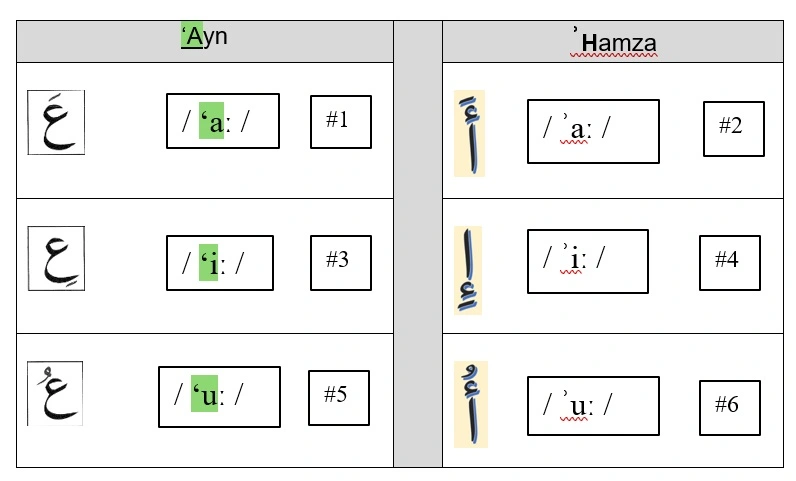
For beginners, a discrimination task similar to Figure 1 allows the learner to familiarize themselves with phoneme differences by selecting if either two sounds played back-to-back are similar (when #1 and #3 are played) or different (when #1 and #2 are played). Once a discrimination is consistently performed correctly, a forced-choice variant can be introduced. These same utterances can be presented in randomized order asking the learner to identify which of the 6 utterances was played. Such forced-choice activities help reinforce the auditory distinction by repeatedly engaging learners in an active listening task. Feedback from these exercises should focus on reinforcing the acoustic cues such as voicing contrast and temporal characteristics.
Production Basics: Where and How ʿAyn Is Formed
At this stage, it is essential that learners learn to produce the target sounds accurately before integrating them into broader communicative contexts. This phase is organized into three distinct segments. First, instructors provide a detailed explanation of the articulatory processes involved in producing ʿAyn and Hamza by outlining the place and manner of articulation—addressing where and how each sound is formed. Next, learners engage in isolated sound repetition, focusing on accurately reproducing the target sounds based on the demonstrated articulatory techniques. Finally, learners participate in random order drills that incorporate minimal pair production.
For the production of ʿAyn—a voiced pharyngeal consonant—learners are instructed to focus on the following key points, illustrated in Figure 2:
- Initial Positioning: Relax the tongue so that it rests naturally in the oral cavity while maintaining slight muscular tension in the throat.
- Narrowing the Pharynx: Gently contract the muscles in the back of the throat, similar to the preparatory phase of swallowing or yawning, without fully occluding the airway.
- Vocalization: Allow voiced air to pass through the slightly constricted pharynx, resulting in a sound that is acoustically deeper than typical English vowels or consonants.
- Tactile Feedback: Some learners may benefit from placing a finger on the throat near the Adam’s apple to monitor vibrations and the long rise of the glottis.
Figure 2
Sound Location and Degree of Glottis Rise between ‘Ayn and Hamza
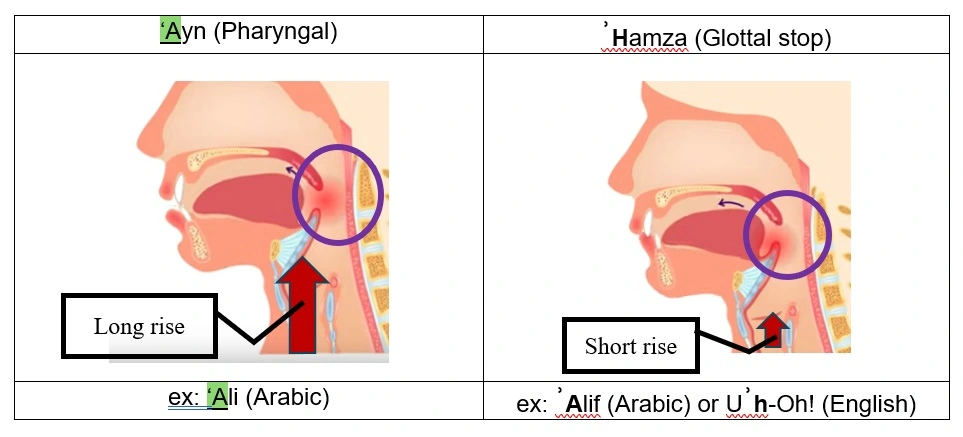
The production of the voiceless Hamza differs from ‘Ayn by starting at the vocal folds in the following manner:
- Complete Closure: Briefly approximate the vocal folds to create a momentary interruption in airflow, as exemplified by the pause in the expression “uh-oh.”
- Release: Allow a sudden release of air, generating a short, distinct sound.
Minimal Tenseness: The production of Hamza requires less muscular tension in the pharynx compared to ʿAyn.
Isolated Repetition
Controlled production practice should begin with isolated sound repetition. In this phase, learners focus on reproducing the target sounds—ʿAyn and Hamza—in isolation before incorporating them into more complex linguistic contexts. For instance, the instructor can model the production of ʿAyn by demonstrating its unique articulatory mechanism or by playing sound clips. Learners then attempt to mimic the sound, paying attention to key production cues such as tongue position, pharyngeal constriction, and breath control. For this activity, Figure 1 should be used again, establishing a direct visual relationship between the previous aural tasks and this production task.
Random Order Drills and Minimal Pair Production
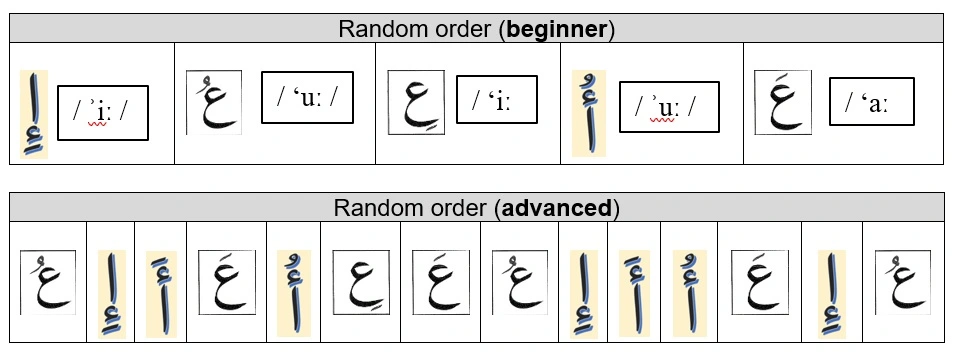
Controlled production drills using randomly ordered phoneme pairs can now be introduced. Continuing at the smallest unit of sound ensures that learning is progressive before going into word lists. Figure 3 presents a beginner level example for presenting ‘Ayn and Hamza in different sequences, forcing the learner to distinguish between articulations. Presentation of these items can vary from paper based to screen presentation by way of a PowerPoint slide.
Figure 3
Beginner and Advanced Random Order Drills
To further enhance accuracy, minimal pair drills can be included. For these activities, learners could be paired to provide evaluation to their partners, reinforcing perception and production for both learners. In the activity shown in Figure 4, one student is tasked with reading the minimal pairs using a finger on their glottis. After each utterance, their partner assesses the production by giving feedback on the perceived word.
Figure 4
Minimal Pair Activity
Read aloud and get marked by your partner on how well you can distinguish these minimal pairs. An ❌ when it’s a mistake and a ✅ when it’s correct! Go!
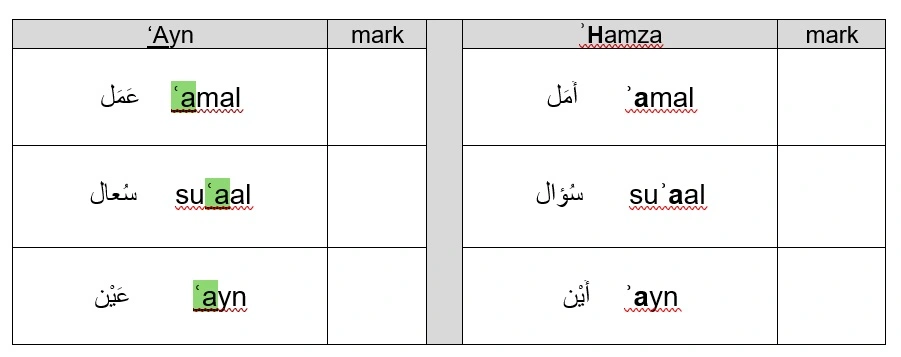
These production drills bridge the gap between perception and spontaneous speech. Although many learners may initially produce a glottal stop in place of ʿAyn due to its relative ease, targeted production practice along with explicit feedback, can help shift their articulatory habits toward the more accurate pharyngeal constriction. Over time, as learners can become more aware of the acoustic and articulatory differences making their production becomes more consistent and intelligible.
Integrating Technology in Production Practice
Although computer assisted pronunciation training for listening tasks are rare for Arabic learners, with some success with HVPT (Smith et al., 2022), Automate Speech Recognition (ASR) and Speech-to-Text (STT) offer more promising grounds for practice. Applications equipped with these technologies can be used for self-assessment in production tasks. Learners can record their production of target words and immediately receive a transcription. If the ASR output transcription misidentifies ʿAyn as Hamza, this discrepancy serves as a cue for further practice. While generic ASR systems may not always perfectly capture the nuanced production of ʿAyn, they offer a valuable means for independent practice.
Conclusion
Teaching the Arabic consonant ʿAyn to L1 English speakers presents unique challenges. The common tendency among English speakers to substitute ʿAyn with the easier and more familiar glottal stop Hamza benefits from prioritizing auditory discrimination training. By first engaging learners in listening exercises can help learners develop a more refined perceptual sensitivity to the subtle acoustic cues that distinguish ʿAyn from Hamza. Once these listening skills are established, controlled production practice through isolated sound repetition and random order drills enables beginner learners to adjust their pronunciation and overcome L1 phoneme substitution. Following these steps may help your students pronounce ‘Ayn as a pharyngeal and rediscover words they were saying with differently.
References
Celce-Murcia, M., Brinton, D. M., & Goodwin, J. M. (2010). Teaching pronunciation hardback with audio CDs (2): A course book and reference guide. Cambridge University Press.
Flege, J. E. (1995). Second language speech learning theory, findings, and problems. Speech perception and linguistic experience: Issues in cross-language research/York.
Heselwood, B. (2007). The ‘tight approximant’variant of the Arabic ‘ayn. Journal of the International Phonetic Association, 37(1), 1-32.
Sara, S. (2013). The classical Arabic lexicographical tradition. In J. Owen (Ed.), The Oxford Handbook of Arabic Linguistics (pp. 429–442). Oxford university press.
Smith, A. A., Medina, A. M., & Rangarathnam, B. (2022). Perceptual training of Arabic consonants in English-speaking learners of the Quran. Journal of Monolingual & Bilingual Speech (JMBS), 4(2).
 Mahdi Duris is a Ph.D. candidate in Applied Linguistics and Technology at Iowa State University. After teaching English several years in Saudi Arabia, he completed a TESL Masters at SCSU and is currently a research assistant for Dr. John Levis. His work focuses on phonetics and developing automated systems for intelligibility ratings.