
A Spoonful of Water: Raising Visibility with Shrinking Resources
Eric Grunwald, Massachusetts Institute of Technology, Cambridge, MA, USA
“It could be a spoonful of water
save you from the desert sand.”
—from “Spoonful” by Howlin’ Wolf
For reasons we’re all aware of, many of us are facing not only shrinking programs but diminished visibility on campus. And just when we need to raise that visibility and demonstrate the benefits of what we offer, we have fewer resources with which to do it. How can we broaden our reach with little to no money?
Years ago, when I was a hard-up adjunct, I heard a saying: “With no money, you can’t do anything, but with a little money, you can do a lot.” I’ve found it true in life, and now, fortunately, in administration as well, as the tips below demonstrate.
As with all tips we share with each other, you’ll need to decide whether these fit your program’s contexts or are even possible for you. My program, English Language Studies (ELS), offers for-credit courses in academic and professional communications for multilingual undergraduates and graduate students at MIT. I have two other full-time instructors. We just lost funding for our adjunct, and I have a pittance to spend on anything else over the year.
Also, many if not most of these ideas come from others, but I’ve added information I’ve gleaned from enacting them.
First, Do Nothing
Or rather, stop and think through your communicative goals and what messages are most important for you to convey. My first step in leading the charge to revamp the Consortium on Graduate Communication’s website last year was to read Sarah Durham’s The Nonprofit Communications Engine: A Leader's Guide to Managing Mission-driven Marketing and Communications (2019) and take time with my committee to review our organization’s mission and how a website could best support it. I’m now applying this approach to ELS, and I can’t overemphasize its usefulness is in guiding one’s communications.
Use Your Words
In a session at the 2024 TESOL International Conference, Tracey McGee, Director of English Language Services at the Illinois Institute of Technology regaled us with tales of her getting herself invited to or just showing up at every possible meeting of relevant stakeholders on campus, touting her program and its benefits, and even handing out swag. Having recently become Director of ELS, I returned to MIT eager to raise my “inside voice” and emailed the head of the faculty senate asking if I could speak at its next meeting.
I was told their “docket was full” but was urged to write a piece for the bimonthly faculty newsletter, a mouthpiece for faculty opinions. This detour turned out to be a blessing in disguise, for in writing, one can plan, research, and revise, and I was able to comment in a targeted way on data (always king at MIT) from important research on ELL grad students that had recently appeared as well as my own MIT graduate communication survey. (See https://bit.ly/ELS_FNL24.)
Figure 1
Example of a Faculty Newsletter Submission
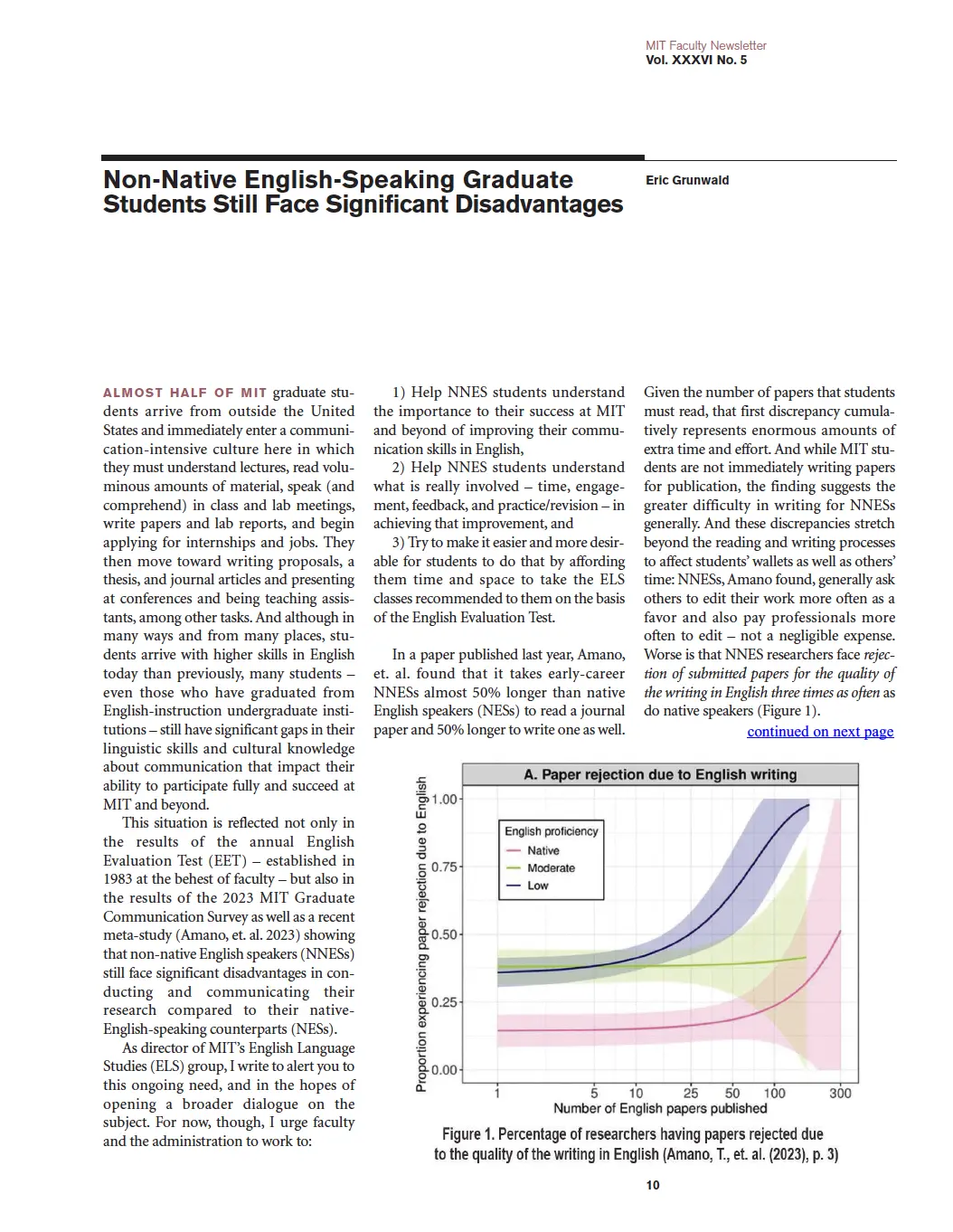
Note. A piece in your faculty newsletter or other campus publication can provide useful visibility.
The proof was in the pudding: our enrollments leapt the following fall. Unfortunately, people’s memories are shorter than ever, and AI appeared, so one must sustain a larger program of visibility that includes live relationships. Unfortunately, at my institution, non-tenured teaching staff like me are not particularly welcome to just show up. In any case, I wrote a second piece this spring: https://bit.ly/ELS_FNL26.
Annual Retort
What if you can’t find an existing written venue that will have you? Create your own!
A couple years ago, my department head told me a previous director of MIT’s writing center used to send out an annual report to as many faculty, deans, and administrators as possible. Its purpose was as much marketing tool as anything, reminding readers of the center’s existence, offerings, and achievements. I have thus produced one the past couple of years.
Of course, who reads an “annual report” unless we have money invested in that organization? Snooze. So, this year I may retool it as a newsletter, giving it a catchy name (vowelsounds? still tinkering), using MIT’s site license for InDesign and its many templates, and featuring articles on such things as our new faculty advisory council and student profiles. In addition to the e-version, I plan to use a few hundred dollars of our remaining funds to print some in color and distribute them on campus.
Don’t know how to use desktop publishing programs or write an effective newsletter? As Dr. D.J. Kaiser, Professor and Assistant Vice President for Academic Affairs at Webster University, put it in the June PAIS chat, “I’ve had to learn so many skills that I never imagined in grad school for teaching that I’d need” (DJ Kaiser, personal communication, June 8, 2026). Get learning.
Figure 2
Logo of vowelsounds
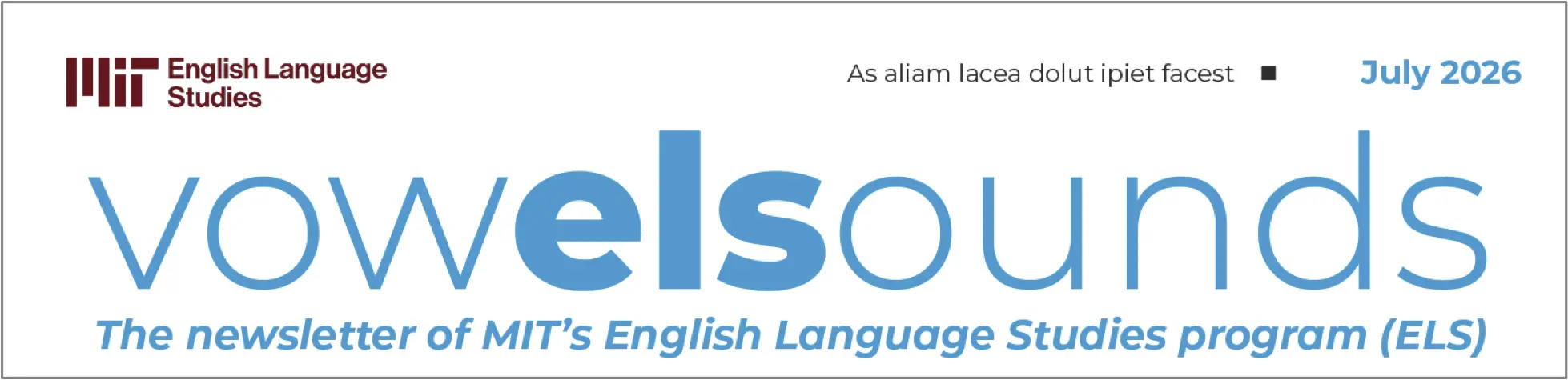
Note. An annual report or newsletter can provide visibility in a format allowing you to present the information you want or need on a regular basis.
Do I Have Your Attention?
Businesses and organizations have always had to “hang out a shingle” to attract passersby, and the way we do that these days—and provide useful, attractive information for potential clients—is a good website. My group’s is currently less than stellar.
This didn’t used to matter so much, even a few years ago. But today we live in the “attention economy,” in which “human attention has emerged as the principal object of economic capture and commodification” (Masoud, 2025). Every organization and even department is competing for students’ attention in the hopes getting buy-in, and that attention and is more fractured than ever. If a site is not attractive and accessible, you risk losing clients.
Of course, slick websites cost thousands of dollars. On the other hand, I’m just talking about a spinoff site of just a few pages linking from my department’s current site, and these days, as many on the Web will tell you, “Anyone can create an attractive website!” and WordPress is not that hard.
And you needn’t go it alone. My department’s IT support guy is going to help me choose a WordPress template and perhaps even modify it, and my teaching team and I have together compared sites and decided together what would be useful and attractive to students. In any case, something with pictures and colors and testimonials will be better than what we have now.
Oh, Yes, Testify!
Following the lead of Dr. Michelle Crow, who directs Cornell University’s English Language Support Office (ELSO) and who spoke to the PAIS in October about ways to build program sustainability, I’m reaching out to alumni who took our unit’s classes and collecting video testimonies to post on our site about how what they learned has impacted their careers. Better in their own words than ours, right?
MIT’s video production group is, unsurprisingly, far too expensive for me, but they referred me to a nifty online testimonial-collection site, VocalVideo, where you set up the platform, add a few prompts, and send “testifiers” a link through which they easily record their own 2- to 3-minute video that you can then download.
They offer a two-week free trial, which I unfortunately signed up right before finals week, so I couldn’t get any testimonials then, and I’m finding their paid plans too expensive. But there seem to be other good, less expensive or even free testimonial sites, too, such as Senja.com.
I’ve also written to our registrar’s office and obtained a list of all students who’ve taken our classes the last ten years, and our alumni office will help me get the alumni’s contact information, and, hopefully, voila.
Figure 3
Example of a Vocal Connector
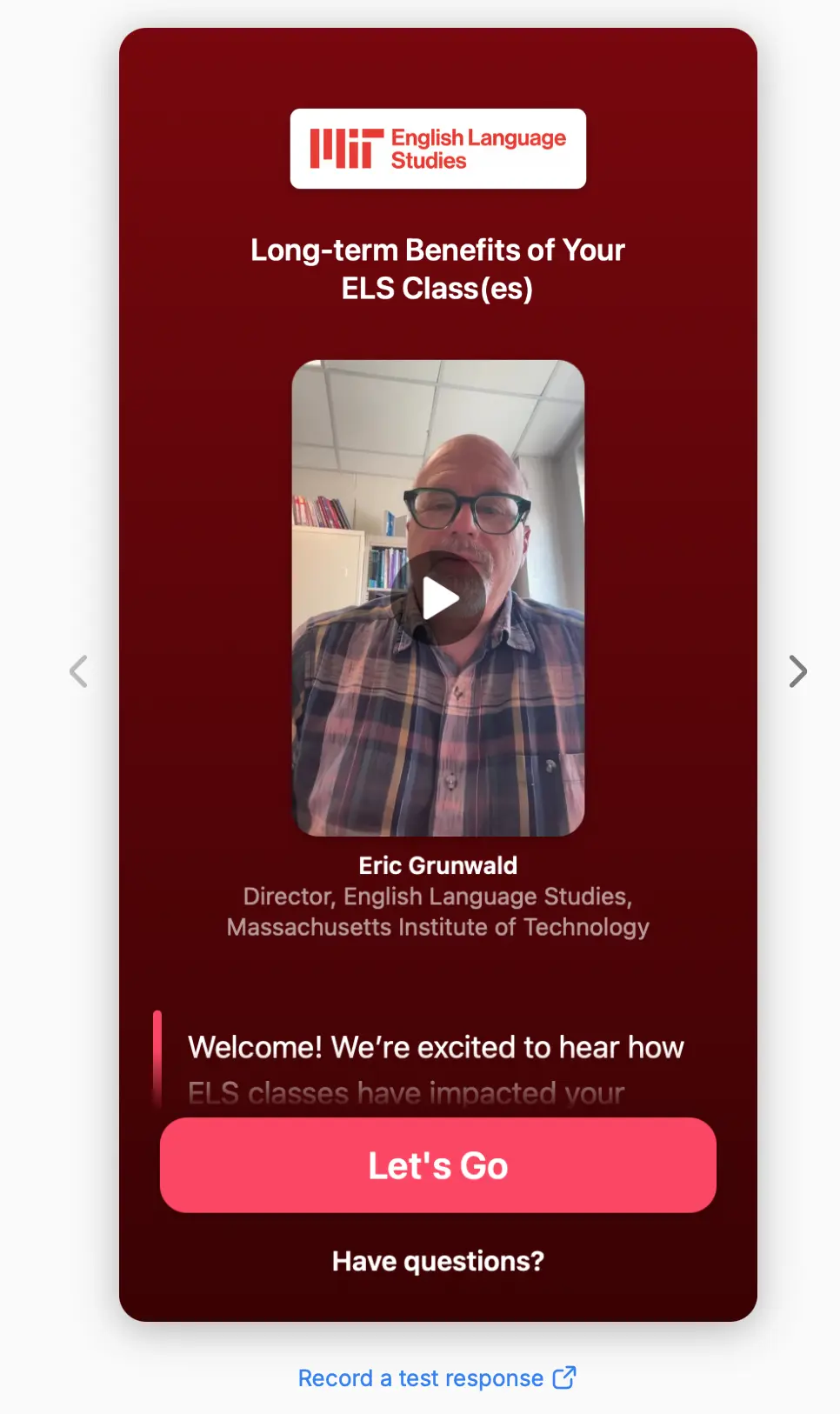
Note. Testimonial websites now make it easy to collect video comments from alumni.
On the Advice of Counsel . . .
Despite the importance and usefulness of all these strategies, one of the biggest challenges remains getting the ear of faculty, who seem to really hold the purse-strings of their graduate students’ time and curricular priorities, especially in a program such as mine where our for-credit courses are not required.
Thus, taking another nod from Michelle, I set about forming a faculty advisory council of from key departments across the Institute. I used that list from the Registrar to determine five advisors who had a good number of students taking our classes and wrote them a letter inviting them to join an ELS faculty advisory council and give me faculty’s perspectives and advice on how to best support multilingual students. Four said yes, and I wrote to a sixth and she agreed. Within a month, we’d had a meeting!
Nothing concrete has come of it yet, but they are willing to advocate on our behalf for issues or changes that I already know can’t get support for otherwise.
I don’t know yet which of these will work and how well, but this is what others and I are doing. Track data, and good luck!
References
Crow, M. (2025, October 31). Strategies for increasing the visibility of English language programs [Conference presentation]. PAIS Informal Chat.
Durham, S. (2019). The Nonprofit Communications Engine: A Leader's Guide to Managing Mission-driven Marketing and Communications. Big Duck Studio, Incorporated.
Howlin’ Wolf. (n.d.) BrainyQuote. https://www.brainyquote.com/quotes/howlin_wolf_609979.
Masoud, R.H. (2025, July 25). The attention economy and the collapse of cognitive autonomy. Georgetown Law School Blog. https://www.law.georgetown.edu/denny-center/blog/the-attention-economy/.
McGee, T., & Fox, J. (2024, March 25). Validating your English program on a university campus [Conference presentation]. TESOL 2024 International Convention, Tampa, FL, United States.
 Eric Grunwald directs the English Language Studies program at the Massachusetts Institute of Technology (MIT) and serves as board member at large and chair of the communications committee in the Consortium on Graduate Communication.