
Navigating AI in an EFL Scientific Writing Classroom: A Case Report
J. T. Salita, Language Centre (Sprachenzentrum der Hochschulen im Land Bremen), University of Bremen, Germany
Editorial note: This article is accompanied by two tables, a figure, and four appendices. To optimize readability, we have decided to provide the tables and appendices as separate PDF attachments, rather than insert them directly into the article text. Please scroll to the bottom of the page and open the files on your computer to read the article and attached documents concurrently.
Introduction
The writing classroom has been transforming since the introduction of ChatGPT: students use similar tools to improve their drafts before submission, to generate ideas for inspiration, or in extreme cases, to produce entire essays. Yeo (2023) notes that this change is irreversible as society cannot “put the AI genie back in the bottle” (p. 9, emphasis added). It is therefore time to move the teacher’s mindset, from a detecting-and-preventing approach (Nikiforovoa-Ilieva & Georgiev, 2024) to one which is integrating and innovating (Kudritskaya et al., 2024). Empowering students to use AI may not only be an approach to encourage EFL students to express their ideas more fluidly but more importantly an opportunity to address AI literacy and academic integrity.
Design and Description of the Course
With these in mind, a course for L2 English learners (called “Integrated Academic Skills for Research and Work”) was designed for students of the Natural Sciences and Engineering at the University of Bremen in Germany. It is an elective in many departments allowing students to earn 3 credit units. It is also one of the final obligatory courses qualifying them to take a comprehensive exam for the UNIcert III English proficiency level certificate (see equivalent TOEFL and IELTS scores here). This certificate is a prerequisite for graduate and post-graduate studies in the natural sciences. One enrollment requirement for this course is an English language proficiency of C1.2 (determined through a quick language placement test) according to the Common European Framework of Reference for Languages. The other is being at least in their 3rd semester of a Bachelor’s degree in the Natural Sciences or Engineering.
The course aims to prepare students for research- and industry-related professions by enabling them to communicate and convince others of the implications of their research. Students are to write and present a potential research proposal in their own discipline and learn to evaluate information critically for general purposes or specific needs. While some students enroll to learn how to write a research-oriented paper, most aim to obtain a UNIcert III certificate. Regardless of their primary motivation, students earn 3 credit points by regularly attending the course’s lectures (e.g., on scientific research, writing a scientific paper, academic integrity in the age of AI), participating actively in discussions, carrying out in-class exercises and uploading their weekly research proposal-related assignments (see Activities below) to the learning platform Moodle. An oral presentation of their research proposal and a paper-based written examination each account for half of the final grade.
The experience described here is based on classes during the summer semester 2025 and winter semester 2025-26, with 4 and 7 students respectively.
Framework for AI Implementation
Students were informed on the first day of class that AI would be used to accomplish 90% of the above-mentioned assignments. They were to document the assistance of AI tool/s of their choice by submitting the appropriate templates (several types depending on the activity) with complementary documents (e.g., a grammar report) and using only the prompts provided (in case of gen-AI tools) (see Table 1). Before the examinations, they had to have produced a complete research proposal and filled out a declaration of AI use (see Table 2). Additionally, students were to produce a handwritten, non-graded opinion-based commentary critiquing an AI-generated text (see Appendix 1).
Activities
Before doing the activities in Table 1, the content and mechanics of writing an authentic research proposal were discussed in class. Students were also asked to develop their own research questions (general and specific), turn these into hypotheses and set their objectives, and design a rough research approach. Parallel to these, they also conducted an independent literature search and provided a collection of passages deemed important or interesting by the student, or passages implying gaps in knowledge or suggestions for future research.
Table 1 shows the assignments the students completed every week (1-2 each week) and the 9 different templates they used depending on the activity (e.g., Template 1 is exclusively for correcting grammar, Template 2 for improving cohesion, Template 7 for AI generating a complete text, etc.). Therefore, even with AI assistance, students faced a significant workload, ranging from documenting and evaluating their own progress in grammar, reasoning out their choices and conducting fact checks.
Figure 1 illustrates the workflow for producing the Review of Literature, which is the most challenging part of writing a proposal. This demonstrates that at all stages of writing they were given the choice to use AI (see the changes in color in Figure 1). They could use AI to linguistically improve the text they had written themselves, or depending on how much assistance they needed, use AI to inspire them with new ideas regarding research gaps or to produce an outline in order to serve as a framework for writing their ideas. Figure 1 further demonstrates that following the light blue zone (having AI generate the text for the Review of Literature) was not necessarily a short-cut of activities or responsibilities of the student as they had to fact-check what the AI had produced (see “Instructions” in the light blue zone).
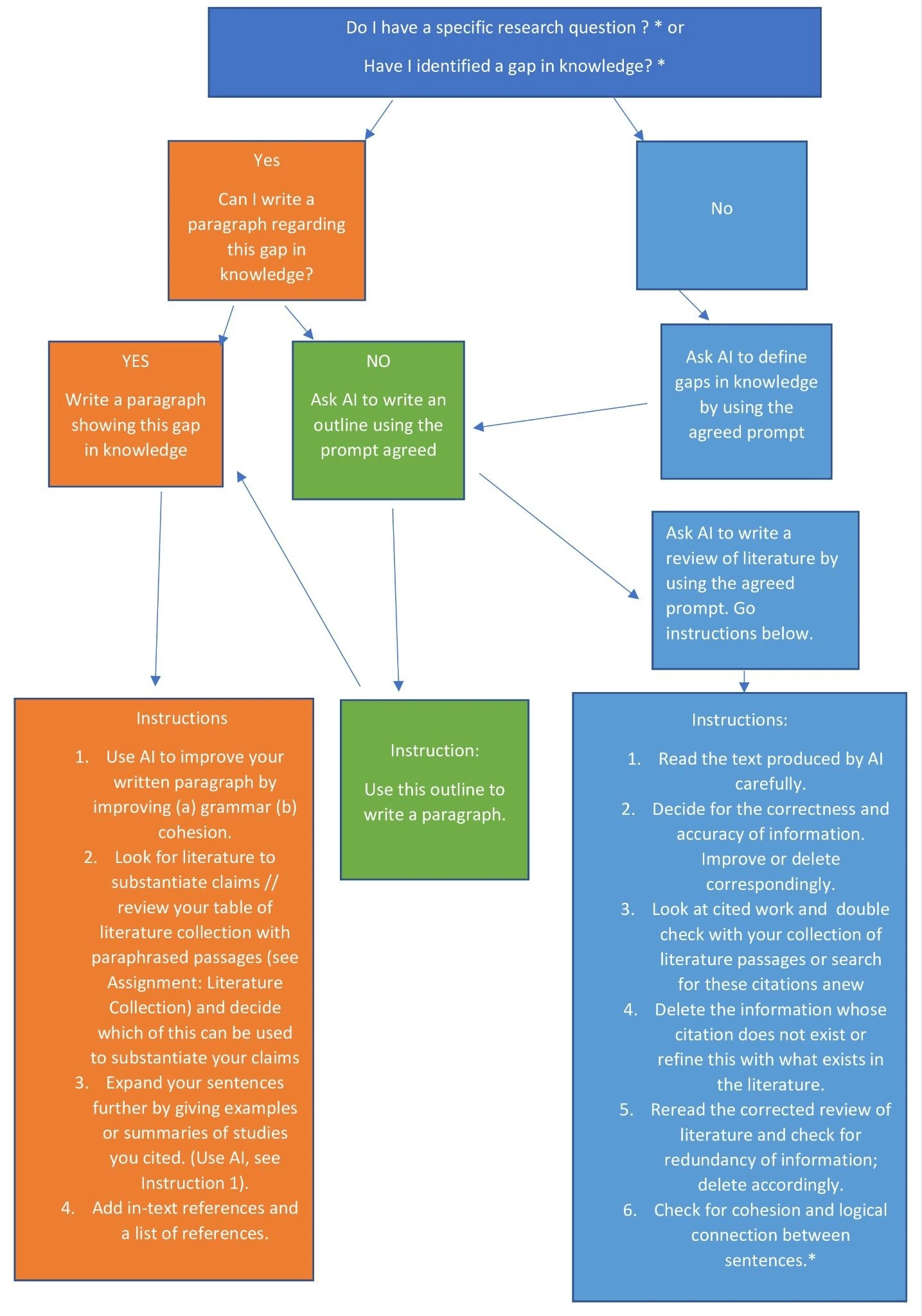
Figure 1: Guide for Students in Writing the Review of Literature (arrows indicate the path to follow, which students choose themselves; the last boxes contain the final instructions; * = previously discussed in class)
Findings From the Activities Submitted
Their submitted research proposals (> 1600 words) contained the following parts: Introduction (background and objectives) with an extensive Review of Literature, Methods/Methodology, Literature Cited and Declaration of AI Use. In the last-mentioned part (see Table 2), students estimated the amount of work AI contributed by identifying the proportion (%) of words produced or changed by AI in one text. Quantifying the text produced by AI versus their own was in this case a more appropriate estimate of authorship (= text production) than the number of hours spent for writing (which reflects the speed of text production).
Table 2 sums up the number of students declaring AI use for each writing stage and indicates the following:
-
10/11 students used AI for improving grammar in all writing stages, demonstrating the use of AI for cognitive offloading.
-
Only 5/11 students used AI for translation, showing that the students were fairly confident with expressing their thoughts directly in English.
-
Students used an AI tool the least (3/11) for understanding content during reading or for fact checking, despite the existence of tools that summarize or turn scientific articles into simplified forms such as podcasts (e.g. Notebook LM).
Table 2 also shows that students estimated AI’s contribution to their whole research proposal to be about 38% (range 14–62%), even if they used it for generating the outline (7/11) and the text of the Review of Literature itself (6/11). These estimates were relatively low because, firstly, students who used AI to generate an outline revised this outline. If they had decided to use only 50% of it, their declaration was about 50% AI use. Some of them barely used the AI-provided outline as they opted to have a generative AI tool write the review itself; therefore, they gave an estimate of about 5% AI for generating the outline. Secondly, students who had AI produce a whole Review of Literature (see “Writing the text”) revised the texts according to the correctness and accuracy of the citations, as well as redundancy and logical flow of information (see also Figure 1, “Instructions” in the blue box). The average estimated contribution of the student here amounted to about 40%, thereby crediting AI for about 60%, instead of 100%. They were told in class that they were the authors of this work and were responsible for the information. The two students who entered 100% AI contribution under “Writing the text” did not change this estimate as they were unsure if fact checking was enough to claim authorship. This activity, facilitated through class discussion, helped them understand the ethical aspects of this technology.
A separate, opinion-based writing activity (without AI assistance) was completed after submitting the research proposal, in which the students had to write (by hand) a commentary on an AI-generated text (see Appendix 1). This text explored the benefits and drawbacks of AI in enhancing writing. In this exercise, all students recognized that the text was biased towards the advantages of AI use, and they expressed their critiques of the content of said text based on their own experience using AI.
An inductive analysis of their commentaries (see Appendix 2) shows that they tackled issues regarding authorship and originality of ideas, AI’s tendency “to overcorrect” a text resulting in the loss of “individual character,” the dangers of obtaining incorrect information, dependency of users and its threat to creative writing and critical thinking. During individual discussions, they also became aware of the importance of having enough knowledge to judge the correctness or accuracy of AI-generated information and of redundancy of information that AI produced. One student clearly expressed concerns on the future of education:
For academic writers, AI may save hours of research and summarizing but can also require writers to spend more time verifying its information…. AI can...improve clarity in a very short time. However, because of its quick response…writers may directly accept the AI-generated suggestions… This is particularly crucial for education, where writing is not just combining words into sentences but learning to think critically.
Some students recognized that the ease of generating uncredited AI content poses a risk to academic integrity. One student suggested that there should be “a system in which AI watermarks itself. Writers shouldn’t get the ethical option” of acknowledging AI; instead, disclosure needs to be automated and obligatory.
A survey (see Appendix 3 for questions) was carried out at the end of the course and 10/11 students reported positive experiences in using AI in the classroom (see Appendix 4). They claimed that their vocabulary increased and general grammar skills improved. The reasons for this could be that “AI showed (my) mistakes” and “AI did not get tired” of explaining repeatedly. Moreover, much of students’ effort was concentrated on having to read authentic scientific papers from their field. Almost all students (10/11) claimed that they could write a research proposal in the future, and 7/11 were confident they would pass the final class exam, which would be paper based and performed without the use of a dictionary or any AI tool.
Conclusion
This report shows that allowing students to use AI to produce written work instills in them a sense of responsibility as authors by showcasing the practice of academic integrity. It also supports Hradilova’s (2025) observation on the strategic shift taking place among students, i.e., the increased use of generative AI as a learning resource rather than a mere shortcut. Even if students use AI to produce a text directly, it can be a legitimate aid for deeper learning. It is also probable that critical thinking skills were not at all sacrificed in this exercise as students had to examine the accuracy of information and extend their literature search to accomplish this.
This report also gives insight to teachers on (1) modifying the assessment of student skills (e.g., instead of evaluating the produced text, consider evaluating how students examine and criticize an AI-generated text), and (2) on integrating AI to prepare students for future careers as scientists. In a recent discussion on scholarly publishing, Staiman (2026) argues that the “AI-ness” of scientific prose should be justified as the risks of the consequences involved in making unclear writing readable are low in terms of the more important aspects of scientific publishing (methods validity, data provenance and replicability). Therefore, in the future, using AI in writing will probably be perceived as “normal” and not unethical.
Recommendations
In an era where AI is beginning to be a standard tool for publishing scientists, we should allow students of science the same access to these tools to ensure their ideas are not silenced by language barriers. When used with proper literacy involving reflection (here, filling out the declaration of use, writing an essay in the form of a commentary, answering survey questions), AI supports rather than discourages scientific communication. It is not as vulnerable as creative writing, where developing one’s style and voice to reach the reader’s imagination is a very crucial dimension.

Joyce Salita finished her PhD in Biology at the University of Bremen through a German scholarship. She spent years working as a research assistant and freelance editor. Today, she has traded editing for education. Rather than simply polishing students' work, she now teaches them the craft of writing at the University of Bremen’s Sprachenzentrum.
References
Hradilova, A. (2025). Generative AI in teaching academic writing: Guiding students to make informed and ethical choices. CercleS, 15(2),447–461. doi:org/10.1515/cercles-2024-0103
Kudritskaya, M., Plastinina N., Kushnina L., Plekhanova, Y., Matytcina, M. & Stepanova, M. (2024). Balancing innovation with ethics: AI applications for enhancing language competence in academic writing and reading. 2024 4th International Conference on Technology Enhanced Learning in Higher Education (TELE), Lipetsk, Russian Federation, 2024, 380–385. doi:10.1109/TELE62556.2024.10605668
Nikiforova-Ilieva, K. & Georgiev, T. (2024). AI-generated text detection and prevention of unethical AI use in student exams. 2024 5th International Conference on Communications, Information, Electronic and Energy Systems (CIEES), Veliko Tarnovo, Bulgaria, 2024, 1–4. doi:10.1109/CIEES62939.2024.10811427
Staiman, A. (2026, February 3). Part 2 – Why authors aren’t disclosing AI use and what publishers should (not) do about it. The Scholarly Kitchen. https://scholarlykitchen.sspnet.org/2026/02/03/why-authors-arent-disclosing-ai-use-and-what-publishers-should-not-do-about-it-part-2/
Yeo, M. A. (2023). Academic integrity in the age of Artificial Intelligence (AI) authoring gaps. TESOL Journal, 14, e717. https://doi.org/10.1002/tesj.716
AI Use Statement and Acknowledgements: Gemini was used in developing the title, in rephrasing some of the author’s original ideas, and in final proof-reading. Claudia Harsch read the first drafts and suggested improvements in substantiating claims. The students of the above course consented to the use of their data.