
Native-Like Models or Multilingual Practitioners? Re-Evaluating the Pedagogical Roles of NESTs Through Translanguaging
Gayoung Choi, University of Nebraska–Lincoln, Lincoln, NE, USA
Background and Issues
In South Korea (hereafter, Korea), students come to class with Korean as their shared dominant language and begin learning English as a foreign language in elementary school. However, English instruction has largely been shaped by monolingual assumptions. Since 1995, the Korean government has recruited Native English-Speaking Teachers (NESTs) to increase students’ exposure to English, institutionally positioning them as monolingual providers of authentic input. This practice is rooted not only in a belief that maximum exposure leads to acquisition, but also in the ideology of native-speakerism, which equates native-like proficiency with pedagogical authority and constructs the teachers from inner-circle English-speaking countries as the most legitimate models of language and culture (Holliday, 2006; Jenks & Lee, 2020; Park, 2009). Within this framework, NESTs are often expected to perform an English-only (EO) identity as linguistic authorities. NESTs are reduced to native-like models of language, while the relational, interpretive, and pedagogical dimensions of teaching are pushed to the margins (Pham, 2026).
This reliance on monolingual instruction is further reinforced by the assumption that learning English as a foreign language requires access to authentic language and culture, implicitly equated with Western, particularly Anglo-American, norms. It is also shaped by the widespread belief that young learners are especially receptive to language input and therefore more likely to benefit from immersive exposure. As a result, students’ first language (L1) is framed as interference rather than a pedagogical resource, and full immersion is considered the most legitimate pathway to acquisition.
However, this monolingual orientation often fails to reflect classroom realities. Students may experience frustration in linguistically inaccessible environments, particularly when instruction depends on unfamiliar vocabulary, culturally distant references, or interactional demands beyond their current level of comprehension. In such cases, English becomes a barrier rather than a resource for meaning-making.
In applied linguistics, multilingualism is now widely understood as a fluid practice in which individuals draw on their full linguistic repertoires to achieve communicative goals, rather than treating language as separate and compartmentalized systems (García & Li, 2014). From this perspective, pedagogical translanguaging has emerged as an asset-based approach that leverages learners’ existing linguistic resources to support meaning-making, identity development, and learning (Cenoz & Gorter, 2020).
However, the growing body of research on pedagogical translanguaging has focused primarily on local teachers, often overlooking the roles and practices of NESTs. This omission reflects an implicit assumption that NESTs are, or should remain, monolingual English speakers. As a result, even NESTs who have developed localized knowledge and linguistic awareness through extended engagement in Korean contexts are often discouraged from drawing on students’ linguistic resources and are positioned outside the multilingual realities of their classrooms.
To address this gap, this study adopts the lens of trans-speakerism (Hiratsuka, 2025), which challenges the native/non-native binary and reorients attention toward pedagogy. Although NESTs are often perceived as having linguistic privilege, their professional roles are frequently constrained, as they are positioned as peripheral figures responsible primarily for pronunciation, exposure, and the performance of authenticity. Using Korean is often stigmatized as unprofessional, even when it could be pedagogically transformative (Cho, 2025; Franzese & Cho, 2024; Hiratsuka, 2025). Moving beyond essentialized notions of nativeness, a trans-speakerist perspective foregrounds performative agency and recognizes NESTs as multilingual practitioners who can strategically mobilize diverse linguistic resources to support meaningful, identity-affirming learning.
The study is guided by the following research question: How do NESTs mobilize students’ linguistic and cultural resources to support meaningful and identity-affirming English learning in EFL elementary classrooms?
The Present Study
This qualitative study examines the practices of two localized NESTs who have lived in Korea for nearly a decade. Data were collected through classroom observation, semi-structured interviews, and instructional artifacts. One participant, Joe (pseudonym), an American male teacher in a Korean elementary school, was observed over one month. The second participant, Tumba (real name used with permission), a Black British multilingual teacher educator of African heritage and a former elementary school teacher, participated in an in-depth interview and shared pedagogical materials. Data were analyzed interpretively, focusing on how translanguaging was enacted as pedagogical practice and how NEST identities were negotiated in practice. Informed consent was obtained from all participants.
The following sections present the findings across two dimensions, illustrating how translanguaging is enacted through culturally grounded, multimodal pedagogical approaches and how NESTs position themselves as multilingual practitioners.
Alphabet Learning through K-dish
Claudia Tumba, a localized NEST from the UK, observed that a strict EO approach led students to label English as no-jaem (no fun, 노잼), as incomprehensible input led to disengagement. Moving beyond the role of a distant monolingual authority, Tumba chose to validate students’ cultural and linguistic resources. This pedagogical philosophy culminated in Tumba’s (2025) K-dish ABCs, grounding alphabet learning in what students already know and love: local Korean culinary culture.
Korean elementary English has aimed to foster communicative ability through authentic materials rooted in Anglophone cultural contexts and immersion, resulting in instructional resources that are largely Eurocentric and that can leave students feeling alienated from English. While intended to provide real-world language, for Tumba, these imported materials felt distant from students’ lived experiences, stripping them of motivation and agency.
To bridge this gap, she addresses what she refers to as the “Full Brain Problem,” in which young learners are cognitively overloaded by having to process unfamiliar phonetic systems alongside culturally distant concepts. She leverages their existing funds of knowledge by drawing on Korean food as a familiar cultural resource, allowing students to focus their limited mental energy on acquiring linguistic forms rather than deciphering foreign cultural codes. For her, English learning in EFL contexts is not about replicating the West; it is about empowering students to use English to express their own identity. The following examples illustrate how the translanguaging approach is enacted in practice, specifically through localized, multimodal instructional design.
Multimodality and Translanguaging in Alphabet Learning
Tumba’s practice decolonizes English language teaching (ELT) by replacing Eurocentric examples with local cultural assets. Traditionally, ELT has positioned English as both a new linguistic system and a culturally distant domain, requiring Korean children to learn unfamiliar letters alongside disconnected concepts. By contrast, Tumba uses locally grounded references that allow learners to anchor new phonetic forms in existing linguistic and cultural knowledge, thereby reducing cognitive demands and supporting more intuitive letter-sound processing.
Tumba’s pedagogy builds on the familiar by integrating English letters with Korean phonetic systems and locally situated content. Figures 1–3 are sample pages from K-dish ABCs. Figure 1 illustrates how English letters are juxtaposed with corresponding Korean Hangul characters. Because the two phonological systems do not align perfectly, the mapping is approximate rather than one-to-one. Instead of presenting the English alphabet in isolation, each letter is linked to its closest phonetic equivalent in Korean (e.g., “A” to “아 [Ah]” and “B” to “ㅂ [b]”), enabling learners to draw on their established linguistic repertoires. This constitutes an enactment of pedagogical translanguaging.
Figure 1
The Translingual Mapping of Juxtaposing English and Korean Phonetic Systems

In K-dish ABCs, each English letter is paired with a Korean food item that corresponds to the target phonetic sound and is supported through multimodal design. Figures 2–3 present examples in which visual imagery, color-coded phonetic cues, and rhythmic patterns work together to support phonological awareness and engagement. By linking English letters to meaningful cultural references, Tumba transforms abstract symbols into recognizable and accessible forms.
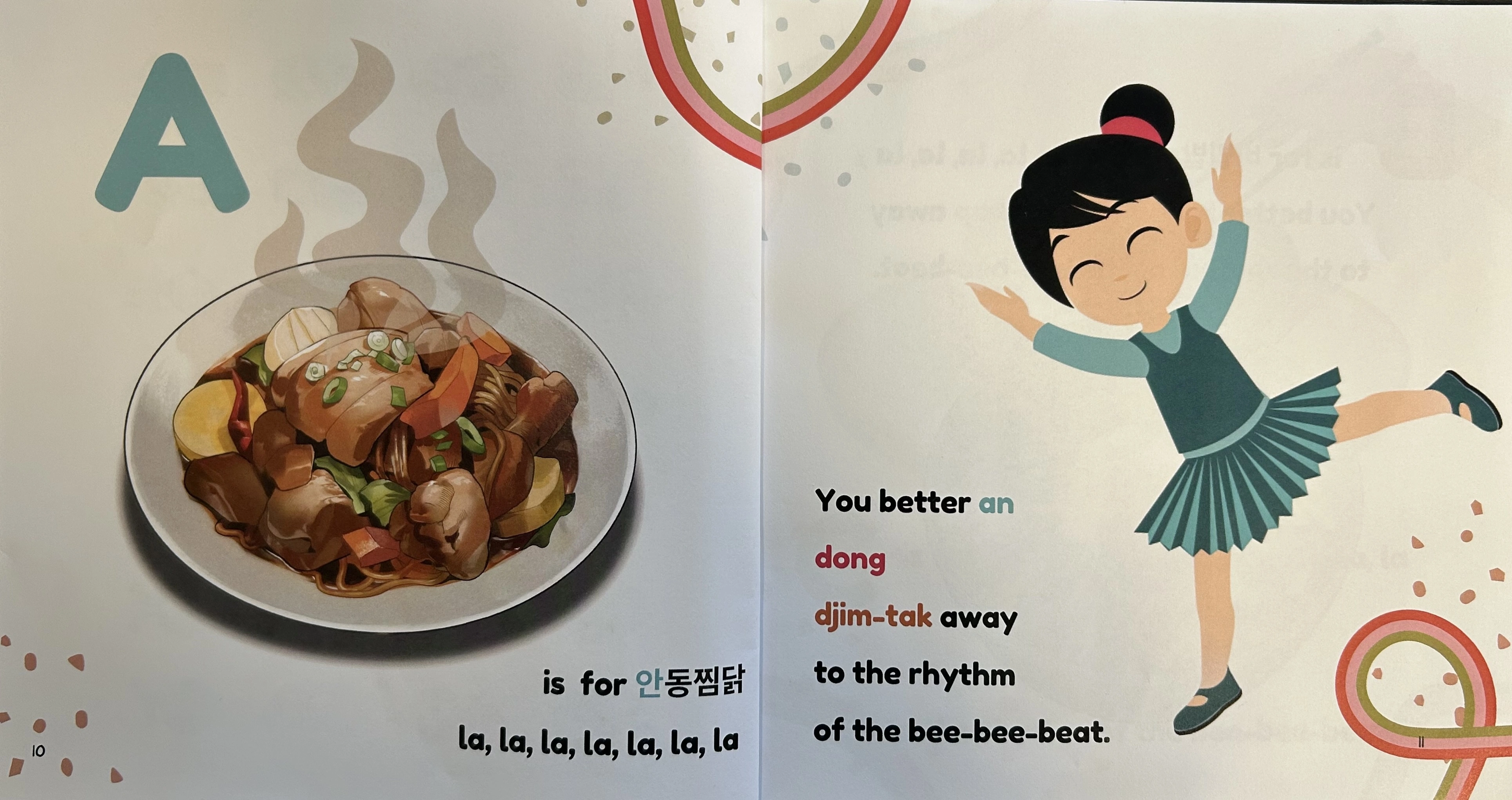
For children encountering the alphabet for the first time, conventional examples such as “A for Apple” can feel abstract, as they require learners to process both an unfamiliar sound “A” and an unknown concept “apple.” By contrast, Tumba provides “A for 안동찜닭 (Andong jjimdak)” (Figure 2), reducing cognitive load. A new sound “A” is anchored in the Korean food “안동찜닭 (Andong jjimdak),” a Korean braised chicken dish. Color-coding further facilitates phonetic mapping by linking the English letter “A” and the Korean syllable “안 [an]” through shared visual cues in the same blue hue.
Figure 2
“A is for 안동찜닭 (Andong jjimdak).”
In Figure 3, Tumba presents “P for 파전 (Pahjohn),” instead of “P for Pie.” Rather than relying solely on text, she strategically employs color-coding for the letter “P,” while rhythmic chanting (e.g., “Pah and John and dance away”) segments sounds into manageable units.
This multimodal approach—combining visual design, localized audio, and strategic L1 use—functions as a scaffold that supports comprehension and lowers linguistic anxiety (Guichon & McLornan, 2008; Mayer, 2009). Drawing on local culture is therefore not a failure of immersion, but a pedagogical necessity for identity-affirming language learning.
Figure 3
“P is for 파전 (Pahjohn).”

From Native Speaker to Multilingual Practitioner
NESTs in this study disrupted the institutional expectation that positions them as English-only models by actively incorporating students’ L1 into their teaching practices. Rather than functioning as monolingual representations of Anglophone norms, they operated as multilingual practitioners who strategically mobilized linguistic resources to support learning. In doing so, they reconstructed their professional identities, shifting from an imported specimen to a reciprocal practitioner. This repositioning redistributes pedagogical agency in EFL classrooms and reframes students not as deficient learners but as emergent bilinguals.
You Learn English, I Learn Korean.
Joe, an American NEST teaching in Korean elementary schools, positions himself as an educator rather than a mere native English speaker. He strategically uses students’ L1 for classroom management, ensuring pedagogical clarity precedes linguistic performance. Beyond the classroom, Joe actively studies Korean, a practice that informs his empathetic approach to his students’ learning journeys.
During lessons, by asking, “How do you say this in Korean?”, Joe embraces reciprocal vulnerability by validating students’ struggles and demonstrating that he, too, is a language learner. Similarly, Tumba builds rapport through shared linguistic resources, incorporating interjections like “Dae-bak (대박, awesome)!” to signal that she values the students’ world. Tumba and Joe demonstrate that both parties are emergent bilinguals co-constructing meaning in a shared space where the teacher learns Korean as the students learn English.
Empowering Voices in English Learning
Joe and Tumba’s positioning as multilingual teachers rather than NESTs reimagines what it means to use English globally. Joe deconstructs the myth of a single, perfect English in Korean society by accepting diverse Englishes. By doing so, he removes the fear of failure that often paralyzes learners and challenges the notion that English must conform to native-speaker norms. This practice demonstrates that learning English does not mean mimicking Western norms; rather, it involves developing a global voice—the agency to explain one’s home to the world in English. As Tumba notes, students do not have to forget their home to learn English; instead, they reclaim English as a resource for expressing their local identities.
Reimagining the NESTs through Translanguaging
This study foregrounds the voices of NESTs that have been relatively overlooked in TESOL research. Existing research on NESTs has largely focused on issues of identity and native-speakerism rather than on their pedagogical practices and what they do as teachers. Such a focus, paradoxically, reinforces native-speakerist assumptions by equating linguistic origin with pedagogical legitimacy.
To address this, I advocate trans-speakerism that shifts the focus from biological origin to performative agency. This perspective aligns with scholarship that calls for moving beyond the NEST/NNEST dichotomy and emphasizes alternative constructs such as bilingual/multilingual teachers (Higgins, 2017). NESTs should be understood as teachers rather than native speakers, moving beyond reductive views of NESTs as mere language models. As seen in the cases of Tumba and Joe, a teacher’s value lies not in their linguistic origin but in their ability to navigate the delicate intersection of language, culture, and student identity.
In practice, NESTs can draw on multimodal design and locally grounded resources to support students’ identity and learning. Rather than teaching English as a Western model to be mimicked, teachers can position English as a global resource for meaning-making. For example, incorporating materials such as K-dish ABCs allows teachers to build on students’ cultural and linguistic repertoires, making learning more meaningful and accessible.
In this sense, NESTs must no longer be viewed as monolingual saviors imported to rescue students from their local accents. NESTs are often characterized as monolingual; however, many are in fact multilingual and experienced educators who strategically mobilize linguistic and cultural resources to facilitate learning. Through such practices, they engage in translanguaging and actively challenge native-speakerist ideologies.
Closing Thoughts
This study examined how NESTs mobilize students’ linguistic and cultural resources to support meaningful and identity-affirming English learning in EFL elementary classrooms. The findings show that NESTs enact pedagogical translanguaging by drawing on students’ existing linguistic repertoires, integrating local cultural knowledge into instruction, and adopting translingual teaching stances. Through practices such as localized, multimodal alphabet design and the strategic use of students’ L1, NESTs move beyond monolingual models of instruction and create learning environments that are both cognitively accessible and identity-affirming.
Building on the findings, this study reflects on the broader implications of translanguaging for reimagining the roles of NESTs. Translanguaging by NESTs is not a breakdown of instruction; it is a decolonial act of empowerment. The EO mandate can function as a colonial vestige that silences student voices and constrains the pedagogical agency of NESTs. As Tumba’s experience demonstrates, imposing a monolingual environment on young learners may lead to disengagement (no-jaem), whereas more effective classrooms are those where English and students’ L1 naturally interact.
NESTs must be reimagined as localized pedagogical practitioners who share linguistic resources with students and collaborate with local teachers to co-construct dynamic multilingual spaces. In this role, NESTs serve as translingual guides, mediating between the target language and students’ local identities. Through tools such as K-dish ABCs and a reciprocal teaching stance, students do not have to abandon their home cultures to learn English; instead, they learn to express them through the language. In this sense, local identity forms the foundation of global Englishes.
Ultimately, the goal of language education is communication, not the replication of a native ideal. What matters is not where a teacher was born, but their ability to build bridges between languages, cultures, and hearts. By validating students’ roots, educators do not hinder English learning; they create the conditions through which learners’ global agency can emerge.
However, this study is not without limitations. The findings are based on long-term NESTs in Korea and therefore may not capture the experiences of teachers at different career stages. Future research could explore how early career NESTs enact translanguaging in diverse classroom contexts.

Gayoung Choi is a Ph.D. candidate at the University of Nebraska-Lincoln, where she teaches elementary literacy methodology courses. She is a former elementary teacher in South Korea and a mixed-methods researcher whose work focuses on second language acquisition, multilingual education, and AI-integrated language learning.
References
Cho, H. C. (2025). English native teachers’ demotivation in Korean language learning [Unpublished Master’s thesis]. Hankuk University of Foreign Studies.
Cenoz, J., & Gorter, D. (2020). Teaching English through pedagogical translanguaging. World Englishes, 39(2), 300–311. https://doi.org/10.1111/weng.12462
Franzese, J., & Cho, Y. (2024). Teachers’ views of L1 use in English speaking classes: A case study of university teachers in Korea. Korean Journal of General Education, 18(1), 235–256. https://doi.org/10.46392/kjge.2024.18.1.235
García O., & Li, W. (2014). Translanguaging: Language, bilingualism and education. Palgrave Pivot London. https://doi.org/10.1057/9781137385765
Guichon, N., & McLornan, S. (2008). The effects of multimodality on L2 learners: Implications for CALL resource design. System, 36(1), 85–93. https://doi.org/10.1016/j.system.2007.11.005
Higgins, C. (2017). Towards sociolinguistically informed language teacher identities. In G. Barkhuizen (Ed.), Reflections on language teacher identity research (pp. 37–42). Routledge. https://doi.org/10.4324/9781315643465-10
Hiratsuka, T. (2025). Native-speakerism and trans-speakerism in ELT: Interpretations, manifestations, and ramifications. System, 128, Article 103543. https://doi.org/10.1016/j.system.2024.103543
Holliday, A. (2006). Native-speakerism. ELT Journal, 60(4), 385–387. https://doi.org/10.1093/elt/ccl030
Jenks, C. J., & Lee, J. W. (2020). Native speaker saviorism: A racialized teaching ideology. Critical Inquiry in Language Studies, 17(3), 186–205. https://doi.org/10.1080/15427587.2019.1664904
Lee, M.-J., & Seong, G. (2011). A native English-speaking teacher’s and a Korean teacher’s roles in the co-teaching classroom. Journal of Education & Culture, 17(1), 225–260. https://doi.org/10.24159/JOEC.2011.17.1.225
Mayer, R. E. (2009). Multimedia learning (2nd ed.). Cambridge University Press.
Park, J.-K. (2009). ‘English fever’ in South Korea: Its history and symptoms. English Today, 25(1), 50–57. https://doi.org/10.1017/S026607840900008X
Pham, J. (2026). The professional identity of native English‐speaking teachers: A study on the professional development of novice and experienced EPIK teachers. TESOL Journal, 17(1), Article e70102. https://doi.org/10.1002/tesj.70102
Tumba, C. (2025). K-dish ABCs. Laughing Lamb.