
Purpose of Language: Using Systemic Functional Linguistics To Advance Multiliteracy
Olivia Orichiella, Drake University, Des Moines, Iowa, United States
Language and literacy are intertwined. This relationship is observed and expanded upon by many literacy experts within the science of reading (Cardenas-Hagan, 2020; Scarborough, 2001), which demonstrates the connectedness between language comprehension and word recognition. Understanding this symbiotic relationship is integral to supporting literacy development. This article expands on word recognition and language comprehension by highlighting how the use of Systemic Functional Linguistics (SFL) can advance structured multiliteracy. Cardenas-Hagan (2020) defined structured literacy as a systematic, explicit approach to literacy that benefits multilingual learners by integrating language instruction with reading instruction. Through this approach, multilingual learners utilize multiliteracies and multimodalities to engage in literacy instruction. For example, when students interact with a written text orally and connect the text to their linguistic repertoire, multilingualism is affirmed and used to make deeper connections to content. Providing educators with training on structured literacy and SFL develops systemic change that can advance multiliteracy. This article will extend on research around SFL and multiliteracy by defining language in context and providing an example lesson that demonstrates this connection through application.
Language in Context
Multilingual Learners of English are a growing population in schools across the United States. The National Education Association (2020), for example, predicted that by 2025, one out of four children will need English Language Learning (ELL) services. These ELL services may differ depending on the location (i.e., pull-out, push-in, co-teaching) but must be grounded in research and theory (Castaneda v. Pickard, 1981), so connecting pedagogical approaches to transformative, research-supported instruction is critical for supporting language and literacy. Previously, language education has been centered on providing educators with the best strategies to support language acquisition (Ferlazzo & Sypnieksi, 2022), ensuring the content is comprehensible while lowering the affective filter for L2 learners. However, when language strategies are disconnected from linguistic theory, progress remains stalled. Educators need to consider what students need to do with the language to understand which language strategy best supports their language acquisition. The following section builds on research from Derewianka and Jones (2023) by emphasizing how language is used to create context and empower learners to understand the varying social purposes of language.
Systemic Functional Linguistics: A Brief Overview
Systemic Functional Linguistics (SFL) is a transformative approach to language instruction initially developed by Halliday to underscore the importance of teaching language in context (Derewianka & Jones, 2023). A critical component of understanding SFL is defining Halliday’s metafunctions (Halliday & Matthiessen, 2006; Martin, 2016). Within the social system of language, metafunctions identify how texts are constructed for their social purpose, with there being key functions: the ideational, interpersonal, and textual. The ideational metafunction is referred to as the field. This component focuses on the language features used to develop the author’s point. The interpersonal is referred to as the tenor. The tenor is how the author uses language to communicate with their reader. Lastly, the textual metafunction is known as the mode. The mode describes how a text is structured. While discussing the metafunctions within SFL, Martin (2016) connected how the metafunctions help people make meaning of text through exploring linguistic structures. This highlights how the text is structured to communicate the point or purpose. For the remainder of this paper, field, tenor, and mode are used to refer to the metafunctions. These terms will be further unpacked in the following sections and connected to multiliteracy through a structured, systematic approach.
Structured Multiliteracy and Systemic Functional Linguistics
Research from the Science of Reading indicates a connection between word recognition and language comprehension when developing skilled readers (Scarborough, 2021). Scarborough’s (2021) research builds on Gough and Tunmer’s (1986) Simple View of Reading theory by detailing how word recognition and language comprehension work together to develop skilled readers through explicit, systematic instruction. As this body of research expands, approaches to linguistics, specifically Systemic Functional Linguistics (SFL), should also be explored. One reason for this is that SFL deconstructs how texts are constructed for their social purpose. As students read complex texts, SFL supports pattern recognition through explicit instruction on how different texts use language forms and functions to create meaning (Derewianka & Jones, 2023). This can help students understand how word recognition leads to a deeper connection to the language being communicated. Further, SFL values language instruction in context, allowing students to build background knowledge and engage in complex texts. The following section will demonstrate how educators can use SFL in their practice to strengthen multiliteracy using a 5th-grade Common Core writing standard: CCSS.ELA-LITERACY.W.5.1—Write opinion pieces on topics or texts, supporting a point of view with reasons and information.
Preparing for Application
When preparing to use SFL in practice, educators first must understand what students need to do with this standard to be successful. According to the common core standard above, when writing an opinion piece, students need to state an opinion and provide reasons and evidence to support it. Through an SFL approach, students first need to understand what makes an opinion an opinion. Spycher et al. (n.d.), for instance, defined the purpose of opinion texts as “to persuade the reader to agree to a certain viewpoint or take a certain action” (p. 13). Within an opinion piece, the writer naturally structures the writing to include an introduction, a list of reasons, acknowledgment of other views, and a conclusion. To support the structure of opinion text, the language features used might include conjunctions, modal auxiliary verbs, and citations. Once the language of the standard is unpacked and understood, a model text should then be analyzed. During the analysis, three key questions should be considered:
-
Mode: How is the text structured?
-
Tenor: How is the author communicating with us?
-
Field: What language features are used to support the writing?
These questions address the three metafunctions of SFL: field, tenor, and mode, as demonstrated above (Derewianka & Jones, 2023). Through the deconstruction of model texts, students can co-create the meaning of grammar functions to understand how their opinion piece takes form. Additionally, students will notice patterns with similar syntax structures that can then be used in their writing samples.
Application
The following opinion text was constructed to highlight the language forms and functions to persuade the reader to their viewpoint.
Sample Opinion Text
There are many animals I could have as a pet. In my opinion, I think the best pet would be a dog. Here are some reasons why I want a pet dog. The first reason I would like a pet dog is because I enjoy playing outside. I think it would be fun to play fetch outside with my dog. Also, I really like to go on walks. I think it would be so much fun to walk my dog with my friends. This is why I would want a pet dog.
Mode: How is the text structured?
Sample student responses: The text is in a paragraph. There are eight sentences. I know this is a sentence because there is a subject and a predicate. Also, I see transitional words, capital letters, and punctuation.
Tenor: How is the author communicating with us?
Sample student responses: The author uses the first person. They want us to know why they would like a dog by using reasons to support their opinion.
Field: What language features are used to support the writing?
Sample student responses: transitional words, present tense, modal auxiliary verbs.
After discussing, consider then deconstructing the grammar in context by highlighting a few skills to focus on. See below for an example:
Sample Opinion Text Coded
There are many animals I could have as a pet. In my opinion, I think the best pet would be a dog. Here are some reasons why I want a pet dog. The first reason I would like a pet dog is because I enjoy playing outside. I think it could be fun to play fetch outside with my dog. Also, I really like to go on walks. I think it would be so much fun to walk my dog with my friends. This is why I would want a pet dog.
What do you notice, what do you wonder in this paragraph?
-
What verbs did the author use?
-
What similar syntax structure was followed?
-
What transitional words/phrases were used?
-
How were modals used?
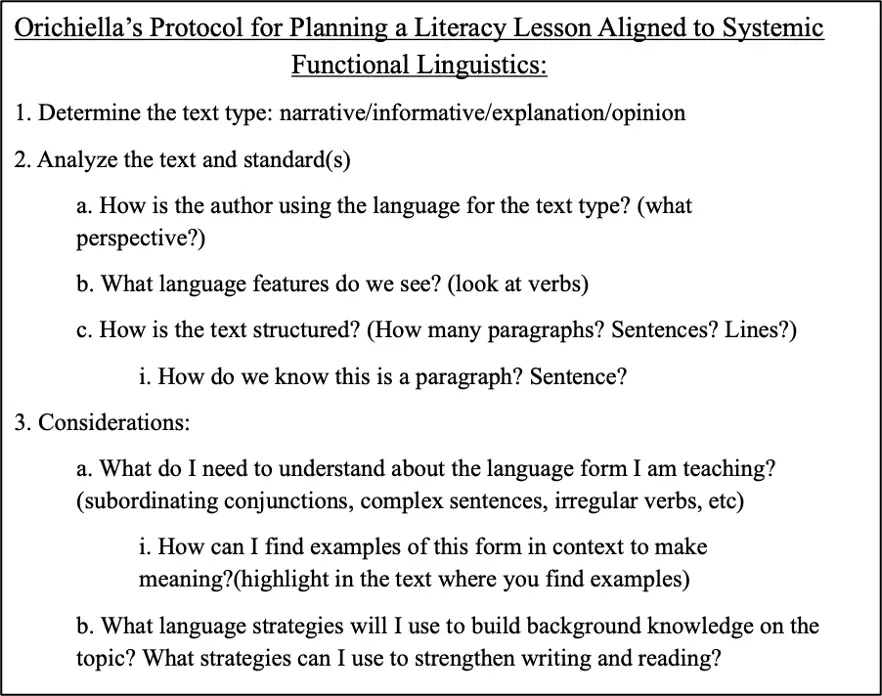
The above example demonstrates how a short text can explicitly prioritize language in context and teach literacy skills. This approach to language and literacy instruction encourages educators to move beyond out-of-context grammar drills to meaningful language instruction through text deconstruction. Through this approach, students strengthen their literacy by applying forms and functions of grammar within the context of the text. Figure 1 below includes a protocol to follow when utilizing this approach:
Figure 1
Orichiella’s Protocol for Planning a Literacy Lesson Aligned to Systemic Functional Linguistics
Conclusion
Language and literacy instruction does not need to occur outside of context. The purpose of this article was to show how multiliteracy and Systemic Functional Linguistics can be a bridge to develop skilled, multiliterate readers. By analyzing the social purpose of a text, educators can deconstruct the text with their students for the specific language features. Through this co-deconstruction, students learn in context the function of language for social purposes. When students engage with language in context, they metacognitively understand how their language can change based on the social context. By grounding structured multiliteracy in systemic functional linguistic theory, educators can empower students to understand how language adapts depending on the context. Additionally, through an explicit and systemic approach, educators can increase multiliteracy of their students through strong pedagogy and theory. This approach develops structured systems to support language acquisition for all students through meaningful literacy experiences.

Dr. Olivia Orichiella, EdD, is an experienced educator for multilingual learners. She currently serves as a teaching and learning coordinator for teachers specializing in language acquisition.
References
Derewianka, B., & Jones, P. (2023). Teaching language in context (3rd ed.). Oxford University Press.
Cárdenas-Hagan, E. (2020). Literacy foundations for English learners: A comprehensive guide to evidence-based instruction. Brookes Publishing Company.
Castaneda v. Pickard, 648 F.2d 989 (5th Cir. 1981). https://www.azed.gov/sites/default/files/2017/04/Castaneda_v_Pickard.pdf?id=58e2b46f6f53b71eb8265d6e
Ferlazzo, L., & Sypnieski, K. H. (2022). The ESL/ELL teacher's survival guide: Ready-to-use strategies, tools, and activities for teaching all levels (2nd ed.). Jossey-Bass.
Gough, P. B., & Tunmer, W. E. (1986). Decoding, reading, and reading disability. Remedial and Special Education, 7(1), 6–10. https://doi.org/10.1177/074193258600700104
Martin, J. R. (2016). Meaning matters: a short history of systemic functional linguistics. WORD, 62(1), 35–58. https://doi.org/10.1080/00437956.2016.1141939
Halliday, M. A. K., & Matthiessen, C. M. I. M. (2006). Construing experience through meaning: A language-based approach to cognition. Continuum.
National Education Association. (2020, July). English language learners. https://www.nea.org/resource-library/english-language-learners#:~:text=ELL%20students%20are%20the%20fastest,students%20in%20grades%20K%2D12
Matthiessen, C. M., Wang, B., Ma, Y., & Mwinlaaru, I. N. (2022). Systemic functional insights on language and linguistics. Springer. https://doi.org/10.1007/978-981-16-8713-6
Scarborough, H. S. (2001). Connecting early language and literacy to later reading (dis)abilities: Evidence, theory, and practice. In S. B. Neuman & D. K. Dickinson (Eds.), Handbook of research in early literacy (pp. 97–110). Guilford Press.
Spycher, P., Blitz, J., & Garegnani, D. (n.d.). OELAS: Supporting English language learners’ academic writing contents. WestEd. https://www.azed.gov/sites/default/files/2018/11/Master%20PDF%20OELAS%20Elementary%20ELA_ELD.pdf?id=5bf2e63b1dcb251308d26e81