

Breaking the Fourth Wall in Chinese EFL: Stakeholder Perceptions of Situated Learning “In the Wild” With Young Learners
April Jiawei Zhang, City University of Macau, China
Zhuohan Chen, University of Oxford, UK
A systemic disconnect often persists between classroom input and real-world output, where intensive study fails to yield communicative confidence beyond the school gates (Staples, 2025). Such an approach effectively constructs a fourth wall between the learner and material reality, where linguistic information remains confined to the school environment and fails to translate into practical use (Schurz, 2025). For instance, a student might correctly identify and label various food items within a textbook exercise, yet they frequently find themselves unable to ask for help when standing in a physical grocery store. In this context, the “fourth wall” represents the artificial semiotic boundary that isolates classroom discourse from authentic social interaction. Breaking this wall is essential for fostering authentic communicative agency. By empirically examining a situated pedagogy intervention, this study addresses this disconnect, offering a transformative blueprint for evolving learners from passive test-takers into active social actors within their local communities. Towards this objective, the following sections outline the conceptual and methodological framework before presenting findings on stakeholder perceptions and offering practical guidance for educators navigating high-stakes educational contexts.
Theoretical Framework: Situated Learning and Affect
Situated Learning Theory (SLT) and situated pedagogy provide the framework for breaching this fourth wall when synthesized with an ecological perspective on affect. SLT (Lave & Wenger, 1991) posits that learning is conceptualised not as knowledge accumulation but as an emergent property of participation in meaningful social practices, where novices progress to expertise via authentic, context-embedded social activities. This forms the basis of situated pedagogy that rejects decontextualized instruction in favour of real-world application. By relocating instruction to authentic semiotic domains, we disrupt the passivity inherent in the classroom container. This relocation compels learners to negotiate their identities as social actors rather than mere test-takers.
However, this shift stirs affective tensions, especially in examination-driven cultures where outdoor learning is often dismissed as insufficiently serious. This resistance highlights Waddington’s (2019) observation that young learners’ self-efficacy is frequently fragile, prone to debilitating attributions within the confines of static classroom environments. Consequently, by pivoting the definition of success from grammatical precision to communicative outcome, situated pedagogy fosters a more resilient learner self-concept. This internalised reconfiguration of the self-concept enables the individual to perceive themselves as a capable social agent, thereby providing a psychological buffer against the communicative anxieties common in high-stakes environments. The strategic confluence of authentic context and attenuated evaluative pressure creates a safe space (Chou, 2025; Waddington, 2019). This affective shift ultimately serves to mitigate the foreign language anxiety that is endemic to high-stakes systems.
The Present Study: Architecture of The Wild
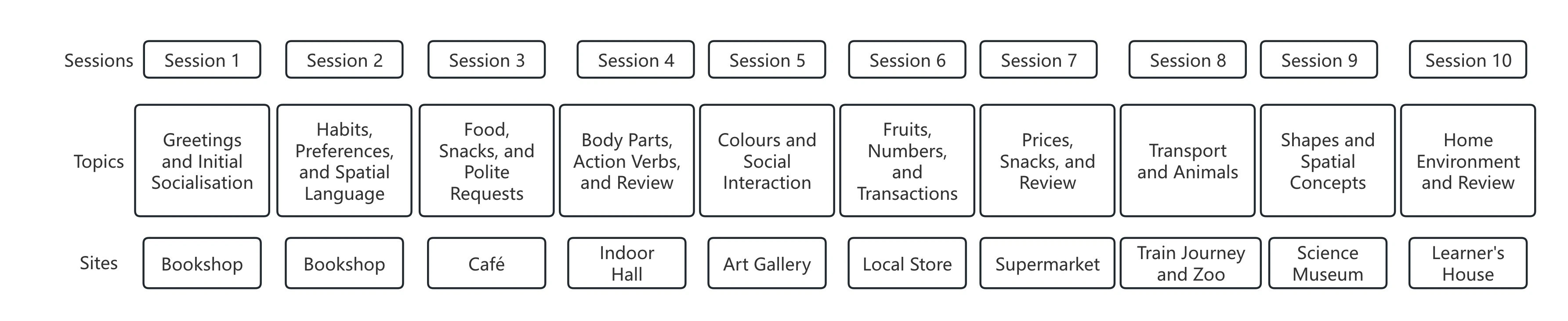
This study employs a concurrent mixed-methods design to triangulate data collected from three ten-year-old Chinese learners (Wu, Chen, and Qiu; pseudonyms), their parents (only mothers), and their teacher (the first researcher of this study). The teaching activities were delivered in a coastal city in East China in the form of private tutoring, which prioritises measurable test scores. All three learners exhibited extroverted traits and were prepared for formal instruction in Grade Three in primary schools, yet they concurrently displayed significant speaking anxiety. To motivate their English learning, a situated pedagogy was designed based on both the accessibility of physical sites and learners’ upcoming formal language learning needs. Therefore, ten topics and corresponding sites were selected, as shown in Figure 1. Detailed description and sample lessons can be found in Appendix A. Most lessons followed a three-phase structure: preparatory lexical introduction in a quiet space; site-specific enactment in public spaces (e.g., buying fruit at a local store or navigating a science museum in English); and home-based consolidation using GenAI-driven narratives to bridge episodic experience and formal literacy (for a sample story, see Appendix B).
Figure 1
Pedagogical Design
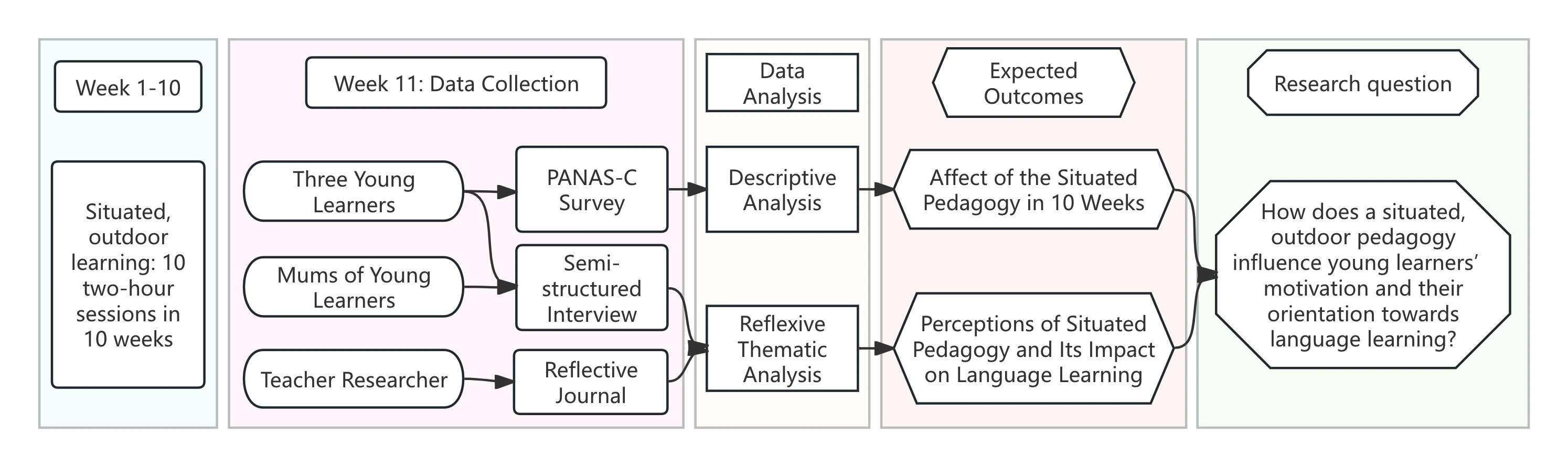
Data was collected and analysed after the 10-week teaching (Figure 2). Instruments include a 15-item Positive and Negative Affect Schedule for Children (PANAS-C), measuring learners’ general affect of the learning experience; semi-structured interviews with young learners and their mothers to investigate their perceptions of the learning experience; and an end-of-course teacher-researcher journal reflecting the teaching effectiveness academically and affectively. As a teacher-researcher, the first author maintained reflexivity through secured post-course parental/child consent before data collection, gathered surveys/interviews only during end-of-course social celebrations outside teaching sites, and journaled positionality checks (exemplified in Appendix C) before the data analysis. Integrating descriptive statistical analysis of PANAS-C survey with thematic coding of interviews and the journal provides a comprehensive response to the core research question: How does a situated, outdoor pedagogy influence young learners’ motivation and their orientation towards language learning?
Figure 2
Research Procedures
Findings and Discussion
Triangulating the aforementioned data sources revealed three salient themes concerning the intervention’s efficacy and stakeholder reception. These themes illustrate how breaking the “fourth wall” of the classroom reconfigured the learners’ affective landscape, solidified their lexical retention through episodic memory, and challenged the entrenched educational ideologies of their parents.
The Affective Turn: Comfort as a Precondition for Agency
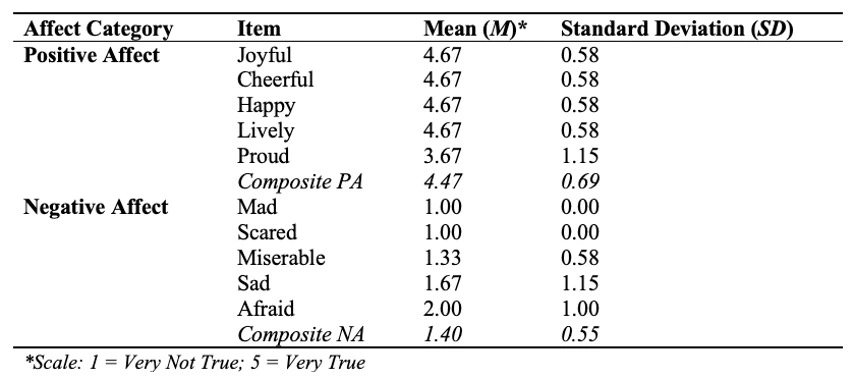
The PANAS-C results (Table 1) reveal a robust ceiling effect for positive affect (M = 4.67), confirming that situated pedagogy effectively stimulates intrinsic motivation. Aligning with Chou (2025), these results position positive affects as the primary predictor of achievement, where interactive, tailored pedagogies enhance affective support over traditional classroom environments. Conversely, a negative affect floor (M = 1.40) indicates that scaffolded environmental unpredictability bypasses typical foreign language anxiety. Somatic comforts, exemplified by café sofas, function as essential affective scaffolding, mitigate tension and promote agency—the context-driven capacity to act (Staples, 2025). These affordances facilitate authentic communication, reinforcing Waddington’s (2019) link between learner self-efficacy and emerging self-concepts.
Table 1
Descriptive Statistics for Learner Affects
Qualitative data explains the environmental mechanisms behind this affective shift. For the learners, the wild was not chaotic, but physically liberating. Chen contrasted the experience with his traditional schooling, noting that the outdoor sites offered “many fun things” compared to a “small, cramped classroom”. Similarly, Wu explicitly linked her positive affect to physical comfort, citing the “sofa” and “air conditioning” in the café session. While seemingly trivial, these material comforts reduced the somatic tension often associated with high-stakes learning in East Asia.
Material Affordances and Episodic Memory
A second major finding was the shift from rote memorisation to the learning anchored in specific events. The interview data suggest that learners recalled vocabulary not because they had reviewed it repeatedly, but because the words were physically indexed to the environment. This situated outdoor pedagogy effectively breaks the barrier where language remains “locked within educational spheres” (Staples, 2025, p. 13). By coding the environment in real-time, such as teaching “push” and “pull” at a shop door or “ticket” at the train station, the instruction ensured that form and meaning were mapped onto physical action. Qiu’s successful recall of terms in the interview, such as “notebook” and “bottle of water”, demonstrates that lexical acquisition was embedded in the authentic usage through teacher-mediated instruction delivered during the immediate, functional acts of notetaking and hydration. As Wu’s mother observed, the accumulation of words was no longer abstract; the learner could “see a thing and know it is that thing”, rather than translating via Chinese. This transition from passive recipient to agentic user demonstrates how situated learning moves students along the spectrum of foreign language learner positions (Waddington, 2019), from classroom learners to social actors.
Negotiating Educational Ideologies: “Exam” vs. “Tool”
The final theme addresses the tension between the intervention’s communicative goals and the examination-oriented habitus of the parents. Initially, these East Asian mothers viewed the situated outdoor pedagogy with a degree of pragmatic scepticism, prioritising test scores in private tutoring (Chou, 2025). Wu’s mother, for instance, admitted her primary expectation was simply that the child would “not be afraid to open her mouth”, implicitly acknowledging that traditional schooling had failed to build confidence.
However, the findings show a post-intervention shift in how parents valued learning. Qiu’s mother reported a reversal of the traditional hierarchy when her daughter began “teaching” the father English at home. This transformation mirrors Staples’ (2025) observation that students who position themselves as “teachers” or “translators” within their families develop more positive multilingual identities. By the end of the course, the parents’ perception of English shifted from a static school subject to a functional social tool. As the children moved from being passive test-takers into active knowledge-holders, the parents began to see that multilingual identity cannot be a fixed outcome of institutional provision but must be lived through individual meaning-making in real-world contexts (Staples, 2025). By bridging the gap between knowing and living a language, the intervention successfully reshaped the stakeholders’ definition of pedagogical success.
Conclusion and The Take-Away
To conclude, situated pedagogy redefines success by anchoring positive affect in comfort to manage real-world unpredictability. This approach evolves students from passive recipients into active social agents who prioritise interaction over rote memorisation. Accordingly, parental ideologies shift from high-stakes achievement toward valuing English as a communicative resource for enhancing learner self-concept and agency.
As such, practitioners can conceptualise the instructional environment as an active co-teacher. Notwithstanding the unique affordances of outdoor sites, these situated principles remain scalable for constrained institutional contexts. Where off-site excursions are unfeasible, educators might reconfigure the indoor semiotic landscape by establishing functional zones. This approach necessitates a shift from textbook simulations toward designs where physical objects serve as material anchors for episodic memory. Furthermore, in examination-oriented systems, such tasks may be adapted into immersive homework assignments that invite students to perform minor communicative acts within their local communities. By prioritising functional agency, educators could bridge the critical rupture between classroom input and real-world confidence.

April Jiawei Zhang, PhD, is an Assistant Professor at the City University of Macau. She earned her doctorate in Language Education from the University of Sheffield. Her research interests include formative assessment, technology-assisted language education, and learner emotions.

Zhuohan Chen is a DPhil candidate in Applied Linguistics at University of Oxford. Zhuohan did an MSc in Applied Linguistics and Second Language Acquisition from Oxford and was awarded Distinction. Her research interests include global Englishes and child language learning.
References
Chou, M.-H. (2025). The roles of subjective task values, private tutoring, and emotions in predicting primary school students’ English achievement. Sage Open, 15(2), 1–13. https://doi.org/10.1177/21582440251340552
Lave, J., & Wenger, E. (1991). Situated learning: Legitimate peripheral participation. Cambridge University Press. https://doi.org/10.1017/CBO9780511815355
Schurz, A. (2025). Exploring the potential of extramural English in the development of implicit, automatized, and explicit knowledge of grammar. Language Learning. Advance online publication. https://doi.org/10.1111/lang.70008
Staples, H. (2025). Multilinguality in context: An ecological study of young language learners in Wales. Journal of Multilingual and Multicultural Development. Advance online publication. https://doi.org/10.1080/01434632.2025.2575800
Waddington, J. (2019). Developing primary school students’ foreign language learner self-concept. System, 82, 39–49. https://doi.org/10.1016/j.system.2019.02.012