
Translingualism in First-Year Writing: Insights From the Two-Year College
Antonella Pappolla, University of Wisconsin-Madison, Wisconsin, USA
First-year writing instructors often find it challenging to prepare students for the demands of college writing without unintentionally reinforcing linguistic hierarchies. This issue is especially pronounced at two-year colleges, which serve a significant number of multilingual and bidialectal students from low-income backgrounds who aim to transfer to four-year universities to earn bachelor’s degrees. Many of these students have limited exposure to literacy-rich curricula before college, making it more challenging to meet the first-year writing standards set by transfer agreements. Additionally, they often face linguistic and cultural marginalization both inside and outside educational settings, which affects their sense of belonging in English-dominant academic environments. Instructors at two-year colleges can create meaningful, restorative language-learning experiences for students at a linguistic disadvantage. This article highlights how three instructors (Leo, Ava, and Amanda; pseudonyms) advance equity by integrating principles of translingualism into first-year writing classes. It first describes Leo’s efforts to help multilingual and bidialectal students see themselves as agents in their writing. Next, it discusses how Ava’s choice to assign readings by underrepresented authors helps students recognize language as a form of oppression. Finally, it explains how Amanda’s decision to leverage linguistic diversity in undergraduate research fostered participatory parity and academic growth. These insights are especially valuable for college language instructors seeking to support writing in linguistically diverse classrooms.
Theoretical Framework: Translingualism
This study adopts the framework of translingualism (Cushman, 2016; Horner & Trimbur, 2002; Horner et al., 2019; Lu & Horner, 2013) to examine how writing instructors at two-year colleges respond to and address their students’ linguistic diversity. Translingualism, as both a conceptual and pedagogical paradigm, aims to revitalize writing and language instruction by embracing a “post-monolinguistic moment” defined by de-centering standard English and moving away from Eurocentric frameworks (Cushman, 2016, p. 236). This perspective highlights that “difference is an inevitable product of all language acts,” including those viewed as “standard,” which means that writing always involves some degree of translation, recontextualization, and renewal of established meanings (Lu & Horner, 2013, p. 585).
Supporters of translingualism advocate moving beyond implicit monolingual policies and practices in colleges and universities, including those that underpin first-year writing classes. Translingualism addresses longstanding efforts to limit linguistic diversity in the modern university curriculum, which have shaped “a tacit policy of unidirectional English monolingualism” (Horner & Trimbur, 2002, p. 596). The institutionalization of the U.S. first-year writing requirement in the late nineteenth and early twentieth centuries contributed to this policy, symbolizing the dominance of written English over the classical curriculum and modern languages. Since then, universities have often operated under a “myth of linguistic homogeneity” and have employed “linguistic containment” practices to restrict the presence of both domestic and international varieties of English (Matsuda, 2006, p. 641). These practices include language proficiency tests, ESL courses for international students, and remedial classes, but also attitudes that view language differences as barriers or problems.
Envisioning a translingual university involves curriculum and teaching reforms that embrace (rather than suppress) variation and fluidity in reading and writing. In a translingual framework, teachers are encouraged to stay open and curious about students’ language choices and to be humble about what they consider correct forms or errors (Lu & Horner, 2013). Translingualism specifically promotes valuing linguistic diversity in students’ reading and writing practices, and teaching that language standards are historical, variable, and negotiable. Therefore, instead of expecting students to conform to dominant conventions and language practices, translingual pedagogies challenge them to consider “what kind of difference to attempt, how, and why” (Lu & Horner, 2013, p. 592).
The Present Study
The three instructors highlighted in this article are part of a larger comparative case study that examined writing programs and classroom practices designed to support students performing below the English 1 level at a Midwestern two-year college. The study was conducted during the 2023–2024 academic year. It involved more than 200 hours of classroom observations across six sections of writing courses that were prerequisites or co-requisites for enrollment in English 1.
Additionally, in-depth interviews were conducted with 20 multilingual and bidialectal students enrolled in these classes and 13 instructors, including those of the observed courses.
In what follows, the article describes three different enactments of translingual principles and strategies emerging from observation and interview data. These cases demonstrate the nuanced ways in which writing instructors uphold writing standards while remaining critical of the dominant language ideologies and deficit perspectives that often underpin those standards.
Translingualism in Writing Tutoring and Classrooms
Leo, Ava, and Amanda are full-time faculty members at a Midwestern two-year college, with experience teaching first-year composition (English 1) and writing courses at lower levels. They approach their teaching of first-year composition standards with a critical perspective, helping students become comfortable writing in standard English while also incorporating principles of translingualism into their mentorship and instruction.
Stimulating Writers’ Agency
Translingualism was practiced at the interpersonal level when instructors demonstrated “openness and inquiry toward language and language differences” and stimulated writers’ agency during writing conferences (Horner et al., 2019, p. 311). Leo saw linguistic diversity as a strength and believed college language teachers should learn about students’ language backgrounds to better support them. In his coaching, he promoted reflection and decision-making, not just adherence to standards.
For example, Leo recalled a conversation with a student who chose to use African American Vernacular English in their writing. Saying that “We sometimes ask the wrong questions,” Leo described how he avoided practices of linguistic containment, such as correcting grammar or immediately suggesting code-switching. Leo said, “Instead of saying, ‘Oh, your writing does not sound academic,’ I’d say, ‘Oh, this is a very interesting way of writing. Why did you write this? What do you mean by this?”
Inquiring into students’ language choices went hand in hand with warning them to “address potential discrepancies between the official and practical” (Lu & Horner, 2013, p. 591). Leo recognized the benefits of using standard English in academic contexts and believed that adhering to this variety would give students access to a broader audience: “You start asking questions to see if they can express themselves differently to appeal to more people.” Leo thought that language standards and conventions should be part of students’ writing education, but by encouraging their reflection and decision-making: “I think when you present it like that, the student is more open to exploring different ways of expressing themselves instead of feeling like they have to conform, they have to adapt.” Translingual principles underpinned both his openness to and curiosity about language differences, as well as his non-prescriptive approach to suggesting writing revisions.
Discussing Power Structures
In addition to embodying translingual principles in writing coaching, instructors also incorporated translingualism into classroom teaching. Ava focused her initial unit of English 1 on narrative writing, choosing readings that highlighted connections between language, race, and inequality. She included underrepresented authors such as Sapphire, Jesmyn Ward, and Gloria Anzaldúa, whose prose intentionally included “non-standard” features or was politically charged. Ava wanted to enhance students’ rhetorical awareness in preparation for writing their own narratives. She explained that she not only wanted to instill in students an “egalitarian view of language” but also to show them that sometimes, non-standard English is rhetorically more effective than the linguistic norm.
Discussing language ideologies in the writing classroom aligns with a core aspiration of translingualism: “revealing and leveling colonial matrices of power” (Cushman, 2016, p. 237). When Ava proposed a group discussion about Push, a novel told from the perspective of Precious, a 16-year-old Black girl living in Harlem who experiences intersecting social disadvantages, she saw an opportunity to discuss dominant language ideologies. Students had mixed reactions to the vernacular, stream-of-consciousness style used by the protagonist to narrate her life experience. For some, both the “kind of trauma” and style resonated; for others, the protagonist’s language might not seem “appropriate” professionally but was “reliable” and “authentic to her true self.” Some, instead, did not expect the language to be “this bad” and found it “hard to understand Precious.”
An example of translingualism’s influence on writing instruction was the instructor’s acknowledgment of the racial and classed dimensions of standard English. Ava highlighted the rhetorical effect of these choices as “punchy” and crucial for the novel’s political message. She also addressed students’ concerns about non-standard features, offering a power analysis: “Whiteness has been linked to education, and if standardized English is associated with formality and norms, it’s not because it’s superior but because we live in a White supremacist society that values standardized English over Black English.”Ava aligned with translingualism in three key ways: she exposed students to diverse Englishes, acknowledged their rhetorical strengths, and highlighted the power structures behind the hegemony of standard English.
Figure 1
A Translingual Research Tool
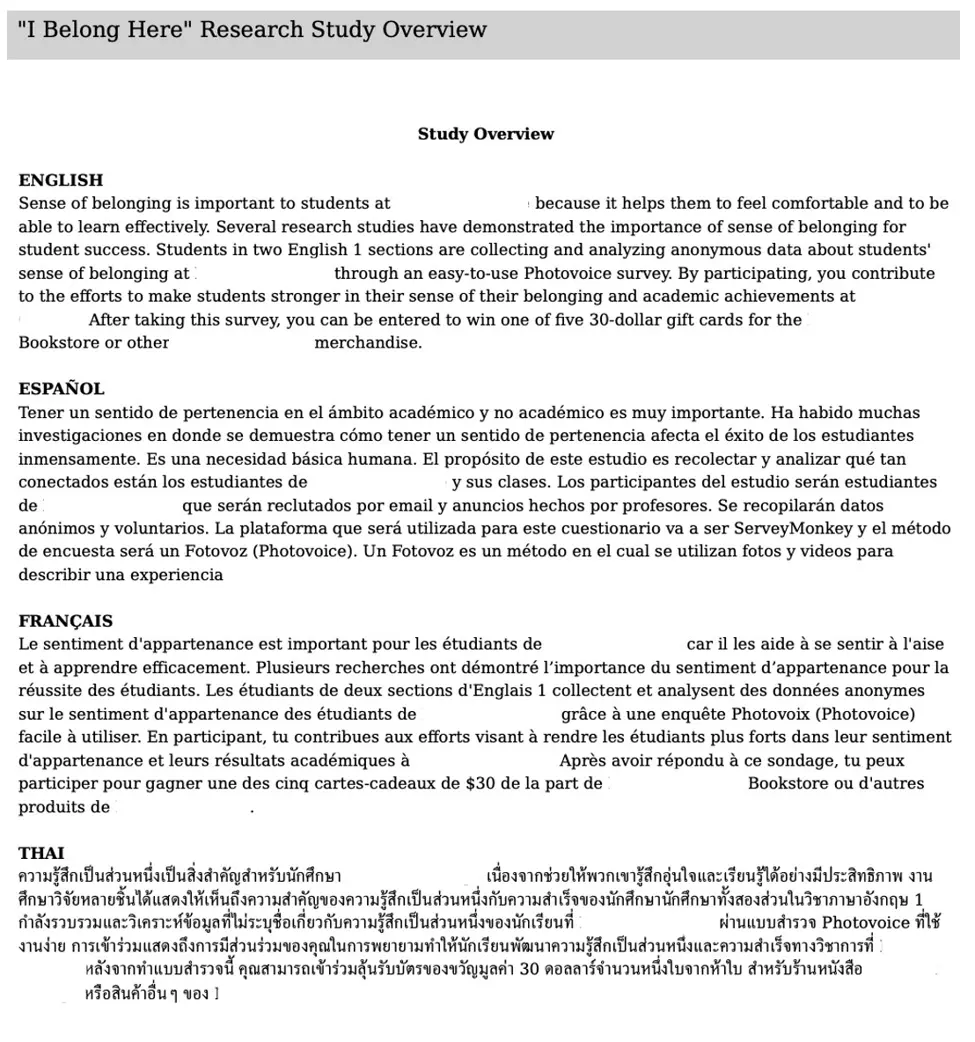
Note: This translingual artifact was created by students in Amanda’s English 1 class to collect survey responses in multiple languages.
Using Linguistic Diversity as a Research Tool
Another example of translingualism in the first-year writing class was the use of linguistic diversity as a research tool. In Amanda’s co-requisite English 1 class, students worked on a group research project about the topic of “sense of belonging,” collaborating to create a literature review, develop recruitment and data-collection materials, analyze data, and prepare the final report, which they also presented at a poster session. Amanda aimed for students to develop strong research and writing skills, but she also wanted to show that linguistic diversity is a strength in academic settings and beyond.
By promoting the use (rather than erasing) of multiple languages in an English writing class, Amanda helped students draw on a “broad and diverse repertoire of language resources” (Horner et al. 2019, p. 308). Aware of the diverse linguistic backgrounds of her students, she suggested developing research tools for data collection in the languages spoken in class, including Spanish, French, English, and Thai. Both monolingual and multilingual students formed language groups to collaborate on creating flyers and surveys in different languages (see Figure 1 for an example). This translingual activity aligned with first-year writing standards, as students practiced key academic writing skills, such as writing concisely, writing with audience awareness, and composing in multiple modes. At the same time, the activity highlighted the equal value of languages other than English in research, as the translingual tools helped the team gather more responses. By capitalizing on the pedagogical value of linguistic diversity, Amanda encouraged students to connect through language, practice research-writing skills, and challenge the default choice of standard English for academic purposes.
Pedagogical Recommendations
This article recommends applying three core principles of translingualism when mentoring and teaching writing in linguistically diverse classrooms:
-
Practicing critical inquiry when responding to student writing. When teachers show genuine interest in students’ language choices, especially those they perceive as diverging from standard English, this enables a supportive dialogue that focuses less on correcting mistakes and more on understanding the context and relationships surrounding their writing.
-
Highlighting the rhetorical effectiveness of different varieties of English. Providing students with opportunities to analyze how and why authors from underrepresented backgrounds make language and rhetorical choices helps students understand that writing is a social and political act. This approach, in turn, helps diversify a school curriculum that often emphasizes an Anglo-Saxon, Eurocentric perspective.
-
Promoting the use of linguistic diversity in writing assignments. Linguistic diversity can be used pedagogically to enhance writing skills. Students can write in multiple languages or dialects for different purposes, reflect on linguistic variation in their own or others’ writing, use non-English sources to build arguments, or gather data in various languages. These approaches are especially valuable in linguistically diverse classrooms, yet they also broadly support writing development.
These pedagogical recommendations serve as guiding principles, not strict rules, for how translingual strategies can support learners, especially those from underprivileged language backgrounds. They are inspired by the practices of the three writing instructors featured in this study, and therefore, their relevance should be assessed in relation to specific language-learning contexts.

Antonella Pappolla is the Assistant Director of the Writing Across the Curriculum program at UW-Madison. She earned a Ph.D. in Educational Policy Studies from the same university. Her research focuses on programmatic and pedagogical methods to tackle disparities in language and literacy development at open-access colleges.
References
Cushman, E. (2016). Translingual and decolonial approaches to meaning making. College English, 78(3), 234–242. https://doi.org/10.58680/ce201627654
Horner, B., & Trimbur, J. (2002). English only and U.S. college composition. College Composition & Communication, 53(4), 594–630. https://doi.org/10.58680/ccc20021465
Horner, B., Lu, M.-Z., Royster, J. J., & Trimbur, J. (2019). Language difference in writing: Toward a translingual approach. In D. Baca, E. Cushman, & J. Osborne (Eds.), Landmark essays on rhetorics of difference (pp. 273–289). Routledge. https://doi.org/10.4324/9781003576556-20
Lu, M.-Z., & Horner, B. (2013). Translingual literacy, language difference, and matters of agency. College English, 75(6), 582–607. https://doi.org/10.58680/ce201323836
Matsuda, P. K. (2006). The myth of linguistic homogeneity in U.S. college composition. College English, 68(6), 637–651. https://doi.org/10.58680/ce20065042