
Reflections of the Past Editor
Larry Udry, Assistant Professor at IELI, Divine Word College, Epworth, Iowa, USA
When current Editor, Michael Winans, asked me to reflect on my eighteen years of CALL-IS editorship, I have to admit my mind went completely blank. It was a long time, and it would be nearly impossible to distill that time into a short article without glaring omissions. I was, after all, only the editor with a very small role playing part in the IS. I was a member of the Board but not really involved in the daily decisions of the Electronic Village (EV) nor the direction of the IS. All had roles, big and small, to play, and that created the vibrancy. In addition, there are other (many other) stalwarts who have a more encyclopedic knowledge of the breadth of the CALL-IS history - our former historian John Madden, EV Online (EVO) Charter member Christine Bauer-Ramazani, Webheads in Action lion Vance Stevens, TESOL President Justin Shewell, Past TESOL President Deborah Healey, Reading guru Tom Robb, and Foundations of CALL Phil Hubbard to name a few… and so many others I dare not mention, for fear of excluding someone.
However, briefly reflecting on my time, in 2005, thanks to a recommendation from Chris Sauer, my biking buddy and boss, my stint as Editor began as Editor in Training under the keen eyes of Suzanne Stamper (who ran the Making Connections column almost as long as I was editor). Seeing a need for help and possibly training others (so I could work my way out of the job), I developed an editing team and used Google Drive for the entire newsletter process, from the collection to the editing, even the submission to TESOL was done via this platform. I’ve worked with three coeditors and three TESOL liaisons: Sarah Sahr, Michelle Kim, and Nancy Flores. Suzanne Stamper trained me diligently and continues to do so. Not too surprisingly, I leave with many great memories of colleagues and friends from whom I have learned much, and with whom it has been an honor to work. The CALL-IS intersection has undergone immense change, and it still continues to change. Yet, the vibrancy of the community is startling, constantly adapting to continually changing conditions, unlike most other IS communities under the TESOL umbrella.
Then, when Michael Winans asked to narrow it down to some of the best articles, the panic really set in. Who would I mention, and more importantly, who would I inevitably inadvertently omit? I must admit my criteria for what makes an article compelling are completely arbitrary. When I publish an article, I am looking for something that I have been somewhat interested in, something new but also something pedagogically sound and “classroom” practical - often a piece of new technology or a new wrinkle on an old piece. And, it should not be too related to any recently published articles. I remember, with some trepidation, the Great Deluge of AI Articles of 2024 - two consecutive newsletters devoted mostly to AI. While OnCALL, at least during my tenure, was not an academic journal, per se, it was “academic” with a classroom application. When editing, I tried not to overedit, rewriting the article in my voice. I tried to keep the voice but with an academic tone, because I wanted the classroom teacher voice to be the focus. Finally, to be quite honest, in considering this “ best of” list, I also have to consider what it was like to work with the writers, whether they accepted editing in a spirit of collegiality, whether they accepted my edits in a timely manner, and whether the articles had already followed the criteria stated in our Call for Submissions. A few did not.
There have been so many interesting and tantalizing articles, but four of note are from the following people: Minsun Kim, Michelle Kang, Vance Stevens, and Jasmin Cowin, some of which are linked below. I highly recommend looking back in the CALL archives because many are still well worth reading and/ or rereading. Current articles can be found here, and archived articles back to 2018 can be found here. Beyond that, there is no record. As someone wiser said, I should probably have created a hardcopy archive of them myself for CALL-IS and posted them on our current website. I still may.
First is Minsun Kim’s article, in which she reviews the web-based reference managers EndNote, Mendeley, RefWorks, and Zotero. It illustrates practical ways to use them as a pedagogical approach to prevent unintended plagiarism and help student writers track sources and format references. Far from assuming that students mean to plagiarize, it gives them tools to make them aware of how to manage sources so that it becomes less easy just to borrow. Her article as a pdf in the archives can be found here.
Next is Vance Stevens. What more can one say about Vance? Though there is no longer access to the article, it was a long, thoughtful, thorough article on the history of CALL-IS from its simple beginnings. Of which he played no small part. His meticulousness was singular, like his sense of humor/ irony. Like many, I do have a short Vance anecdote. It was 2016 at the TESOL convention in Baltimore, and we were still webcasting. I was on the team. We were broadcasting in a very large room with a panel of speakers: our table with mics and equipment was in one section of a large conference room. The speaker’s table was in another section, and their voices couldn’t be picked up by the mics at our table. In comes Vance, who immediately inverted one of the two chairs on top of the other, put the microphone on the very wobbly top chair, and the problem was solved in a very Vancian way. He left the room with a satisfied Cheshire smile.
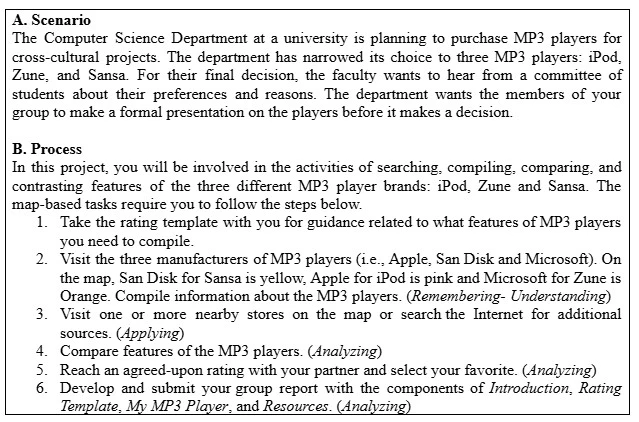
Second up is Michelle Kang's article Scaffolding Thinking Skills Through Web-based Activity,published in 2011 (though not available through the TESOL platform, it is now available in its final draft form before publication here, with the author’s permission ). I still remember the creative, practical scenarios ( relevant in 2011). One scenario, choosing an MP3 player, used Bloom’s Revised Taxonomy, taking the reader through each taxonomy level with a student-centered corresponding activity. The students evaluated various MP3 player options, weighing factors like cost, ratings, durability, and name-brand reliability.
So seamless was it that I adapted this framework for the content of an environmentally-based ESL ebook I wrote while I was CALL-IS Newsletter Editor.
Lastly, and more recently, Pioneering Practices: AI Innovations and Challenges by Dr. Jasmin Cowin discusses AI, seamlessly blending the positive and negative aspects of AI. As her short teaser to the article says, “critically assessing both opportunities and obstacles, ensuring AI enriches language learning while addressing ethical concerns and potential risks.” Like her other articles, this one begins with a compelling rhetorical question from history, in this case, Jules Verne who stated: "Everything that I invent, everything that I imagine, will always fall short of the truth, because there will come a time when the creations of science will outstrip those of the imagination." and she muses, “Are we moving toward an educational paradigm where AI not only supports but enhances the human endeavor of teaching? Or could we be inadvertently paving the way for a future where human educators are obsolete, and homogenized AI dictates the nuances of our languages and thinking?”
It’s been a long but very fulfilling stretch. Along the way, I’ve made enduring friendships and met some great colleagues. And I would like to thank all those who have served before, the newsletter editing team who helped in so many ways, and Michael Winans for giving me this chance.
 Larry Udry has worked at Divine Word College, a minor Catholic seminary in Epworth, Iowa, since 2003. He has published the CALL-IS Newsletter and has served on the CALL-IS Steering Committee since 2009. He recently revised the second edition of an ebook, entitled Earth, Wind, Fire, Water: An ESL Student's Guide to the Biomes of the World, an environmentally-themed e-text, that now has an accompanying app. Before his position at Divine Word College, he worked at UT Martin for eleven years, where he published the TNTESOL Newsletter.