

Pioneering Practices: AI Innovations and Challenges
Dr. Jasmin Cowin, Ed.D. Touro University, Graduate School of Education, U.S. Department of State English Language Specialist
Introduction
"Everything that I invent, everything that I imagine, will always fall short of the truth, because there will come a time when the creations of science will outstrip those of the imagination." This reflection from Jules Verne in a letter to Charles Lemire resonates profoundly as we envision the classroom of 2060. It compels us to question: Are we moving toward an educational paradigm where AI not only supports but enhances the human endeavor of teaching? Or could we be inadvertently paving the way for a future where human educators are obsolete, and homogenized AI dictates the nuances of our languages and thinking?
A Glimpse into the Future: The Classroom of 2060 a la Jules Verne
Imagine a classroom in 2060, an extraordinary amalgamation of advanced technology and education. As students step in, personalized AI-assisted learning pods, tailored to each student’s English proficiency, greet them. Dominating the room is a central holographic display, conjuring vibrant virtual environments that bring the English language to life in ways only Jules Verne might have envisioned. These wrap-around pods provide a myriad of activities—interactive theater, collaborative writing projects, and engaging language games—transforming learning into an adventure.
Parents are not left out of this innovative system. They receive regular updates on their child’s progress, along with practical suggestions for supporting language development at home. Virtual parent-teacher conferences are seamlessly integrated, offering a convenient platform for discussing student progress. Additionally, virtual workshops and cultural exchange events invite families to partake in the learning process, fostering a supportive community spirit.
The classroom’s AI companions, with their advanced capabilities, offer features like text-to-speech and speech-to-art, facilitating engaging, scenario-based dialogues. Visual feedback and immersive haptics make abstract language concepts tangible and interactive. Students can feel the rhythm and structure of the English language, enriching their understanding through a multisensory approach. In this visionary classroom, education transcends traditional boundaries, becoming a dynamic, interactive, and deeply personalized journey. Here, technology and the human touch intersect, creating a learning environment where students not only learn a language but also embark on a grand adventure of global connection and understanding. The future of education, much like the extraordinary voyages imagined by Verne, is a testament to the boundless possibilities of human ingenuity and the relentless pursuit of knowledge.
Where are we today?
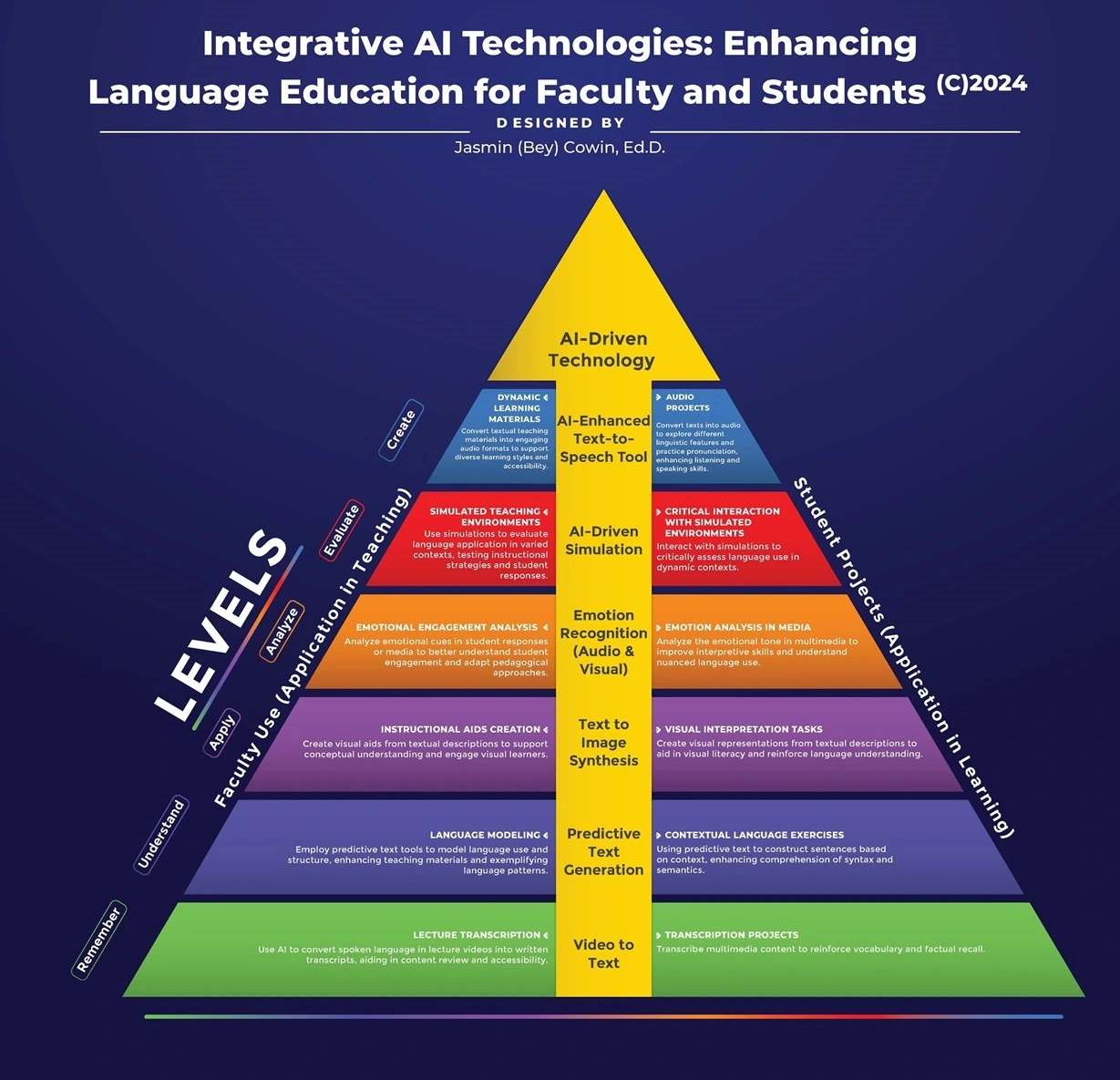
Here are some practical use cases of current AI tools for language education,(Figure1.) ordered using Bloom's revised Taxonomy ordered from lower to higher cognitive processes, which of course is only a guide.
It’s Not a Bird: Stochastic Parrot vs. Stochastic Chamber
The term “stochastic parrots” refers to large language models (LMs) that may perpetuate biases present in their training data, leading to a reinforcement of dominant worldviews. For instance, if an LM is trained on a dataset that over-represents certain linguistic features or dialects, it might generate text that disproportionately reflects these features, thereby reinforcing linguistic biases. This is particularly relevant in language teaching, where an LM might inadvertently favor certain dialects or language uses over others, potentially leading to a skewed representation of the language.
This phenomenon primarily concerns the generation of text by LMs, but it also applies to other applications such as classification, query expansion, and information retrieval, where LMs or their derived word embeddings are used. For example, in a language identification task, if the training data is biased towards certain languages or dialects, the LM might misclassify less represented languages, thus perpetuating the bias.
On the other hand, “stochastic chambers” incorporate randomness and variability into AI’s decision-making processes to mimic the unpredictability and diversity of human thought and behavior, which are essential aspects of natural language use and learning. For example, in a language teaching context, an AI tutor might introduce variability in its responses to student queries, thereby exposing students to a broader range of linguistic phenomena and promoting a more comprehensive understanding of the language.
By introducing stochastic elements, AI systems can simulate the variability found in human language, making interactions feel more natural and less mechanical. This is particularly beneficial in language teaching, where exposure to a wide range of linguistic variability can help students develop a more flexible and adaptable understanding of the language, better preparing them for real-world communication. For instance, an AI language tutor might sometimes use formal register and other times use informal register in its responses, helping students understand the appropriate contexts for different language styles.
Navigating Challenges
Let us pivot now and look at one of the most pressing concerns in the integration of AI in language education: the risk of language homogenization. As AI models are often trained on homogenous datasets, they may inadvertently marginalize less-represented dialects and languages. This can lead to a concerning scenario where AI algorithms favor certain accents, dialects, or linguistic structures over others, potentially disadvantaging students who speak in less-represented ways. It is our responsibility as educators to ensure that the rich tapestry of language diversity is preserved and celebrated in the face of AI-driven language learning.
Ethical Considerations
As we integrate AI into language education, it is crucial to address ethical considerations and policies. These include the impact on teacher-student relationships, data privacy, algorithmic biases, and the digital divide. Ensuring that AI tools are designed and used ethically will help protect students' rights and well-being while maximizing the benefits of AI-enhanced learning. Data privacy, algorithmic fairness, and equitable access to technology are essential to fostering a just and inclusive educational environment.
Embodied Cognition, Neurodevelopment, and Information Overload
Embodied cognition is a fundamental aspect of language learning, deeply intertwined with our innate biological and physical expressions. As highlighted by Kosmas and Zaphiris (2018), our cognitive processes are inextricably linked to our interactions within the physical world. The limitations of digital platforms, which often lack avenues for direct physical engagement, can lead to a disconnection that hinders the natural development of cognitive abilities rooted in our physical embodiment. Therefore, it is essential to foster learning environments that prioritize real-world experiences, guided by teacher intervention, and facilitated through group interactions. Such environments leverage our biological predisposition for socialization and physical interaction, essential for the holistic development of language skills. By integrating direct human contact and collaborative learning activities, we can create educational settings that fully embrace the physicality of our human experiences.
We must also be mindful of the potential neurological changes associated with prolonged exposure to digital interfaces and information overload. A study by Zhao et al. (2022) suggests that screen media activity may impact neurodevelopment in youth, linking it to brain structural patterns such as cortical thinning. As educators, it is our responsibility to stay informed about the latest research in this area and to develop strategies that mitigate any potential adverse effects on our students' cognitive development. There needs to be more empirical research into how high levels of screen time can affect areas of the brain related to cognitive control and emotional regulation. As Zhao et al. point out in Brain structural covariation linked to screen media activity and externalizing behaviors in children “Screen media activity (SMA) may impact neurodevelopment in youth. Cross-sectionally, SMA has been linked to brain structural patterns including cortical thinning in children.” As an educator and mother, I would appreciate more in-depth discussions on the long-term impacts of these changes and whether they could lead to significant neurological alterations.
Conclusion: AI Precision vs Human Creativity
Creating a balance between AI's precision and human creativity involves developing AI tools that support and enhance the teacher's work rather than replace it. This approach could involve AI systems designed to suggest personalized learning materials or adaptive learning paths that respond to a student's progress, while teachers focus on higher-order teaching tasks like facilitating discussions, providing nuanced feedback, and fostering a supportive learning environment.
The integration of AI and advanced technologies in English language education presents both exciting opportunities and complex challenges. The caveat is that the current exponential transformative processes involve more than merely adopting new tools; they necessitate a fundamental reevaluation of how these technologies alter teaching and learning and could potentially change neurological structures. As educators navigate through the myriad spaces of digitization, it is imperative to carefully consider the implications for students’ physical being, recognizing that cognitive abilities are significantly shaped by bodies and their interaction with the environment.
As AI reshapes educational approaches, it prompts a critical reevaluation not just of tools but of pedagogical philosophies. Educators must question whether they are prepared to adapt and thrive in this new era or if they are unwittingly contributing to a future where technological advances undermine core educational values. In conclusion, as educators chart the course toward a digitized educational future, maintaining a critical perspective is essential, fostering innovations that genuinely enhance learning while vigilantly safeguarding cognitive integrity. As the journey continues, a balanced perspective is crucial, recognizing the potential benefits while remaining vigilant about the risks of language homogenization, the limitations of stochastic parrots, and the importance of embodied cognition in language teaching and learning.
References
Kosmas, P., & Zaphiris, P. (2018). Embodied cognition and its implications in education: An overview of recent literature. International Journal of Educational and Pedagogical Sciences. Retrieved from https://www.academia.edu/download/57088607/Embodied-Cognition-and-Its-Implications-in-Education-An-Overview-of-Recent-Literature.pdf
Johnson-Glenberg, M. C. (2016). Effects of embodied learning and digital platform on the retention of physics content: Centripetal force. Frontiers in Psychology. Retrieved from https://www.frontiersin.org/journals/psychology/articles/10.3389/fpsyg.2016.01819
Zhao Y, Paulus M, Bagot KS, Constable RT, Yaggi HK, Redeker NS, Potenza MN. Brain structural covariation linked to screen media activity and externalizing behaviors in children. J Behav Addict. 2022 Jun 30;11(2):417-426. doi: 10.1556/2006.2022.00044
 Dr. Jasmin Cowin, Ed.D. , is an Associate Professor of Touro University, Graduate School of Education and U.S. Department of State English Language Specialist (2024). She is a columnist for Stankevicius where she writes on Nicomachean Ethics – Insights at the Intersection of AI and Education.