
Using The U.S. Naturalization Civics Test for Academic Vocabulary Development and Cultural Exchange
Matt Goode, University of Florida English Language Institute, Gainesville, Florida, US
About Naturalization Civics Tests
This article focuses on the US naturalization test, but other countries have similar English-language tests: Canada and Australia have their own citizenship (as opposed to naturalization) tests, and the UK has the Life in the UK Test. Ireland and New Zealand do not currently administer naturalization tests. The US test is much more accessible than the others; its questions and preferred answers are available in a simple, 11-page file. The other tests are based on book-length texts.
The U.S. test bank–at the time of writing–consists of 100 questions focused primarily on civics, while the other tests contain hundreds of potential questions covering a wide array of topics, including the identities of Canadian Olympic gold medal winners or the name of the biennial cricket series between England and Australia. The U.S. test consists of 10 random questions, of which 6 must be answered correctly, while the other tests are longer and require higher percentages of correct answers. In other words, the U.S. test is easier to casually incorporate into a curriculum, while the others could be overwhelming. US Citizenship and Immigration Services plans to extend the test by 28 questions in the near future, but most of the information in this article will still apply.
Background
I often include season-appropriate materials in intermediate and advanced reading classes at the University of Florida’s intensive English program. The fall term offers the most topics within the North American context: Halloween, Thanksgiving, the daylight saving time switch, college football, elections, and the impending Christmas season. Spring brings Valentine’s Day, Easter, March Madness, the Super Bowl, and the daylight saving time switch (again). Summer has few exciting events for my students outside of Independence Day (July 4th); however, this day, combined with Memorial Day and Juneteenth, gives a civics-based theme to the first half of the US summer term. This makes the U.S. naturalization civics test an appropriate resource for summer reading classes. I have used the test in class since 2017, and it has been a popular activity.
Justification from Curriculum
Use of the naturalization test conforms to various aspects of my program’s mission and curriculum:
- English Language Institute Mission (excerpt): The mission of the English Language Institute (ELI) is to foster the learning of the English language and the culture of the United States of America (US) through its Intensive English Program and other various programs.
- Reading/Writing 50 Objectives to Teach: Use a variety of strategies and sources to increase core academic vocabulary.
- Reading/Writing 50 Student Learning Outcomes: Gather information on a topic by reading multiple texts that approach and develop the topic in different ways.
Student Motivation and Relevance
Although a relatively small portion of my students aspire to remain in the United States permanently, many of them will stay in the country for years pursuing their degrees. The naturalization civics test provides societal context for them. Some portions of the test may be a bit boring, but students often express enthusiasm for the material overall. The context for the test has changed recently; having some knowledge of their rights and government functions is paramount to international students in the U.S. today.
About the Test
At the time of writing, the US naturalization civics test consists of 100 questions in 3 main categories, further divided into 9 total sections:
- American Government: Principles of American Democracy, System of Government, Rights and Responsibilities
- American History: Colonial Period and Independence, 1800s, Recent American History and Other Important Historical Information.
- Integrated Civics: Geography, Symbols, and Holidays.
On the surface, the information in the test provides potentially useful information for living in the US. The deeper benefit is tangential: opportunities for vocabulary expansion, spontaneous class discussions, and further reading on related topics.
A complementary resource for the civics test is History.com, the official website of the History Channel. While the television channel is known for programs like Ancient Aliens, Ice Road Truckers, and Pawn Stars, the website is a trove of real history articles with frank titles like “The Most Damaging Myths about Slavery, Debunked” and “Native Americans’ Long Journey to US Citizenship and Voting Rights.” If listening activities are more desirable than reading, another resource is the The History Guy YouTube channel, which examines specific individuals, making some of the civics topics more personal; for example, videos relevant to the topic of U.S. slavery include “Omar Ibn Said: Futa Toro Scholar” and “Oluale Kossola, the Last Survivor of the Atlantic Slave Trade.”
The test questions and recommended answers contain key vocabulary terms. The following Academic Word List terms make appearances:
- Sublist 1 constitution, create, defines, economy, income, issue, labor, legal, legislative, legislature, major, period, policy, principles, vary
- Sublist 2 commissioner, commissioners, community, participate, resident, security, selective
- Sublist 3 convention, register
- Sublist 4 civil, integrated, resolves
- Sublist 5 amendment, energy, license, pursuit, symbols
- Sublist 6 discrimination, federal, transportation
- Sublist 9 founding, military
- Sublist 10 assembly, depression
Other indispensable terms include the following: almanac, citizen, diplomat, district, economic depression, election, emancipation, executive, jury, judicial, liberty, persecution, petition, representative, stripe, territory.
Using the Test
I typically spread the test questions and answers out over several days or weeks leading up to the U.S. Independence Day. We usually cover 5 to 10 questions with answers per session. Some simple questions–like “Who is the governor of your state?”–require little explanation. Others, like the history section in general, can lead to lengthy asides and readings.
When we begin reading the test, I inform the students that they will eventually take a naturalization “test” in class, and they will be rewarded facetiously with “citizenship” if they pass. Because of their high levels (high intermediate to advanced), they understand that I am not actually bequeathing U.S. citizenship upon them.
A few weeks later, the big day arrives, and the students take the “test.” The real test is typically administered orally, and involves 10 questions supposedly chosen at random. Candidates need to answer 6 questions correctly to pass. The questions on my version of the test are chosen deliberately to increase chances of success, and I maintain the 60% threshold for passing. I display the questions on a screen and also read them aloud. I grade the tests immediately after, and occasionally I have to cook the books to make sure everyone passes. Finally, the big moment arrives: The students are awarded certificates and become “citizens.”
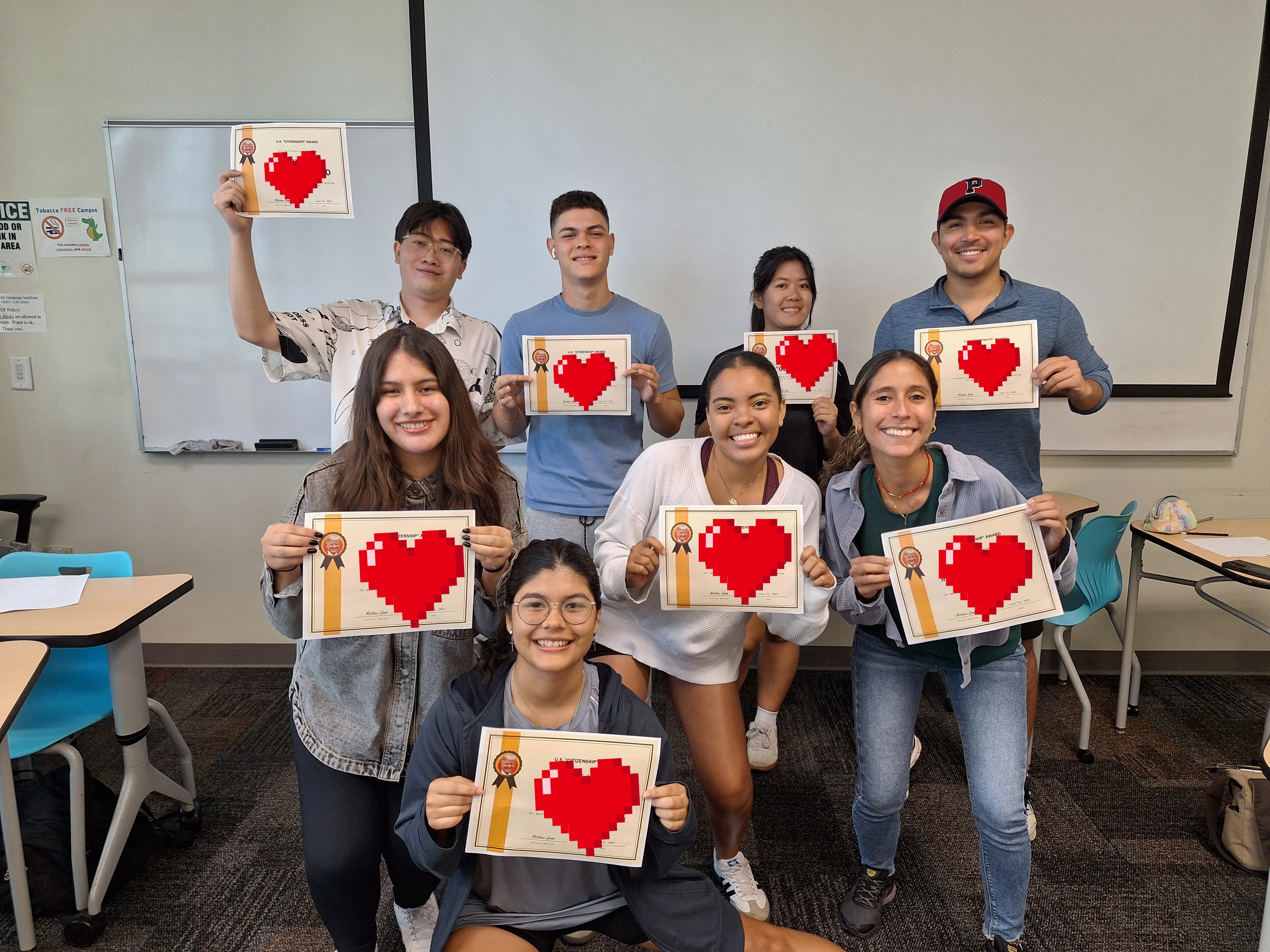
Photo caption: The proud and delighted students of Reading/Writing 50, Summer, 2025
Resources
Civics (History and Government) Questions for the Naturalization Test. U.S. Citizenship and Immigration Services. https://www.uscis.gov/sites/default/files/document/questions-and-answers/100q.pdf
Life in the UK: A guide for new residents. Britizen. https://storage.googleapis.com/britizen-public/static/study-guide/document.pdf
Australian Citizenship: Our Common Bond. Australian Government. https://immi.homeaffairs.gov.au/citizenship-subsite/files/our-common-bond-testable.pdf
Study Guide - Discover Canada - The Rights and Responsibilities of Citizenship. Government of Canada. https://www.canada.ca/en/immigration-refugees-citizenship/corporate/publications-manuals/discover-canada.html
AWL highlighter &; gapfill. EAP Foundation. https://www.eapfoundation.com/vocab/academic/highlighter/
Thanks to Patricia Moon Tapper and Patricia Antonucci for assistance.
 Matt Goode, MEd, taught academic English in the English Language Institute, the University of Florida's intensive English program, from 2012 to 2025. He recently began teaching in the Adult Education ESOL program at Santa Fe College in Gainesville, FL. He has primarily taught intermediate and advanced English classes.