

Why Professional Learning Matters
Gregory Stancil, TESOL International Association, Alexandria, Virginia, USA
The number of multilingual learners of English (MLEs) in U.S. schools has risen dramatically, yet most general education teachers receive little preparation to support them. High-quality professional learning—such as TESOL International Association’s Teacher Leadership for School-Wide English Learning (SWEL) and The 6 Principles framework—can bridge this gap and improve outcomes for students and teachers alike.
In my own career, I saw this need firsthand. I began as an ESL teacher in the Bronx, through the New York City Teaching Fellows program at the High School for Contemporary Arts. Many of my students were from the Dominican Republic or Jamaica, and while English education had the power to transform their lives, the lack of resources and teacher training was striking. Professional learning specific to English learners was rarely prioritized, and ESL was often pushed to the margins despite the large number of multilingual students.
A Growing Population, a Widening Gap
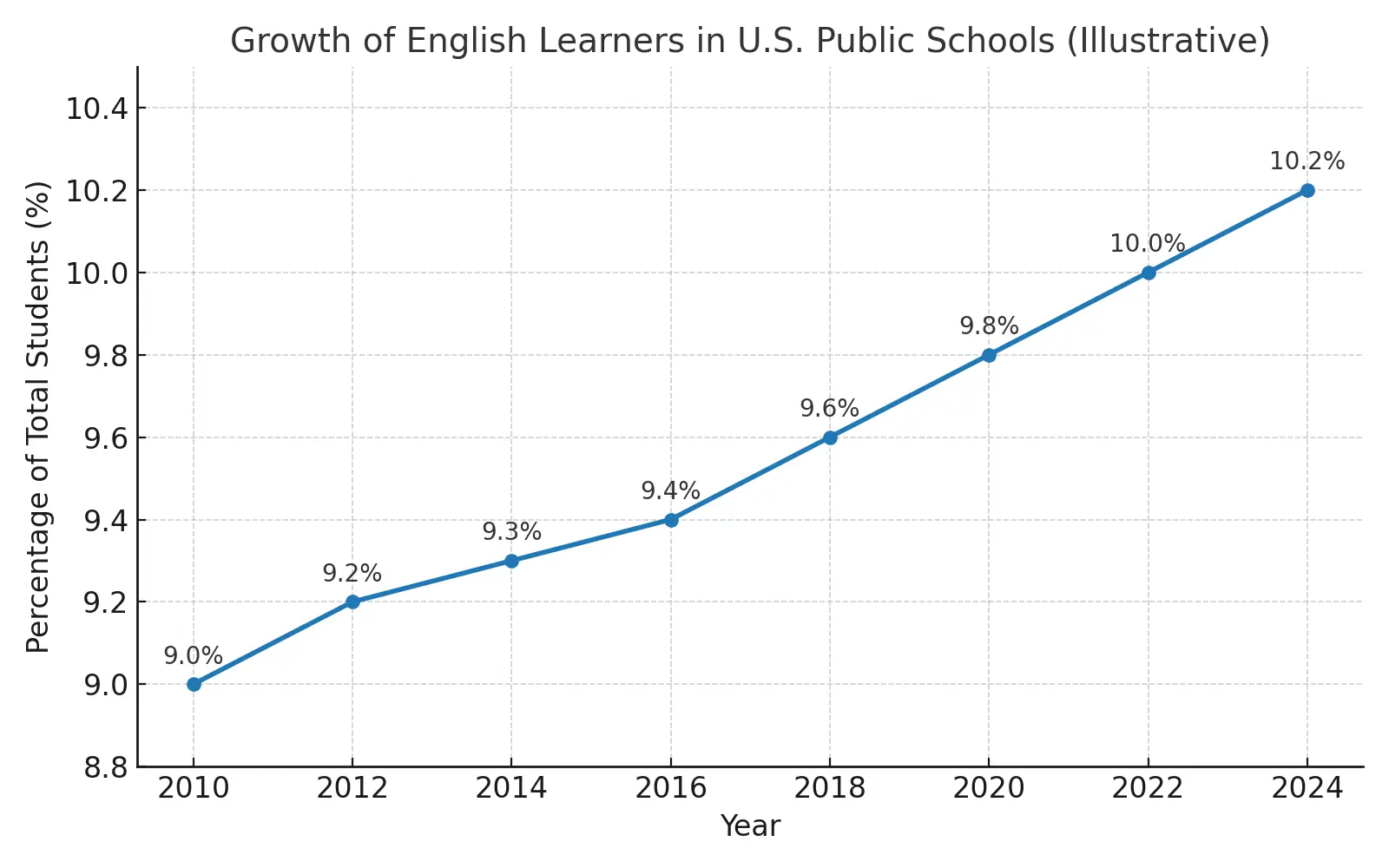
MLEs now make up about 10% of all U.S. public school students, with growth occurring in nearly every state (U.S. Department of Education, 2023). This rise is fueled by shifting immigration patterns, refugee resettlement, and the growth of bilingual families nationwide. As a result, classrooms in both urban and rural districts now include students from a wide range of linguistic and cultural backgrounds (Figure 1).
Figure 1
Growth of English Learners in the U.S. Public Schools
This shift means almost every teacher will work with MLEs during their career. Yet, fewer than half of all teachers have taken even one course on teaching ELs, leaving many unprepared to adapt instruction, scaffold content, or meaningfully engage MLE families. A 2025 RAND survey found that only 10% of principals in schools with multilingual learners ranked MLE-focused professional development as a top priority. Teachers also report a lack of suitable curricula and resources, further limiting their ability to meet MLE needs (Najarro, 2025).
Without training, even dedicated educators may struggle to make grade-level content accessible to students still developing English proficiency. This gap can lead to missed learning opportunities for MLEs and frustration for teachers.
In my current role as Professional Learning Specialist at TESOL, I speak with districts across the country. The same concerns emerge everywhere: general education teachers feel underprepared to work with English learners, while EAL staff are stretched thin and lack opportunities to lead. This is especially true in districts across the Midwest and other regions less accustomed to immigrant populations compared to states like New York or California.
Teachers Want Targeted Training
Encouragingly, educators are asking for more professional learning in this area. English as an additional language (EAL) teachers are twice as likely as their peers to seek PD on adapting curriculum and three times more likely to request training on family engagement (Najarro & Harwin, 2025). Many invest their own time and money to pursue training—a sign of both their commitment and the lack of systemic support.
Professional learning for MLE instruction is not just about boosting test scores—it’s about improving teacher confidence, morale, and retention. Teachers who feel prepared to meet MLE needs often report a stronger sense of purpose, while schools with robust PD programs tend to foster collaboration and consistent instructional practices across classrooms.
Barriers Beyond the Classroom
Even when teachers recognize the value of PD, systemic barriers often stand in the way. Budget constraints and administrative resistance limit opportunities for sustained professional learning. Many administrators worry about taking time away from instruction or covering costs, even when the long-term benefits are clear. Schools can begin with small, embedded approaches such as peer coaching or professional learning communities. Advocacy and creativity are key: when administrators see improved student engagement and teacher retention, they are more likely to support sustained PD initiatives.
Examples of Solutions: SWEL and The 6 Principles
Professional learning can take many forms, and programs such as TESOL’s initiatives provide useful models. Teacher Leadership for School-Wide English Learning (SWEL), for instance, shows how schools can embed expertise by preparing experienced EAL educators to serve as peer mentors and instructional leaders. These coaches support colleagues across grade levels and subjects, helping them adapt lessons without lowering academic expectations.
Similarly, The 6 Principles for Exemplary Teaching of English Learners® offer research-based guidelines that any teacher—regardless of subject or location—can apply. They emphasize practices such as knowing your learners, creating supportive environments, integrating language and content, adapting instruction, and monitoring progress.
Both examples illustrate broader approaches that schools can adapt: building structures for teacher leadership and grounding instruction in consistent, research-informed principles. Whether through TESOL’s offerings or locally developed versions, these strategies help create schoolwide cultures where language development and academic learning are seen as shared responsibilities.
Why This Matters Now
The demographic reality is clear: multilingual learners are not a niche group—they are a central and growing part of the PreK–12 population. Targeted professional learning equips teachers to meet this moment by giving them concrete strategies to integrate language support into every lesson, from early years art to high school algebra.
Programs like SWEL and The 6 Principles illustrate how practical, research-based approaches can build stronger connections between content and language development in every classroom. When implemented at scale, they can transform school culture, making MLE success a shared responsibility.
The payoff is substantial: educators with the proper tools will accelerate English language acquisition, foster academic growth, and build inclusive communities.
References
Najarro, I. (2025, June 19). Teachers aren’t prepared or equipped to teach English learners, survey finds. Education Week.
Najarro, I., & Harwin, A. (2025, June 30). ESL teachers want more PD on curriculum and family engagement. Education Week.
TESOL International Association. (n.d.). Teacher Leadership for School-Wide English Learning (SWEL).
TESOL International Association. (n.d.). The 6 Principles for Exemplary Teaching of English Learners.
U.S. Department of Education, Office of English Language Acquisition. (2023). Educators of English Learners: Availability, Projected Need, and Teacher Preparation.
 Gregory Stancil holds a Master’s degree in TESOL and has over 10 years of ESL teaching experience, along with a background in EdTech business administration. As TESOL International Association’s Professional Learning Specialist, he connects school districts with TESOL’s experts to deliver high-quality, research-based professional learning solutions for educators of English learners.