
“Is My Pronunciation Correct, Sir?”: Utilizing Digital Resources to Improve Pronunciation in EFL Speech Coaching
Ahmad Zubaidi Amrullah, Iowa State University, Ames, Iowa, USA
Introduction
“Is my pronunciation correct, sir?”
This is perhaps the most Frequently Asked Question (FAQ) teachers hear from English as a Foreign Language (EFL) students grappling with pronunciation, an issue that often leads to misunderstandings in spoken communication. While learners’ mispronunciations commonly draw attention, teachers may also observe that students’ speech can still sound unnatural due to difficulties with features such as stress, rhythm, and intonation, which may hinder learners’ overall speaking proficiency.
Developing strong speaking skills is especially important in EFL contexts, where students often lack exposure to authentic practices. One meaningful avenue for showcasing these skills is through speech contests, which have become prominent in many educational institutions. Public speaking empowers students to express ideas effectively and influence others’ beliefs and behaviors, contributing significantly to their self-confidence (Yu-Chih, 2008). However, students often face challenges, including anxiety when delivering speeches in English (Zhang & Ardasheva, 2018). A key linguistic factor is pronunciation, as anxiety frequently stems from a perceived inability to pronounce words accurately, affecting learners' genuine self-representation (Tsang, 2022).
In EFL speech contests, pronunciation is widely recognized as a marker of proficiency, reflecting the naturalness and expressiveness of speakers’ delivery to enhance audience engagement and influence perception. Research shows that foreign language speakers with clearer and more accurate pronunciation are often judged as more educated and socially integrated, affecting their acceptance and credibility (Bashori et al, 2022). Unsurprisingly, pronunciation often contributes significantly to the scoring criteria in speech competitions, playing a significant role in judges’ subjective assessments. Given the significant impact of pronunciation in this context, the present article offers authentic resources and practical strategies to help students address pronunciation challenges in their public speaking performances.
Digital resources for pronunciation practice in speech coaching
In the past years, teachers might merely rely on dictionaries, audios, or recorded videos to teach students pronunciation. As the technology becomes more accessible, teachers can now integrate a range of multimodal resources to support students in developing natural, confident, and intelligible speech. Cambridge English Dictionaryand Google Translate are helpful for quick pronunciation checks, as both provide audio features that allow students to hear how words are pronounced. To strengthen prosodic awareness, students can learn from resources such as TED Talks, Toastmaster speeches, and American Rhetoric, which provide rich examples of effective stress, intonation, and rhythm in authentic public speaking. Most recently, YouGlish has become a key resource, offering diverse native-spoken examples in real-life contexts that can help students internalize pronunciation more effectively. The resources below might be helpful to empower learners to improve their pronunciation in public speaking.
|
Resources |
Link |
|
Cambridge English Dictionary |
|
|
Google Translate |
|
|
YouGlish |
|
|
Toasmaster |
|
|
Ted Talk |
|
|
American Rhetoric |
Dealing with segmental features
EFL students often struggle with segmental features, individual speech sounds such as consonants, vowels, and diphthongs. In my experience, many students with an Indonesian first language (L1) background have difficulty pronouncing words with consonants, such as /θ/ and /ð/ (as in think and this), often replaced with /t/, /s/, or /d/. Another common issue involves distinguishing /v/ and /f/ as these sounds are acoustically close and are not clearly differentiated in the students’ L1. In addition, pronouncing /r/ is especially challenging for students whose L1 includes a rolled or trilled /r/, which influences their articulation in the target language (L2). For the vowels, they often confuse sounds such as /e/, /eɪ/, and /ə/, as well as /ʊ/ and /ɔː/. These segmental difficulties can lead to misunderstandings in spoken communication and hinder overall intelligibility. The nature of these issues may vary depending on the students’ L1.
To address these challenges, teachers could introduce students to basic phonetic symbols to help them use resources like the Cambridge English Dictionary or Google Translate. Students can look up problematic words, examine their phonetic transcriptions, and gain clearer insights into correct pronunciation by focusing on the sounds they frequently struggle with. One practical activity is to have students write the phonetic symbols beneath the mispronounced words in their speech texts and practice them accordingly. Teachers can guide students in using features of the Cambridge English Dictionary, including phonetic symbols, audio pronunciation, and accent options (British/BrE or American English/AmE). For instance, teachers may model how to search for mispronounced words and click the speaker icon to hear how the words are pronounced in the preferred accent style (BrE or AmE), supporting both auditory learning and accent awareness.
Although many digital resources now provide audio models of pronunciation, teaching phonetic symbols remains highly relevant to make students aware of how different symbols are pronounced differently. In my practice, teachers can focus on commonly confused sounds and use contrastive examples between students’ L1 and L2 to enhance their articulation and listening accuracy. Tools like Google Translate allow students to type a word or sentence, click the sound icon, and repeat the pronunciation to improve accuracy. Students can also compare Google Translate with the Cambridge English Dictionary to recognize the difference between machine-generated audio and human-recorded pronunciation. Additionally, YouGlish is a valuable tool for targeting specific pronunciation issues. Students can identify words in their speech that sound unnatural by listing their pronunciation errors and then searching for those words in YouGlish using their preferred accent. By watching how native speakers naturally pronounce these words in authentic contexts, students can gain meaningful exposure and clearer models for imitation.
Dealing with prosody
Students frequently deliver speeches with flat prosody (intonation, stress, and rhythm) largely due to a lack of clear models demonstrating practical prosodic features. In my experience, they often struggle with using appropriate intonation. For example, maintaining a flat or consistently rising tone throughout a speech can make them sound unnatural. They also face challenges using the correct rising intonation for questions and falling intonation for statements. Additionally, many students often misplace word stress (e.g., PREsent vs. preSENT). Rhythm poses further challenges as students have difficulty identifying which words to emphasize, typically content words rather than function words. Unlike English, which uses stress-timed rhythm with reduced unstressed syllables, many students’ L1s are syllable-timed, meaning each syllable is pronounced thoroughly and evenly. This contrast makes it harder for students to adopt the natural rhythm of English speech, for instance:
English: "She WENT to the STORE to BUY some EGGS."
(Content words such as went, store, buy, and eggs are stressed, and function words are reduced.)
Indonesian: "Dia pergi ke pasar membeli telur."
(All syllables are pronounced fully: di-a per-gi ke pa-sar mem-be-li te-lur.
To address stress patterns, students can consult dictionaries to identify which syllable carries the primary stress in a word. For intonation and rhythm, a practical approach involves teaching the distinction between content and function words, combined with shadowing activities (Guskaroska et al., 2025). Using natural English audio or video resources such as TED Talks or Toastmasters speeches, students can practice by shadowing the speakers’ vocal variety to better engage their audience. Encouraging them to incorporate their favorite characters or styles into their speech practice with their own texts can make the process more enjoyable. Additionally, providing opportunities for observation helps students focus on key prosodic features, including (1) rise and fall intonation patterns, (2) strategic pauses and overall tempo, and (3) accompanying gestures or facial expressions.
Another valuable resource for prosodic training is American Rhetoric, which features speech texts by public figures along with accompanying audio. Students can study how rhetorical devices (such as rhetorical questions, repetition, calls to action, etc.) are supported by vocal delivery through audio features on the website. They can also practice shadow reading from the available texts and audios to repeat selected lines with identical intonation, pacing, and rhythm. Learners then shadow a segment: they mimic the speaker’s intonation and rhythm, record themselves, and compare the two versions.
Giving Feedback
In my current practice, students are asked to perform their speeches and upload their video recordings along with the corresponding speech texts to a shared Google Drive folder. I review both the videos and the texts carefully, identifying any words or phrases that sound unclear or unnatural, whether due to segmental errors or inappropriate prosody. To provide targeted feedback, I use the shared Google document to highlight areas of concern and insert links to relevant YouGlish videos that demonstrate how native speakers pronounce those words or phrases in authentic contexts.
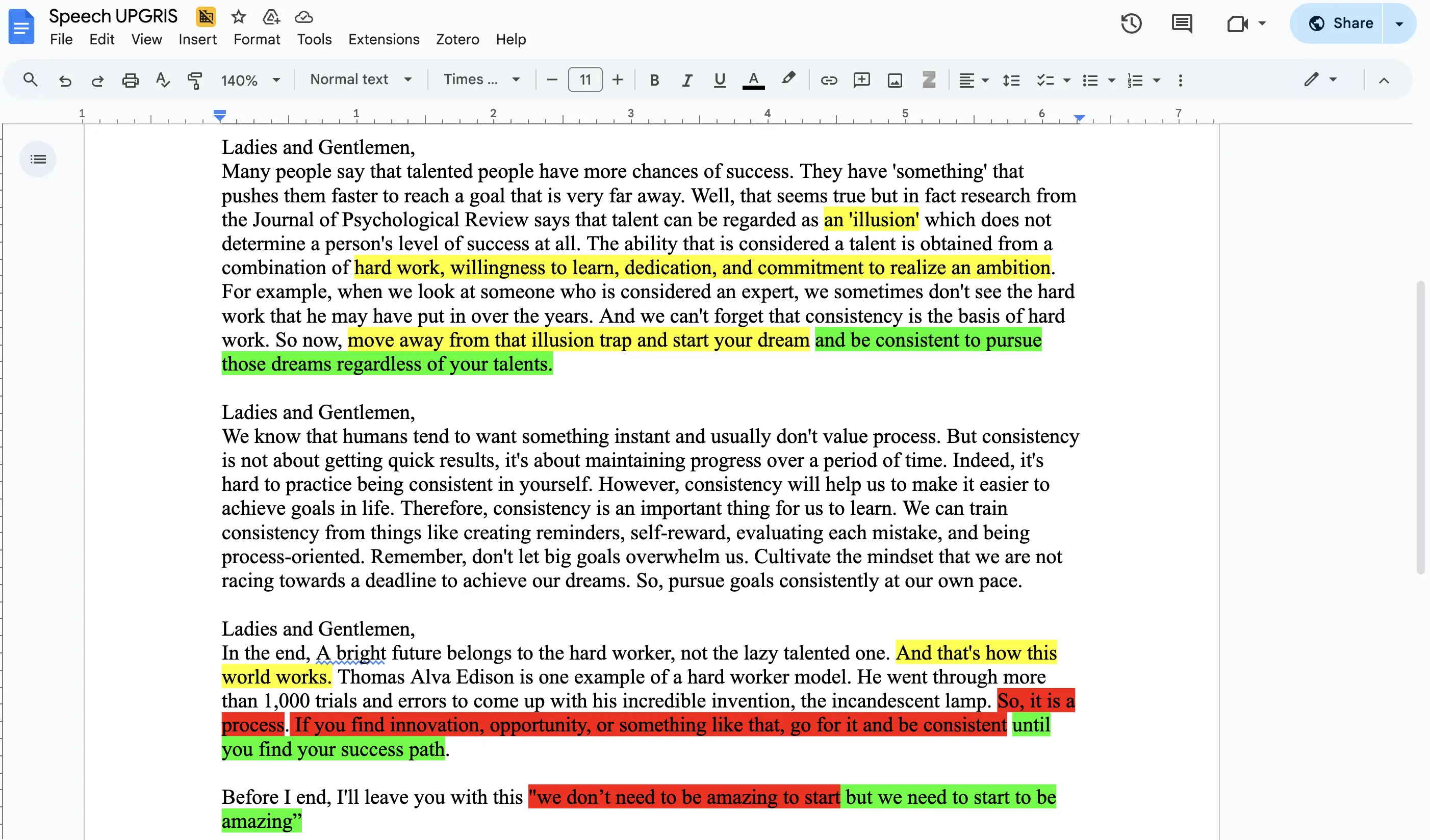
For students struggling with intonation, I occasionally apply a color-coding system to reinforce awareness. For example, I use red to indicate high intonation typically found in questions or emotionally charged statements, yellow to highlight important parts by spelling out the words one by one for emphasis, and green to signal low intonation, which is often associated with certainty or finality. The screenshot below is a sample of how I color-coded parts of the speech text to train students with intonation.
Conclusion and Recommendations
In the early stages of my coaching practice, I primarily used dictionaries to help students develop their segmental pronunciation skills and encouraged them to observe peers or contestants with strong prosodic delivery. As personal computers and smartphones became more accessible, teachers can now guide students to explore a broader range of digital tools for pronunciation practice, including online dictionaries, Google Translate, and YouGlish. I also recommend English speech resources such as American Rhetoric, Toastmasters, and TED Talks. These resources offer authentic, focused examples of public speaking, making them valuable models for pronunciation training.
Coaching EFL students for public speaking is more than polishing pronunciation. It is about empowering them to speak with purpose and confidence. Throughout this process, continuous teacher feedback remains essential to guide students in effectively building pronunciation. While digital resources provide rich exposure and modeling, students still need structured guidance to understand and apply what they observe. By integrating free, user-friendly resources, teachers can scaffold oral skill development in meaningful and personalized ways.
References:
Bashori, M., Van Hout, R., Strik, H., & Cucchiarini, C. (2022). ‘Look, I can speak correctly’: learning vocabulary and pronunciation through websites equipped with automatic speech recognition technology. Computer Assisted Language Learning, 37(5–6), 1335–1363. https://doi.org/10.1080/09588221.2022.2080230
Guskaroska, A., Goodale, E., Kochem, T., Ghosh, M., Compton, L., & Cotos, E. (2025). Oral Communication for Non-Native Speakers of English. https://doi.org/10.31274/isudp.2025.163
Tsang, A. (2022). The relationships between EFL learners’ anxiety in oral presentations, self-perceived pronunciation, and speaking proficiency. Language Teaching Research, 29(4), 1639-1659. https://doi.org/10.1177/13621688221102522
Yu-Chih, S. (2008). The Toastmasters approach: An innovative way to teach public speaking to EFL learners in Taiwan. RELC Journal, 39(1), 113-130. https://doi.org/10.1177/0033688208091143
Zhang, X., & Ardasheva, Y. (2018). Sources of college EFL learners’ self-efficacy in the English public speaking domain. English for Specific Purposes, 53, 47–59. https://doi.org/10.1016/j.esp.2018.09.004
 Ahmad Zubaidi Amrullah is an MA student in TESL/Applied Linguistics at Iowa State University. He has been an English teacher in Indonesia for fifteen years, where he facilitated students to leverage English for competitions and international scholarship opportunities. He is interested in issues such as computer/mobile-assisted language learning, teacher professional development, and gamified instruction.