
Talking, Writing, Mediating: Generative AI for Integrated Communicative Modes In Language Teaching and CLIL/CBIL
Letizia Cinganotto and Giorgia Montanucci, University for Foreigners of Perugia, Italy
In today’s rapidly evolving educational landscape, teachers are increasingly called to prepare students for real-world communication across diverse modes, while adapting to the continuous emergence of digital tools (Cinganotto & Montanucci, 2025). Responding to this dual challenge, a recent teacher training course at the University for Foreigners of Perugia invited educators to explore innovative approaches for integrating Generative Artificial Intelligence (GenAI) into language teaching and Content and Language Integrated Learning (CLIL), also known as Content Based Instruction (CBI). Through hands-on workshops and guided experimentation, participants engaged with GenAI tools to enrich communicative language teaching, designing tasks that reflect both technological fluency and pedagogical depth. In the meantime, teachers developed a reflective awareness of the pedagogical, ethical, and contextual implications of integrating AI into language education.
As part of the professional development course, participants were invited to design CLIL lesson plans and activities aimed at activating all four communicative modes of the CEFR Companion Volume (2020) - reception, production, interaction, and mediation - while experimenting with GenAI tools. Teachers were guided in structuring learning activities in accordance with the action-oriented approach (Piccardo & North, 2019), integrating content learning with meaningful language use, creativity, and real-world engagement. In this context, GenAI demonstrated its potential to support the creation of rich communicative environments, offering valuable affordances for CLIL-based lesson design through AI-powered brainstorming, simulations, content generation, and learner mediation strategies (Cinganotto, 2025).
Following the presentation and exploration of selected AI tools, repositories, and AI-powered platforms relevant to the design of CLIL activities and learning units, participants experimented with the tools and then identified those most suitable for their specific teaching contexts and learning objectives. Starting from the topics they intended to address in their own classrooms, teachers were supported in the design of learning activities through the use of the checklist titled Designing AI-CLIL Activities (Fig. 1), created by the authors, which serves as a practical framework for guiding lesson planning that integrates Generative AI within a CLIL approach. The infographic outlines five key components that ensure pedagogical coherence and learner-centered design. These components include the selection of the activity title and focus, the definition of the activity's learning goals, the identification of the target group, the selection of digital and AI tools, and the integration of the Four Cs Framework (Coyle, 2007).
Figure 1. Designing AI-CLIL Activities: A Checklist for AI-enhanced CLIL Lesson Planning
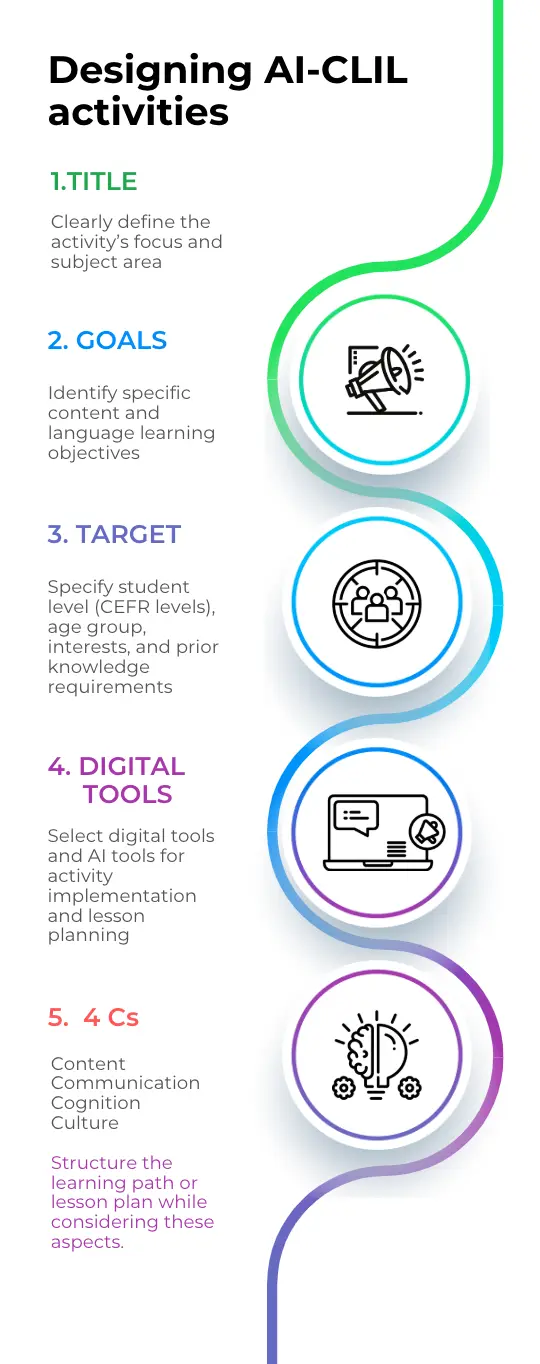
The selection of the activity title and focus prompts educators to begin by clearly identifying the theme and curricular area of the activity, thereby establishing conceptual clarity from the outset.
The definition of the activity's learning goals follows, supporting teachers in formulating specific and measurable objectives that address both subject content and language development, in line with CLIL’s dual-focus approach.
The identification of the target group requires attention to learners’ profiles, including age, interests, prior knowledge, and linguistic competence, as defined by CEFR levels, ensuring that the planned activities are developmentally appropriate and context sensitive.
A key innovation in the framework is the implementation of digital and AI tools, which are strategically selected to support lesson planning, personalise learning paths, facilitate multimodal engagement, and provide real-time feedback. These tools are aligned with pedagogical intentions and the intended learning outcomes.
Finally, our infographic emphasises the integration of the Four Cs Framework, grounding the design process in the core dimensions of Content, Communication, Cognition, and Culture. This ensures that the learning activities promote not only subject knowledge and language competence, but also critical thinking and intercultural awareness, contributing to a holistic and meaningful educational experience.
The model supports the design of multidimensional learning experiences and promotes a scaffolded and purposeful progression of activities, with the components defined and considered in an integrated rather than strictly sequential manner.
This approach is exemplified by the following activity, developed by one of the participants, which reflects a hands-on, action-oriented approach in which GenAI is used to enhance linguistic, cognitive, and intercultural skills for a learner who is, first of all, a social agent. Although the activities designed by the teachers involved English language, the example refers to an interesting upper secondary school CLIL lesson plan for German, titled “Divided Voices – The Berlin Wall” for a B1 CEFR level. The unit focuses on the disciplinary area of linguistics and history, exploring historical content through German, and centred on the communicative theme of human rights, freedoms, and political division. The general objectives were to develop integrated communicative competences through an exploration of the historical context surrounding the construction of the Berlin Wall and the socio-political conditions of the 1960s, and to foster historical awareness, emotional engagement, and critical thinking about life during that era.
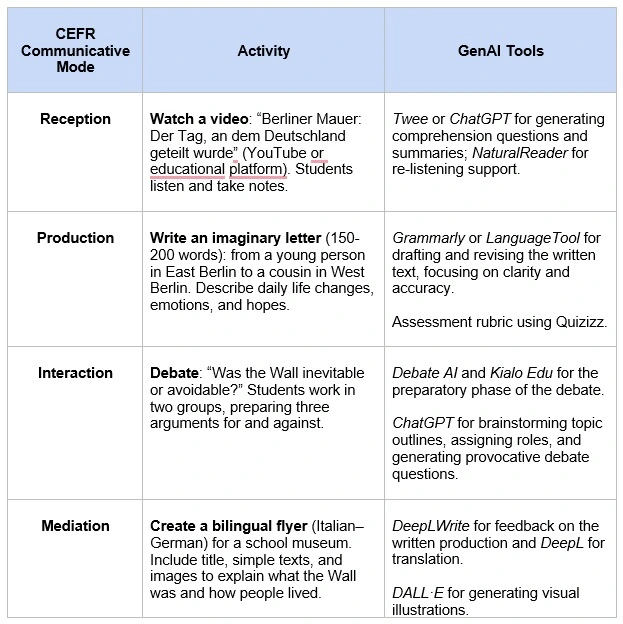
In designing the classroom activities, particular attention was given to the selection of GenAI tools that could enhance language learning and provide added pedagogical value for students. A variety of tools were employed - such as Twee, Debate AI, DeepL Write, and Quizizz - each chosen according to the intended learning objectives and the specific communicative mode addressed (Table 1)
Table 1. Summary design of the CLIL lesson plan “Divided Voices – The Berlin Wall”
Learners are supposed to be evaluated through formative feedback based on CEFR descriptors for each communicative mode. Self-assessment and peer reflection are encouraged, particularly concerning the clarity, coherence, and cultural appropriateness of both language and content.
Another CLIL pathway, developed by one of the participating teachers, centred on the theme “Telling and Planning a Journey” and was designed for B1-level learners of English. The unit was developed with the support of ChatGPT, which used carefully crafted prompts to generate communicative tasks and learning materials. All GenAI outputs were reviewed and selected by the teacher in accordance with the methodological and ethical guidelines introduced at the beginning of the course. The learning sequence aimed to enhance students’ abilities to describe past travel experiences, plan a simple journey, and strengthen both receptive and productive language skills, with particular emphasis on mediation.
For reception, learners listen to audio travel stories and read blogs and brochures in order to extract key information and relevant vocabulary. In terms of production, they write and present personal or imaginary travel narratives, collaborating in groups to design and present a travel plan based on shared preferences and constraints. For interaction, they take part in role-play scenarios, such as dialogues in a travel agency, and participate in classroom debates on different travel styles (e.g., solo vs. group travel). As for mediation, they create a bilingual travel guide by synthesising and adapting information from multiple sources and presenting it to their peers. The unit incorporates a wide range of authentic materials, including travel blogs, websites, brochures, videos, and questionnaires, enriching the learning experience with real-world, contextually meaningful content.
These experiences outline scenarios in which GenAI, when thoughtfully integrated into CLIL planning, functions as a pedagogical ally, supporting the development of communicative, cognitive, and intercultural competences. By aligning GenAI tools with the communicative modes of the CEFR and CLIL principles, teachers are empowered to design methodologically sound, context-sensitive, and future-oriented learning environments – spaces where authentic, purposeful communication becomes the engine of meaningful and transformative language learning.
References
Council of Europe (2020). Common European Framework of Reference for Languages: Learning, teaching, assessment. Companion volume. Council of Europe Publishing. https://www.coe.int/en/web/common-european- framework-reference-languages
Cinganotto, L. (2025). AI-CLIL. Fare CLIL nell’era dell’intelligenza artificiale. La Scuola Sei – Il Capitello.
Cinganotto, L., & Montanucci, G. (2025). Intelligenza artificiale per l'educazione linguistica. UTET Università.
Coyle, D. (2007). Content and language integrated learning: Towards a connected research agenda for CLIL pedagogies. The International Journal of Bilingual Education and Bilingualism, 10(5), 543–562. https://doi.org/10.2167/beb459.0
Piccardo, E., & North, B. (2019). The action-oriented approach: A dynamic vision of language education. Multilingual Matters.
 Letizia Cinganotto, former Senior Researcher at the Italian Research Institute for Documentation, Innovation, Educational Research (INDIRE), currently teaches language teaching at the University for Foreigners of Perugia, Italy, where she is also Rectoral Delegate for International Relations and Member of the Board of Directors and Scientific Committee of the Centre for Language Evaluation and Certification (CVCL).
 Giorgia Montanucci, a PhD candidate in Linguistics and Language Teaching at the University for Foreigners of Perugia, she is a member of the Teaching and Learning Italian with AI and Teaching and Learning Italian as a Second/ Foreign Language in Online Courses: From Design to Assessment Research Groups. Her research focuses on Italian language learning and online courses incorporating GenAI-powered technologies.