

Precision In Practice: Structured Prompting Strategies to Enhance TESOL Instructional Design
Dr. Jasmin Cowin, Ed.D., Touro College, GSE, New York, New York, USA
Introduction: Precision in Practice
A background in prompt engineering helps language educators refine curriculum development approaches, streamline lesson planning, and craft assessments and rubrics that address the diverse needs of multilingual learners (MLs). Educators can direct Large Language Models (LLMs) such as ChatGPT, ClaudeAI, Cohere, Gemini, and others to produce diverse forms of instructional content by crafting prompts to elicit specific language features, ranging from controlled grammar exercises to rubrics.
Structured Prompting Techniques
Structured prompting techniques, such as Chain-of-Thought Prompting (CoT), Few-Shot prompting, Step by Step or Directive Prompts, Meta prompting, and Persona Prompts, create reproducible strategies and methodologies that guide AI systems to generate precise, contextually relevant outputs tailored to multilingual and TESOL-specific needs. These techniques ensure consistency and scalability, enabling language educators to apply reproducible strategies across various instructional and research contexts.
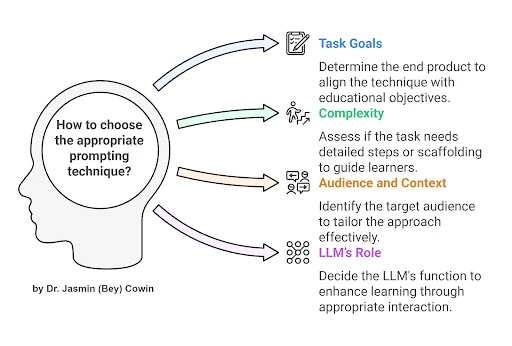
The Anatomy of a Prompt: A Language Educator’s Guide
In language education, structure plays a crucial role in enhancing comprehension and clarity for learners. The same principle applies to creating effective instructional materials. The provided templates are examples of structured prompting frameworks designed for task-specific instructional design in TESOL/ENL/EFL contexts.
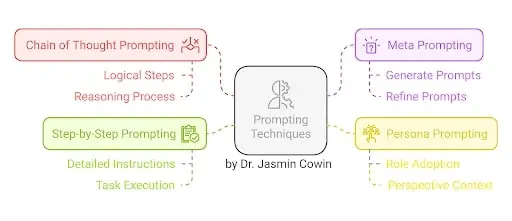
Chain-of-Thought Prompting
CoT prompting refers to a method language educators can employ to design instructional materials by explicitly outlining the logical, sequential steps or instructional steps required to teach a skill or concept. For language educators, each instructional step clearly defines what learners will do and how it prepares them for the next phase of learning. The power of CoT lies in its ability to help educators delegate cognitive load to the LLM, allowing the AI to generate structured instructional sequences or materials. To explore the precision in practice themes the following templates called plug and play were created for readers to insert and experiment with by plugging them into an LLM.
Example of Plug and Play Prompt:
Paste into a LLM:
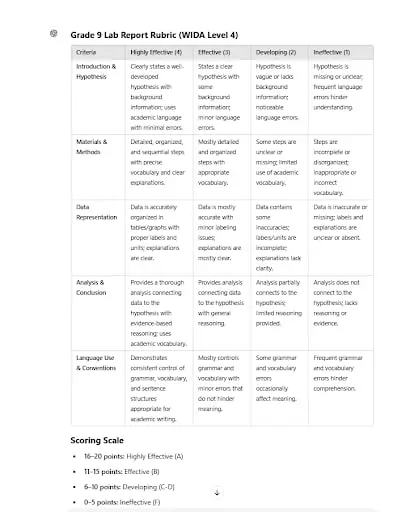
Step 1: Paste into the LLM: “You are a TESOL teacher. Using the following code, give an example to create a rubric for writing a lab report assignment for grade 9, WIDA level 4.”
Step 2: Copy and paste the code below into the LLM.
Rubric Creation Code:
<rubric_template>
Use the following structure to ensure your rubric aligns with the learning goals:
<criteria>
List 3–5 specific skills or competencies students need to demonstrate.
</criteria>
<performance_levels>
Define 3–4 clear performance levels (e.g., HEDI scale/Highly Effective, Effective, Developing, Ineffective).
</performance_levels>
<descriptions>
Provide detailed descriptions for each level, explaining what success looks like. (State performance levels using either WIDA standards or state standards.)
</descriptions>
<scoring>
Add a numerical scale or qualitative descriptors for grading.
</scoring>
Provide the output as a table.
</rubric_template>
Result by ChatGPT:
Meta Prompting
A Meta Prompt is an example-agnostic structured prompt designed to capture the reasoning structure of a specific category of tasks. It provides a scaffold that outlines the general approach to a problem, enabling LLMs to fill in specific details as needed. This approach allows for more efficient and targeted use of LLM capabilities by focusing on the "how" of problem-solving rather than the "what".(Zhang, Yuan, & Yao, 2024)
The following generic meta-prompt allows readers to complete the blanks with their specific information.
Generic Meta-Prompt for Designing a Unit of Study
1. Unit Title and Duration
-
What is the name of the unit?
[Unit Title] -
How long will the unit last?
[Duration: Number of weeks/days/sessions]
2. Learner Profile
-
Who are the learners?
[Age group, proficiency level, specific needs or context] -
What challenges or strengths do these learners bring to the unit?
[Learning challenges or strengths to consider]
3. Essential Questions
-
What are the overarching questions guiding this unit?
- [Essential Question 1]
- [Essential Question 2]
- [Additional questions, if applicable]
4. Learning Objectives
-
What are the goals of this unit?
- Content Objectives: [What learners should know or understand]
- Language Objectives: [The language skills learners need to develop in order to engage with the content. ]
- Skill Objectives: [What learners should be able to do]
5. Unit Structure
-
How will the unit be organized? Outline the focus for each section or timeframe.
- Week 1: [Theme/Skills/Activities]
- Week 2: [Theme/Skills/Activities]
- Week 3: [Theme/Skills/Activities]
- [Add more weeks or sections if needed]
6. Activities and Materials
-
What activities will engage learners?
- Activity 1: [Description of activity]
- Activity 2: [Description of activity]
- [Add additional activities as needed]
-
What materials will support learning?
[List resources such as handouts, videos, real-world objects, etc.]
7. Assessments
-
How will progress be measured?
- Formative Assessments: [Ongoing checks during the unit]
- Summative Assessments: [Final evaluations or end-of-unit tasks]
8. Differentiation and Support
-
How will you support diverse learners?
- Scaffolding: [Sentence stems, visuals, guided practice, etc.]
- Accommodations: [Tailored strategies for different abilities or needs]
9. Reflection and Extension
-
How will learners reflect on their learning?
[Reflection activities or prompts] -
What opportunities will learners have for further exploration?
[Ideas for extension or enrichment activities]”
Persona Prompts
Persona Prompts for LLMs are designed to position the language model within a specific role or scenario, enabling more contextually tailored responses. For example, the model might take on roles like TESOL Specialist, ESOL Classroom Teacher (Grade X), or ENL Writing Instructor for Beginners. The target audience is also explicitly defined, such as third-grade multilingual learners at proficiency Level X or sophomore EFL students. Embedding tasks in these detailed contexts helps the LLM generate responses that align with authentic language use and domain-specific registers, ensuring the output is relevant and pedagogically aligned for the intended audience.
Plug-and-Play Persona Prompt: Speaking Practice Activities
Purpose: Help TESOL teachers design speaking tasks for ELLs based on their ELP level.
Prompt Template:
"You are a Grade [X] TESOL educator in New York State preparing a speaking activity for ELLs at the [ELP Level, e.g., Developing, Expanding]. Using the following text:
[Insert text excerpt here],
Create a scaffolded speaking activity."
Step by Step or Directive Prompt
Step-by-step prompts provide clear, sequential instructions for generating the desired outcome (e.g., a lesson plan). It emphasizes structure and logical progression, guiding the responder through the steps needed to fulfill the request.
Plug-and-Play Prompt for Grammar Lesson Plan Generation:
"Create a detailed, step-by-step [length of time] lesson plan using [lesson plan structure, e.g., SIOP, Communicative Language Teaching (CLT), etc.] for teaching [grammar feature, e.g., present perfect tense] to [Grade X students] with [X English proficiency level, e.g., WIDA Level 3: Developing] on the topic [topic].
The lesson plan should include the following components:
1. Lesson Objectives: Write clear content and language objectives that specify what students will learn and demonstrate about the grammar feature.
2. Activity Scaffolding: Provide logically connected activities:
- Recognition Activity: Include an activity to familiarize students with the grammar feature and key vocabulary through visuals, examples, or demonstrations.
- Controlled Practice Exercise: Design an exercise that guides students to apply the grammar feature in structured, teacher-led tasks (e.g., fill-in-the-blank or sentence frames).
- Contextualized Activity: Create a collaborative activity (e.g., pair work, role play, or discussion) in which students use the grammar feature in a relevant real-life context.
- Independent Production Task: Develop a task where students independently demonstrate mastery of the grammar feature and key vocabulary in writing or speaking.
3. Logical Connections: Ensure each activity builds upon the previous one, with explanations of how the activity prepares students for the next step.
4. Differentiation for English Proficiency: Include scaffolds and supports (e.g., visual aids, sentence stems, graphic organizers) appropriate for the students' proficiency level.
5. Key Vocabulary Integration: Emphasize the use of [list of key vocabulary, e.g., train, bicycle, bus, subway, rush hour, traffic, commute] across all activities.
6. Timing: Allocate a specific amount of time to each activity to ensure a balanced and complete 40-minute lesson.
Sample prompt:
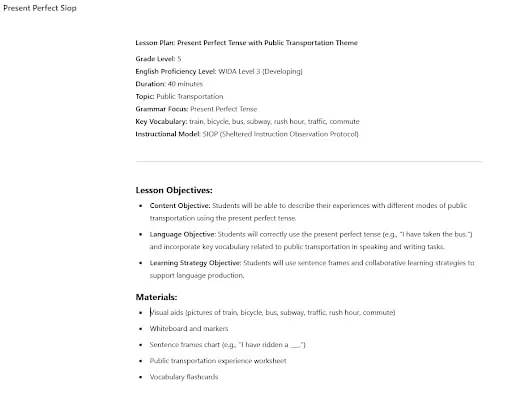
"Create a detailed, step-by-step [40-minute] lesson plan [SIOP] for teaching [ present perfect tense] to [Grade 5] for [students with WIDA level 3, Developing English proficiency] on the topic [public transportation]. Include 7 key vocabularies [train, bicycle, bus, subway, rush hour, traffic, commute]. Ensure the steps are logically connected and include:
- A recognition activity,
- A controlled practice exercise,
- A contextualized activity,
- An independent production task.
Each step should explain how it prepares students for the next."
ChatGPT Output:
Conclusion
Structured prompting represents a practical tool for language educators in creating instructional materials, bridging the gap between pedagogy and technology. The precision with which educators craft prompts plays a pivotal role in directing AI systems to generate meaningful, relevant, and pedagogically sound outputs.
The enclosed Taxonomy of Prompting Pyramid, accessible by clicking, is an infographic that provides a clear and structured guide to various AI prompting techniques, helping educators optimize their interactions with LLM AI systems. Organized from simple to advanced methods, it offers a flow that is accessible to language educators with different levels of prompting experience. Each technique is defined, accompanied by a practical example to illustrate real-world applications and make abstract concepts more relatable.
The effectiveness of AI systems like ChatGPT, Claude, Bing, Gemini, Microsoft, Anthropic Constitutional AI, and others are significantly influenced by the specificity and clarity of the prompts they receive. Structured prompting enables educators to leverage AI's adaptive capabilities effectively while ensuring that instructional content aligns with the needs of language learners. However, implementing precise prompting demands both expertise and careful monitoring of the LLM's outputs. Educators must understand the instructional context, including language acquisition principles, learner needs, and curriculum objectives. Without this expertise, prompts may lack pedagogical grounding or fail to address learners' specific requirements effectively. Over-reliance on AI without critical evaluation can perpetuate flaws, biases, and ethical concerns. Moreover, while prompt engineering is valuable, it is unlikely to remain a future-proof skill; instead, it serves as a transitional phase in the integration of AI into education. Educators must ensure their use of AI is supplemented with human judgment, pedagogical expertise, and a commitment to equity in language education.
References:
WIDA. (n.d.). Can Do Descriptors. University of Wisconsin-Madison. Retrieved January 8, 2025, from https://wida.wisc.edu/teach/can-do/descriptors
Zhang, Y., Yuan, Y., & Yao, A. C. (2024). Meta prompting for AI systems. arXiv. https://arxiv.org/abs/2311.11482
 Dr. Jasmin (Bey) Cowin, is an Associate Professor in the TESOL and Bilingual Department at Touro University Graduate School of Education. Recognized for her academic excellence and leadership in digital education, she was awarded the 2024 Center for Excellence in Teaching and Learning (CETL) Faculty Fellowship for Excellence in Teaching. In addition, she is a member of the AI@Touro team.