
AI Is Multilingual, But Is It Translanguaging?
Brenda Sarmiento Quezada, Purdue University, West Lafayette, US
Introduction
A multilingual teacher opens a generative artificial intelligence (GenAI) tool and asks it to adapt a classroom text for her students. Within seconds, the tool translates the text from English into Spanish, generates a bilingual vocabulary list, and suggests that students discuss the text using both languages. When a student responds using English and Spanish together, the same tool can interpret the response and offer feedback in either language.
At first glance, this may seem like an ideal example of AI-supported translanguaging. Multiple languages are present. Students can move between them. The technology itself appears remarkably multilingual.
But is the presence of multiple languages enough to call this translanguaging?
As GenAI becomes increasingly capable of translating, generating, and responding across languages, multilingual educators face an important conceptual distinction. A technology can be multilingual without necessarily supporting translanguaging. Translanguaging is more than the presence of two or more languages, translation between named languages, or switching from one named language to another. Rather, translanguaging centers how multilingual people draw from their linguistic and semiotic repertoires to make meaning, communicate, learn, and express themselves (García & Wei, 2014).
This distinction matters because AI can easily perform much of the linguistic work that multilingual learners might otherwise do themselves. A student can ask AI to translate an unfamiliar passage, rewrite an idea in English, “correct” a multilingual response, or generate parallel versions of a text. These capabilities can undoubtedly increase access. Yet they also raise a different question: Who is doing the multilingual meaning-making, the learner or the AI?
As educators increasingly explore AI-supported translanguaging, perhaps we need to look beyond what languages an AI system can produce and ask instead what opportunities its use creates, or constrains, for multilingual learners to mobilize their own repertoires.
Multilingual Is Not the Same as Translanguaging
Translanguaging moves beyond an understanding of bilingualism in which multilingual people simply alternate between separate, bounded language systems, centering instead how they strategically and dynamically draw from their linguistic and semiotic repertoires to make meaning (García & Wei, 2014).
This distinction becomes especially important in AI-mediated spaces. GenAI systems can translate passages, respond to prompts written across languages, generate bilingual instructional materials, and provide feedback on multilingual writing. These capabilities can create valuable opportunities for access and participation, particularly when instructional materials or information might otherwise be available only in a dominant language. Yet multilingual fluency does not necessarily translate into linguistic equity. Recent research has identified disparities across languages, preferences for high-resource language information, and cultural and geographic biases even when models respond fluently in multiple languages (Mor-Lan et al., 2026; Sharma et al., 2025).
Yet multilingual output is not, by itself, translanguaging pedagogy. Emerging research suggests that tools such as ChatGPT can help learners activate multilingual resources (Kuzu, 2026), making conceptual precision increasingly important: What exactly makes an AI-mediated activity translanguaging-oriented?
Consider a teacher who asks an AI tool to produce an English version and a Spanish version of the same text. The resulting material is bilingual, and it may be extremely useful. But the interaction still positions English and Spanish as two bounded systems between which content can be transferred. Similarly, asking AI to translate a student's Spanish response into English may make that student's ideas accessible to a wider audience, but translation alone tells us little about whether the student was able to mobilize their own repertoire in constructing those ideas.
This does not mean that translation, language switching, or bilingual materials are incompatible with translanguaging. They can all be resources within a translanguaging space. The difference lies in what the pedagogical environment makes possible for multilingual people. Are learners making choices about the linguistic and semiotic resources they use? Can they combine, adapt, interpret, question, and reshape those resources as they construct meaning? Or has the technology already made those decisions for them?
Seen this way, the question of AI-supported translanguaging cannot be answered simply by counting how many languages appear on the screen. The presence of multiple languages tells us something about what the technology can do; translanguaging requires us to examine what multilingual learners are able to do.
When AI Does the Linguistic Work
Imagine a multilingual learner explaining an idea by writing, “The pig no puede entrar porque the door is too small.” A generative AI system may have little difficulty interpreting the message. But what happens next depends on how the technology is positioned in the learning process.
The system could respond to the learner’s idea as expressed, invite them to elaborate using whatever linguistic resources help them communicate, or help them explore different ways of expressing the same meaning. Alternatively, it could translate the response entirely into English, rewrite it into standardized Spanish, or “correct” it according to monolingual conventions. In each case, the AI demonstrates multilingual capability. Yet each creates a very different space for the learner’s own linguistic repertoire.
This tension extends beyond correction. GenAI can translate a difficult text, summarize it in a preferred language, generate explanations, or compose a response from a learner's ideas. These affordances can reduce linguistic barriers and increase access, particularly for learners navigating instruction through a dominant language. At the same time, support can become substitution.
If GenAI routinely translates before learners have opportunities to negotiate meaning, decides which linguistic resources should be used, standardizes multilingual expression, or generates the language through which learners communicate their ideas, then the technology may gradually assume parts of a meaning-making process that translanguaging pedagogy seeks to recognize and expand.
This creates a paradox: an AI-supported classroom might contain more languages than it did before GenAI without giving learners greater agency over how they use their repertoires.
The issue, therefore, is not whether educators should use AI for translation, feedback, or multilingual material development. Each can serve important pedagogical purposes. Rather, educators might ask what linguistic work the technology is doing, what linguistic work the learner is doing, and why.
So, What Would AI-Supported Translanguaging Look Like?
If multilingual capability alone does not constitute translanguaging, how might educators determine whether AI is supporting a translanguaging space? Rather than beginning with what an AI tool can do, we might begin with what its use allows multilingual learners to do.
Four questions may help.
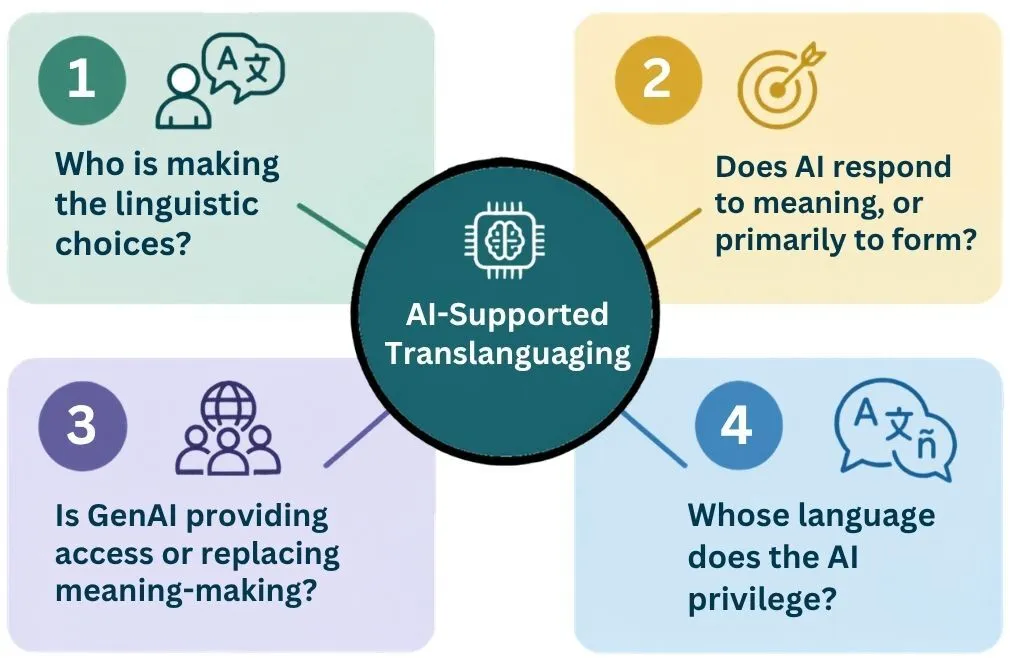
Figure 1. Four Questions for AI-Supported Translanguaging
1) Who is making the linguistic choices?
AI can suggest a language, translate between languages, or offer alternative ways of expressing an idea. But learners should retain meaningful opportunities to decide which linguistic and semiotic resources they use and for what purposes. AI might expand those choices; it should not make them on the learner's behalf.
2) Does AI respond to meaning, or primarily to form?
When learners communicate across named languages or use language varieties that differ from standardized norms, AI-generated “corrections” may alter more than grammar. They can reshape voice, register, cultural meaning, and identity. Before asking AI to correct multilingual language, educators might consider whether correction is actually the pedagogical goal or whether understanding, elaborating, questioning, or communicating the learner’s meaning would be more appropriate.
3) Is GenAI providing access or replacing meaning-making?
Sometimes immediate translation is exactly what access requires. At other times, learners may benefit from encountering a text, discussing it with peers, drawing on prior knowledge, using images or gestures, moving across languages, and negotiating meaning before turning to AI. The question is not whether AI has made the task easier, but whether the support is appropriate for what learners are supposed to be doing and learning.
4) Whose language does the AI privilege?
Multilingual learners do not bring standardized, interchangeable versions of named languages into classrooms. Their repertoires reflect families, communities, regions, histories, and experiences. Educators therefore need to pay attention to what happens when GenAI translates, rewrites, or evaluates those repertoires. Which expressions does it preserve? Which does it change? What does it label as incorrect or inappropriate? And whose linguistic norms become the default?
These questions shift our attention from the number of languages an AI system can produce to the relationships among technology, pedagogy, and multilingual learners. GenAI may indeed become a powerful resource within translanguaging spaces. But that possibility depends less on whether the technology itself is multilingual than on how educators and learners position it within the meaning-making process.
Conclusion: Keeping the Multilingual Learner at the Center
GenAI's growing multilingual capabilities offer real possibilities for bilingual and multilingual education, from greater access to information to multilingual materials and communication.
But multilingual education should resist equating technological multilingualism with translanguaging.
The presence of Spanish beside English, an instantaneous translation, or an AI-generated bilingual text tells us what a technology can produce. It does not tell us whether multilingual learners have been invited to mobilize their repertoires, make linguistic choices, negotiate meaning, or express identities and knowledge on their own terms.
Perhaps, then, the most useful question is not whether GenAI is multilingual, but what happens to multilingual learners' translanguaging when AI enters the meaning-making process.
Translanguaging has always centered multilingual people and what they do with their linguistic and semiotic resources. As GenAI becomes increasingly present in multilingual education, that human center matters more, not less. GenAI can translate, generate, suggest, scaffold, and respond. But if we want to describe its use as AI-supported translanguaging, multilingual learners must remain more than recipients of multilingual output. They must remain the meaning-makers.
References
Garcia, O., & Wei, L. (2014). Translanguaging : Language, Bilingualism and Education (1st ed. 2014.). Springer Nature. https://doi.org/10.1057/9781137385765
Kuzu, T. E. (2026). AI-Supported Translanguaging Processes in Primary School: Empirical Insights into ChatGPT’s Role in Multilingual Interactions. Technology, Knowledge and Learning. https://doi.org/10.1007/s10758-026-09974-7
Mor-Lan, G., Goldman, O., Eyal, M., Gilady, A. M., Eiger, S., Szpektor, I., Hassidim, A., Matias, Y., & Tsarfaty, R. (2026). Location Not Found: Exposing Implicit Local and Global Biases in Multilingual LLMs. https://doi.org/10.48550/arxiv.2604.19292
Sharma, N., Murray, K., & Xiao, Z. (2025). Faux Polyglot: A Study on Information Disparity in Multilingual Large Language Models. https://doi.org/10.48550/arxiv.2407.05502
 Brenda Sarmiento Quezada, PhD, is an Assistant Professor of Literacy and Language Education at Purdue University. Her research focuses on bilingual and multilingual education, translanguaging, teacher education, and the intersections of emerging technologies and multilingual learning.