
Virtual Reality and ITA Hometown Presentations
Frederick Dunn, Oral English Proficiency Program, Purdue University, West Lafayette, IN USA
When I first encountered virtual reality (VR) as a graduate student at the University of Illinois at Urbana-Champaign, I was skeptical. Most of the applications I tried resembled video games filled with cartoon-esque environments and avatars. Authenticity has always been central to my teaching, and those early VR environments felt far from the authentic materials I wanted to bring into the classroom.
Several years later, VR had changed and the apps gained a new level of realism that made me reconsider their use. While exploring the Meta Quest library, I discovered an application called Wooorld. Instead of placing users in imaginary settings, Wooorld allows people to explore real locations around the world using immersive 360-degree imagery. Users can walk through neighborhoods, visit landmarks, and share locations with others in a shared virtual space.
As I explored the app, I realized my international teaching assistants (ITAs) could do something that had never been possible in the classroom before. Instead of describing their hometowns, they could actually take their audience there.
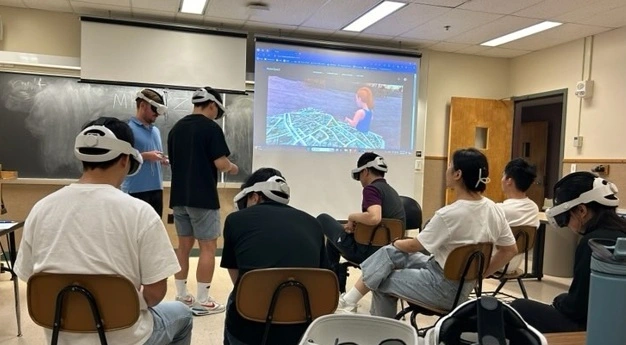
As part of an oral communication course for ITAs, I incorporated a VR activity in which graduate students guided volunteer undergraduate students through their hometowns using Wooorld. Through immersive street-level imagery, students shared places that were personally meaningful while practicing the kinds of instructional communication they would later use as teaching assistants.
ITAs shared neighborhood streets, local markets, university campuses, historical landmarks and places connected to family memories. Some guided their audience to their families’ front door, while others introduced locations that represented important aspects of their culture.
One of the stronger positives of these VR presentations was how it engaged the audience and fostered conversations. Instead of speaking about their hometown or culture from a memorized script, they spoke spontaneously as they recognized the features of the places being visited. The environment encouraged questions and discussions that would have been near impossible to recreate without VR.
Given that the activity focused on places the students knew well, they spoke with greater confidence. They were not trying to remember a speech, they were making an effort to explain the places that they know.
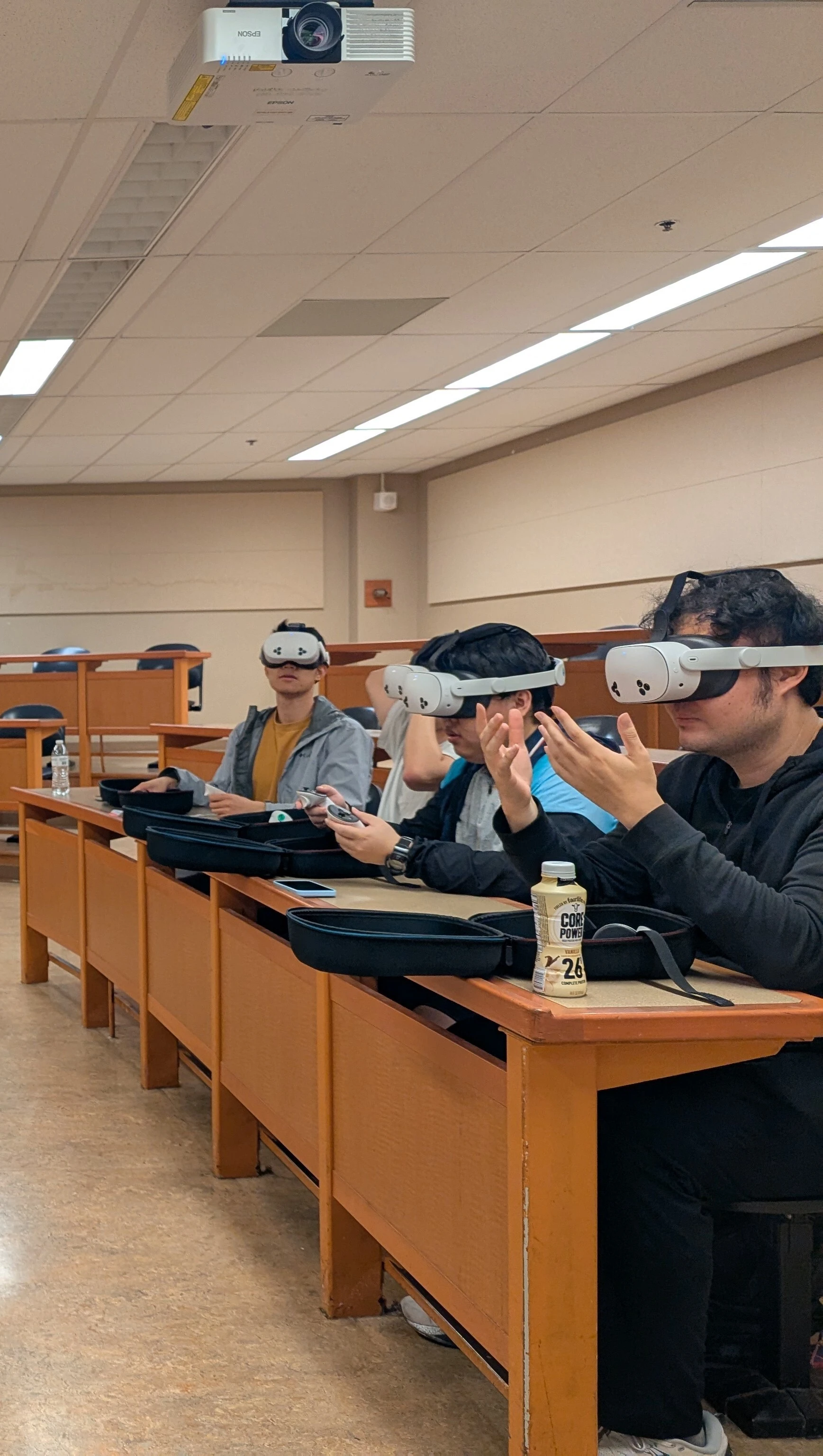
While the activity centered on hometown tours, the communication skills were not only cultural. Many ITAs will eventually teach laboratory or discussion sections where they must guide students through procedures, explain equipment, and direct students. The VR environment in Wooorld provides a prime opportunity for this practice. Students were given target language (directives) to help direct students in the Wooorld app, such as these:
- Look to the left/right of the (noun)
- Can you find the X (noun)
- Tell me what do you see next to the (noun)
These directives became meaningful because the audience needed them to orient and identify the talking points for the presenters. It also required the presenters to check for understanding and confirm that the audience had successfully followed the directives given.
Initially, I worried that the headsets would potentially be too distracting and that the students’ focus would be primarily on the technology itself. However, as the students used the technology the focus changed. During the first class, students were fascinated by the technology. They experimented with the controllers, explored the virtual environment, and became comfortable navigating Wooorld. By presentation day, the conversation and interest of the students were no longer the VR headsets. The focus and conversations were on family traditions, neighborhoods, food, university and other cultural components. The headsets became invisible and VR was clearly a tool for language and not the technology for its own sake.
Like any new instructional technology, this VR activity had some challenges. A few students experienced mild dizziness during the first session with the headsets, so scheduling short breaks proved helpful while students adjusted to the devices.
Another unexpected challenge involved giving directions. Expressions such as “look to your left” or “turn to your right” often caused confusion because participants were facing different directions in the virtual environment. Students learned that they needed a reference point, like visible landmarks, to make the use of “left” and “right” effective. Such as “look to the left of the tallest building.”
One of the largest takeaways I learned was that technical problems did not have to interrupt learning. Whenever students encountered difficulties, troubleshooting became another opportunity to communicate. Explaining what the students were seeing, asking classmates for help, and collaboratively solving problems all required meaningful language use that an ITA would encounter.
This experience also changed the way I think about VR in language education more broadly. Today, thousands of VR applications are available, yet only a small number were designed specifically for language learning. This does not mean, however, that language instructors cannot adapt existing apps for language learning, like Wooorld in my case. As I developed this activity, I often wished there were a place where language educators shared their experiences using different VR applications. Technical forums explain how software works, but they rarely discuss how instructors can adapt those tools to support language learning.
I hope that as VR increases in popularity there could be a shared source where language educators could contribute short reviews of VR applications from a teaching perspective. Instead of simply reviewing whether an app is entertaining, contributors could describe the following:
- The language skills the app helps develop
- Proficiency levels for which it is appropriate
- Examples of how the app was implemented for learning
- Common technical challenges
- General practical tips for the app
This collection could help instructors avoid reinventing the wheel and give insights to make the implementation smoother from the start.
When I first encountered virtual reality, I assumed it had little to offer language education. What changed my mind was watching ITAs confidently guide their audience through places they called home while practicing the communication skills they would soon use in their own classrooms. When thoughtfully integrated, VR can create authentic communicative experiences that were previously difficult or impossible to achieve in the language classroom. As more educators experiment with VR, I hope we are willing to share both our successes and challenges. The shared collection of these experiences can help elevate our students and our field.
 Frederick Dunn is a lecturer in the Oral English Proficiency Program at Purdue University and a Ph.D. student in Engineering Education. He also serves as a U.S. Department of State Virtual English Language Educator. His teaching and research focus on English for Specific Purposes (ESP) in engineering contexts, international teaching assistants, corpus linguistics, and emerging technologies for language learning.
Author's note: ChatGPT (OpenAI) was used for proofreading and language editing.