

Technology-Enhanced Language Learning: Designing and Implementing Gamified Corpus-Based Activities for Second Language Writing
Hui Wang, Bernard Cassie, Alona Kladieva, Anh Dang, Samuel Gnaore, and Dr. Shelley Staples, The University of Arizona, Tucson, Arizona, USA
Gamifying corpus-based activities
A corpus is a large collection of texts used for language analysis. As corpus techniques become popular in helping us to understand how language use differs across genres, we are seeing more opportunities to use corpora for material design and implementation. Our project aimed at developing and implementing corpus-based materials for first-year second language (L2) writing courses. The corpus-based materials were developed using the Corpus and Repository of Writing (Crow), a learner corpus containing texts across different writing assignment drafts from foundational composition courses across three universities (University of Arizona, Northern Arizona University, and Purdue University). While we have had success in creating and implementing these materials, there was a demand for stronger student engagement, motivation, and collaboration in corpus-based instruction (Dang et al., 2023; Wang et al., 2023), as active collaboration boosts participation and varied language learning strategies (Lu & Churchill, 2014).
Gamification has been proposed as an effective strategy to help students cooperate toward shared goals, develop learning communities, and build motivation (Reinhardt, 2019). Game elements, such as points, can serve as catalysts to change traditional learning methods and contexts (Sailer & Homner, 2020). However, there are limited accounts of how to integrate game elements with corpus data to enhance students’ academic writing skills. In this article, we discuss the gamification of corpus-based materials as an effective strategy to foster student engagement, motivation, and collaboration.
Context and game design
For the design and implementation of these gamified corpus-based activities, we focused on the context of first-year L2 writing classes, where students need to develop rhetorical analysis and research writing skills. These activities were developed with the goal of enabling students to better understand and diversify their use of evaluative adjectives, crucial for expressing opinions in a summary and a summary and response assignment. Within these assignments, students were expected to not only summarize a given reading but also to provide a thoughtful analysis as a response. Our games were implemented by two graduate student teachers, who are also the first two authors of the article, in one class session for three separate sections of the same class during Fall 2023. The participating instructors included one MATESL student and one PhD student in Second Language Acquisition and Teaching. They have both taught first-year L2 writing classes for over a year.
The class began with a word frequency list of evaluative adjectives derived from Crow (see Figure 1) and an introduction to the corpus. Students were guided to analyze the list and answer questions. This part aimed to enhance students’ understanding of the functions of evaluative adjectives and the benefits of using less common adjectives in their writing.
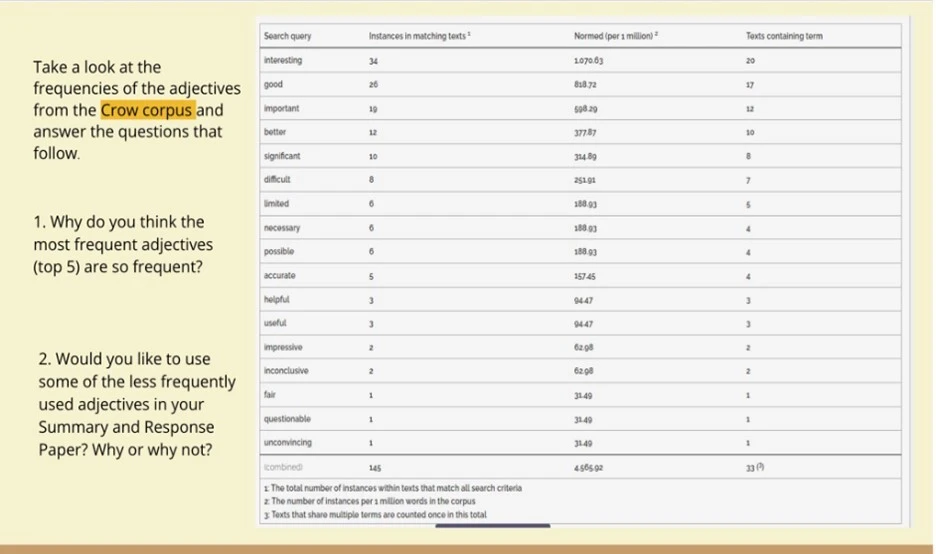
Figure 1. Word frequency list and questions
Find and Replace
The first game focused on an individual competition called “Find and Replace” designed based on a list of evaluative sentence examples derived from Crow (see Figure 2). In this game, students worked individually to identify adjectives that express opinions in the provided sentences. Their task was to brainstorm as many alternative evaluative adjectives as possible within five minutes to replace the original ones. Then, the instructor evaluated grammatical and syntactical accuracy and awarded points for appropriate adjectives.
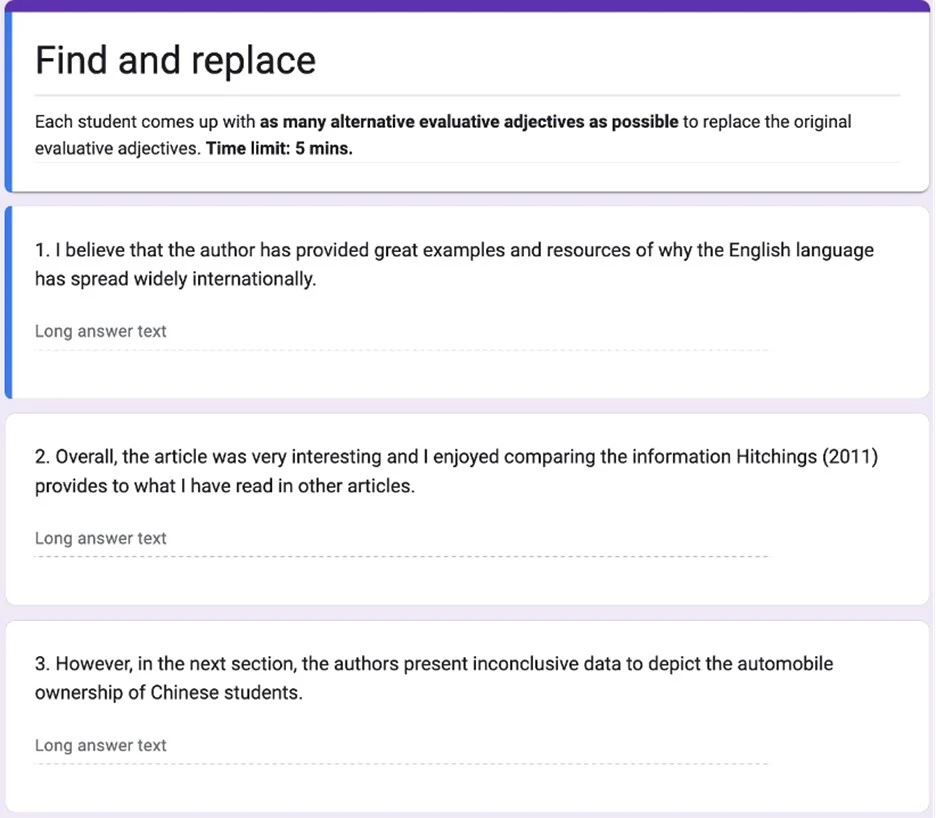
Figure 2. Find and replace
A leaderboard was presented to show the top three winners, who earned the privilege of selecting awards and served as three leaders of the subsequent team competition. There were three different awards for the next game (see Figure 3). The first-place winner chose their award first, followed by the second and third winners, each choosing from the remaining awards without repetition. The purpose of this game was to encourage students to analyze authentic learner samples and identify evaluative adjectives in contexts. The game’s competitive element and time constraints were strategically designed to enhance student involvement and concentration on the learning goals.
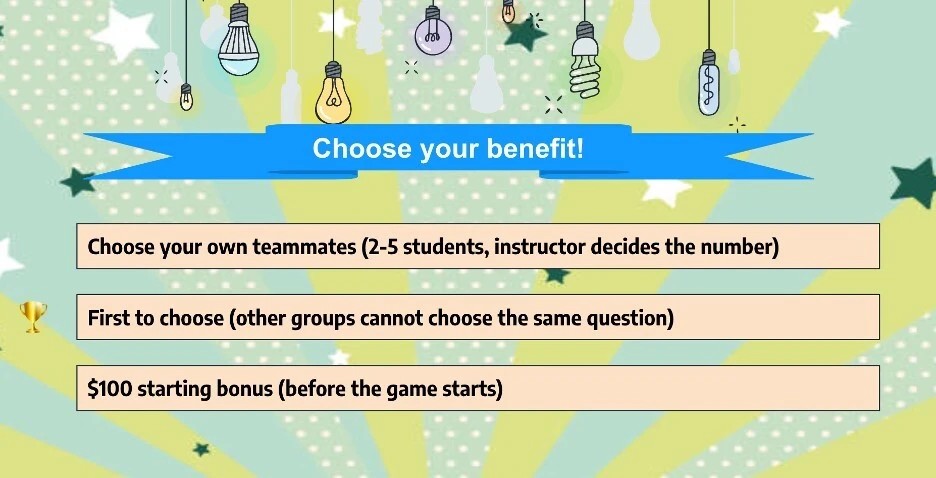
Figure 3. Awards for the winners
Jeopardy
The follow-up activity introduced a modified version of the game show Jeopardy, where students were tasked with creating sentences with evaluative adjectives from Crow. In this game, students were divided into three groups led by the three winners with different benefits from the last game.
The game featured three categories of evaluative adjectives (positive, neutral, and negative) and three levels of difficulty indicated by labels: $200, $400, and $600 (see Figure 4). Groups took turns choosing a category and level (e.g., positive, $200) without repetition. Then, they were asked to create as many sentences as possible with the evaluative adjectives in the selected category and level.
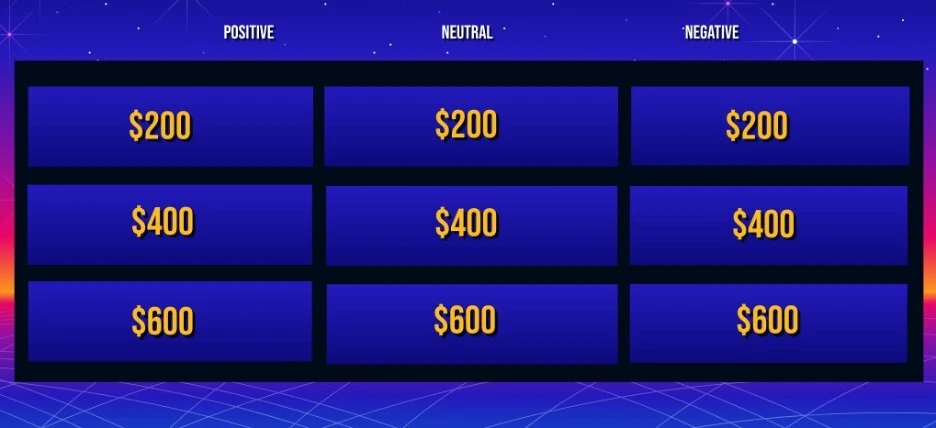
Figure 4. Jeopardy game
To contextualize the sentence creation, students were required to relate sentences to an article they were assigned to read before this class. Although the game was designed to last for three rounds with a five-minute limit each, teachers can modify the number of rounds or the time to address time constraints. The collaborative nature of the game encouraged students to think critically about using evaluative adjectives in a contextualized manner. The competitive element can increase students’ motivation, as they interact with learning materials and strive to lead their teams to the top of the leaderboard. At the end of each round, the instructor assessed the appropriateness of their answers and awarded points based on their category and level. For instance, a group that selected Positive (category), $200 (level), and successfully generated appropriate sentences within five minutes, would receive $200 whereas teams that failed to generate an appropriate sentence within five minutes would be penalized by having $200 deducted from their total points for that round. The group that generated the most sentences at the end of each round earned another $100 bonus. The scoring system was designed to reinforce the importance of quality and efficiency in creating sentences during the game.
In the end, students needed to write a reflection (50 words for the 1st runner-up and 100 words for the 2nd runner-up) of their learning experience. This task allowed students to revisit the evaluative adjectives used in class, which helped consolidate the acquired knowledge and contributed to a deeper reflection on the learning process.
Instructor and student feedback
Two of the authors implemented the activities across three classes and found that the gamified corpus-based activities effectively reshaped the classroom dynamics and increased student engagement. The authentic student samples derived from Crow were approachable and relatable for students, which allowed them to actively participate in Find and Replace, trying to identify and use more alternative evaluative adjectives to win the game. Team collaboration was evident in Jeopardy when students worked together under time constraints to write more sentences using provided evaluative adjectives from the corpus. Students supported each other in selecting evaluative adjectives and produced more sentences for team success. Additionally, the award system connected the two competitions and added another layer of engagement to the learning process. It also offered a sense of accomplishment that heightened motivation throughout their learning.
Students’ reflections also indicated that this class was an engaging and enjoyable learning experience. Many students highlighted that teamwork and competition fostered their interaction, critical thinking and language awareness, leading it to become a fun and impactful class.
Conclusion
This article presented two gamified corpus-based activities designed to aid L2 students in learning evaluative adjectives, aiming to enhance student engagement, motivation, and collaboration in corpus-based instruction. By integrating corpus-based activities with interactive games, students could collaboratively work to acquire information from corpus techniques and effectively apply evaluative adjectives in their writing. These activities have been conducted in first-year L2 writing classes in the US. With modifications, these activities can serve for vocabulary learning across various proficiency levels. For instance, they could be adapted to include other corpus findings, such as corpus-based word lists for teaching different language structures like phrasal verbs. Adopting these methods allows teachers to foster an interactive learning environment, thereby enhancing student participation, motivation, and collaboration in L2 writing classes.
References
Dang, A., Wang, H., Conrad, N., & Staples, S. (Mar, 2023) “How is it done?” A qualitative analysis of using corpus-based materials to teach L2 writing [Conference presentation]. American Association for Applied Linguistics 2023, Portland, OR, USA.
Lu, J., & Churchill, D. (2014). The effect of social interaction on learning engagement in a social networking environment. Interactive Learning Environments, 22(4), 401–417. https://doi.org/10.1080/10494820.2012.680966
Reinhardt, J. (2019). Game-informed L2TL. In J. Reinhardt, Gameful second and foreign language teaching and learning (pp. 173–191). Springer International Publishing. https://doi.org/10.1007/978-3-030-04729-0_7
Sailer, M., & Homner, L. (2020). The gamification of learning: a meta-analysis. Educational Psychology Review, 32(1), 77–112. https://doi.org/10.1007/s10648-019-09498-w
Wang, H., Dang, A., Conrad, N., & Staples, S., (Mar, 2023) “Is it effective?” Exploring L2 writers’ writing performances and perceptions of corpus-based materials for summary and evaluative research practices [Conference presentation]. TESOL Convention & English Language Expo 2023, Portland, OR, USA.
Acknowledgements:
Funding for this project includes a grant from the University of Arizona Center for University Education Scholarship (CUES).
 Hui Wang is a Ph.D. candidate in Second Language Acquisition and Teaching (SLAT) program at the University of Arizona. She has taught first-year writing classes since 2021. Her teaching and research interests include corpus-based pedagogy and technology-enhanced language learning.
 Bernard Cassie is a second-year MA TESL student at the University of Arizona. He has taught first-year writing classes at the University of Ghana and has been in the writing program at the University of Arizona since 2022. His research interests include corpus linguistics, technology-enhanced language learning and second language writing.
 Alona Kladieva is a Ph.D. student in Second Language Acquisition and Teaching at the University of Arizona. She focuses on second-language writing, corpus-based pedagogy, and gameful learning. She has been teaching English since 2018 and currently teaches first-year writing classes.
 Anh Dang is a Ph.D. candidate in Second Language Acquisition and Teaching (SLAT) at the University of Arizona. Her research interests lie in second language writing, outreach initiatives for supporting instructors and students in their courses, multilingualism, and corpus linguistics.
 Samuel Gnaore is an MA TESL student at the University of Arizona, interning as a junior instructional designer at the university's digital learning department. His research focuses on educational technology in second language teaching and learning.
 Dr. Shelley Staples is an Associate Professor of English and SLAT at the University of Arizona. She has taught second language writing for over 20 years. Her research interests include the use of corpora for writing instruction and her publications can be found in TESOL Quarterly, Journal of Second Language Writing, and Journal of English for Academic Purposes among others. She is a PI for the Corpus and Repository of Writing (Crow) project.