
Meet the Experts: An Interview with Umida Hakimova
Umida Hakimova, University of Warwick, United Kingdom
Interview conducted by Ryan Good, TEACH Fellow at the Association of International Cultural and Educational Exchange, Taiwan
Ryan: Tell us who you are as a TESOL person.
Umida: Over the twenty years of my teaching journey, I have taught English from secondary to tertiary education and across diverse age groups, from 11 to 25. A particularly influential stage in my professional development was my participation in the Teaching Excellence and Achievement programme at the University of Nevada, Reno, in the US. This programme enabled me to collaborate with teachers from twenty-two countries around the world. Although we came from different countries, cultural backgrounds and contexts, we shared a common goal: to improve our teaching skills. In other words, TESOL connected us in a meaningful way. We exchanged ideas and learnt a lot from each other.
Inspired by this experience, I decided to strengthen my academic and research skills. I completed an MA in TESOL at the University of Warwick in the UK and gained deeper insights into language education and research. Currently, I am pursuing my doctoral studies at this university, aiming to investigate young learners` experiences and perceptions of learning English.
This ongoing journey has been shaping my teaching beliefs, deepening my understanding of my role as an educator and inspiring me to explore more effective ways of teaching. I view learning and teaching English as a bridge that connects people and cultures through communication. As an educator, my role is to create opportunities for such communication and empower learners to develop confidence, creativity and agency through language education.
Ryan: Could you talk a little about TESOL in Uzbekistan? How would you describe the current state of SLW there? What opportunities and challenges do you see for multilingual learners in your home country?
Umida: There have been many reforms that aimed to enhance TESOL in Uzbekistan. Nationwide projects such as English Speaking Nation (ESN) and Accelerating English Language Teaching in Central Asia (AELLCA) have supported teachers` professional development; new textbook series for schools and online learning platforms, such as Ibrat Farzandlari, have broadened access to learning English.
Reforms in the assessment of English language skills have encouraged both students and teachers to improve their language skills. It has become a strong requirement to have a CEFR B2 level to be admitted to PRESETT programmes, and students with B2 levels are exempt from the English section of the entrance exams in other programmes. Salary bonuses are provided for foreign language teachers who have C1 levels, while the B2 level has become a minimum requirement to teach English at school. Through these reforms, attention to writing has increased, a skill that received little focus until recently. Both students and teachers improved skills in brainstorming, structuring and understanding genres mostly by preparing for these exams.
To have a deeper view of attention to writing in schools, I analysed the curriculum and textbooks for grades 4 and 11 using Ivanič`s (2004) Discourses of Writing (DoW) framework. As the findings revealed, the “Guess what?” textbook for grade 4 focuses on skills and guided process but lacks sufficient creative writing opportunities. The “Prepare” textbook for grade 11 prioritises skills, process and genre discourses, integrating peer collaboration and feedback. However, creativity and thinking discourses appear to be marginalised even in this final grade at school. This trend can be observed in the curriculum, which tends to put more emphasis on form rather than meaning, restricting students` creativity.
My own observations over two decades of teaching align with these findings. Many learners have limited critical perspectives and confidence in writing. In most cases, writing is regarded as preparation for an exam, not a space for reflection or communication. To address these challenges, there is a need for a balanced approach that integrates creative and reflective tasks with exam preparation. Teachers` guidance and useful feedback are of great importance, as they can help learners view writing as a way of communication and reflection, but not merely as an exam requirement.
Ryan: What person or experience has had the greatest impact on your research and career development in TESOL?
Umida: I still recall the moment I started teaching in the Access-STEM programme in Dustlik Academic Lyceum in Namangan, which marked a turning point in my teaching career. At that time, my teaching depended on traditional, teacher-centred methods, as I was trained in these approaches during both my schooling and undergraduate studies. However, the Access-STEM programme syllabus was primarily based on communicative principles, and I noticed that my “old teaching style” was no longer effective. During this transformative period in my teaching practice, observing my colleagues` lessons and sharing ideas with them was extremely helpful. The ongoing support provided by my mentor, Muborak Ismailova, the program coordinator, was invaluable. She used to say, “Karnaychidan bir puf” in Uzbek (English equivalent: “It`s not rocket science”), encouraging to keep moving forward and try innovative approaches confidently.
I gradually incorporated creative, interactive and problem-solving activities into the lessons and this increased students` motivation to learn English. Over time, students became more engaged in the lessons, started to work together and their language skills improved considerably. I still remember how enthusiastically they participated in the Toothpick Bridge and Eco House projects and created their first digital stories collaboratively.
My teaching beliefs changed in tandem with these shifts in my teaching practices. I began to view language education as a space for students to improve their language skills through collaboration and agency, a principle that has become central in my professional development.
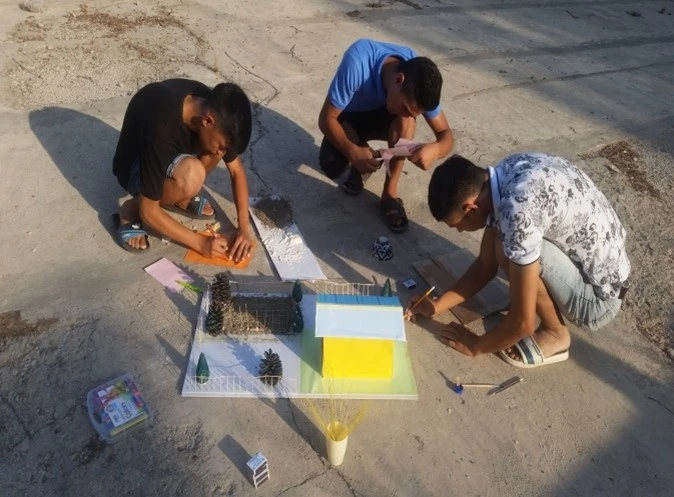
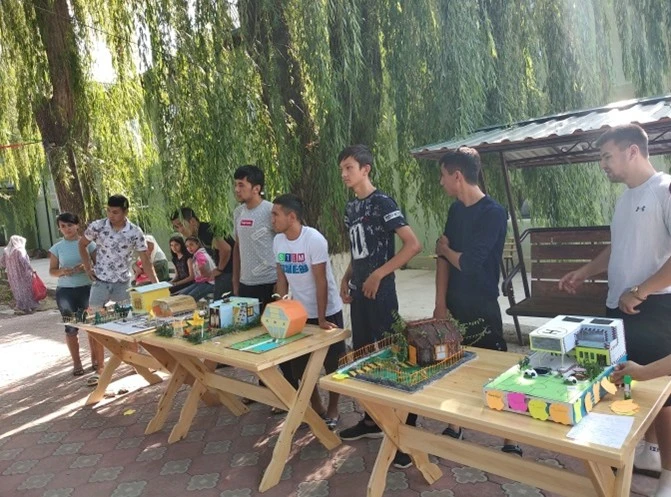
Summer intensive sessions in the STEM programme: Eco House project
Ryan: How do you incorporate writing tasks with young learners? Could you share a specific activity or approach that has been particularly effective in your experience?
Umida: In traditional teacher-centred approaches, learners` active roles are often minimised due to the emphasis on presentation, controlled practice and limited free production (Skehan, 2021). In contrast, task-based language teaching (TBLT) places the learner at the heart of the learning process, drawing on principles of learning by doing, personal relevance and developmental progression (Ellis et al., 2020). As part of my doctoral research, I have developed TBLT materials for primary school students, integrating collaboration, creativity and meaningful interaction into tasks. In addition to scaffolded writing opportunities, I included a space for students to improvise and design their own tasks. For example, in storytelling and drama tasks, the pre-task phase includes facilitating tasks to help build schemata and personalisation. In the main task phase, students listen to the given story using visual aids and engage in drama techniques such as freeze frames and thought tracking (Farmer, n.d.). In the post-task phase, language awareness is included through focus on form tasks and reflections. This pre-task, task and post-task process is repeated twice and then students are asked to rewrite the story in pairs or individually in accordion-shaped booklets, which they make and decorate themselves. In the final lesson, students are given greater autonomy: they create their own stories based on the given prompts, collaborating in small groups, using their imagination and fantasy. This scaffolded process helps learners to develop confidence in writing and perceive it as an enjoyable form of communication and creativity.
Ryan: Having successfully navigated academic writing in English for your own research and professional development, what advice would you offer to established TESOL professionals who are working to strengthen their second language writing skills for research, publication, or career advancement?
Umida: Writing for research or publication can seem daunting for some teachers, as they might not be aware of academic writing conventions. The good news is that these skills can be developed gradually with practice and effort. One of the helpful ways is to analyse the published articles carefully. This helps to learn the structure and language of the article, as well as the style and referencing norms. In fact, writing for research or publication is connected to critical reading skills. Brainstorming, drafting and revising are core stages in writing, which simultaneously improve critical thinking skills.
Another useful approach is to engage in classroom research as a teacher-researcher. It helps to understand the research process and structure more clearly, which facilitates writing. For example, through the NETRUZ (Network of English Teacher-Researchers in Uzbekistan) project, preservice teachers at Namangan State Institute of Foreign Languages conducted exploratory action research projects, under the support of mentors. They are now publishing book chapters on their findings. In-service teachers involved in the project are preparing to present their research at international conferences and publish their work in academic journals.
Ryan: As someone who has done extensive research and service for the field and community, what would you recommend for teachers who want to improve teaching SLW?
Umida: The analysis of the curriculum and the textbooks mentioned earlier indicates the need for a balanced use of discourse in writing, an issue that might also be prevalent in other contexts. This can be addressed by investigating teachers` own classrooms, which enables them to reflect on their own practices, identify discourse types, how often they are used and with what purpose. There is also a need to consider students` perspectives and attitudes towards writing activities, as they can uncover aspects that might be hidden from the teachers` viewpoints. Based on this evidence, writing lessons can be adjusted more effectively.
In some cases, there might not be sufficient time to practice writing within the instructional time. Organising writing clubs or labs can address this limitation, by providing students with further opportunities to practice writing in a collaborative and supportive environment.
Another way of improving writing is to establish a school newsletter. Students can be invited to take responsibility for planning, designing and publishing the newsletter. This proved effective during my teaching at Specialised Boarding School #1 in Namangan. With my colleague, we founded a school newsletter titled “SBSN TIMES,” which continues to be published by students at the school. Students have taken on roles as reporters and designers, writing about school news, interviewing teachers and students, conducting surveys among their classmates and sharing their findings. This experience has not only improved their language skills but also fostered a sense of belonging, ownership and pride in their work.
References
Ellis, R., Skehan, P., Li, S., Shintani, N., & Lambert, C. (2020). Task-based language teaching: Theory and practice. Cambridge University Press.
Farmer, D. (n.d.). Developing freeze frames. Drama Resource. https://dramaresource.com/developing-freeze-frames
Farmer, D. (n.d.). Thought tracking. Drama Resource. https://dramaresource.com/thought-tracking
Ivanič, R. (2004): Discourses of writing and learning to write. Language and Education, 18(3), 220–245.
Skehan, P. (2021). The psycholinguistics of task-based performance. In M. J. Ahmadian & M. H. Long (Eds.), The Cambridge handbook of task-based language teaching (pp. 3–26). Cambridge University Press.
 Umida Hakimova is an EFL teacher with 20 years of teaching experience from secondary to tertiary education levels. She has an MA in TESOL from the University of Warwick in the UK. Currently, she is a PhD student at the University of Warwick. She is also involved in AELLCA and NETRUZ projects as a national consultant and mentor. Her research interests include teacher education, teaching young learners, learner agency and materials development.
 Ryan J. Good is a TEACH Fellow with the Association of International Cultural and Educational Exchange in Taiwan. He holds a Master’s in TESOL from the University of Maryland, Baltimore County and preK-12 TESOL licensure from the State of Maryland. He has spent the last 15 years teaching English abroad in Indonesia, Uzbekistan, and Taiwan.