
Designing Multilingual and Intercultural Writing Experiences through Virtual Reality
Jung-Hsien Lin, University of California, Irvine, USA
VR for Multilingual and Intercultural Writing
Virtual reality (VR) extends the landscape of literacy by allowing learners to inhabit the worlds they read and write. Within TESOL and English for Academic Purposes (EAP), it reframes writing as a multimodal and intercultural act—one that unfolds through movement and design as much as through sounds and words. As immersive environments become more accessible, the question is no longer whether language education can integrate these modes, but how they can transform writing into a more flexible and inclusive practice for multilingual learners.
Research on extended reality (XR), which encompasses augmented (AR), mixed (MR), and virtual forms, demonstrates how immersion reorients literacy toward embodied, sensory meaning-making (Mills et al., 2025). For multilingual writers, such experiences create opportunities to compose across languages and modes without being confined to standardized forms of expression. The multilingual turn in writing studies reframes communication as creative negotiation rather than correction, emphasizing how meaning emerges from the interplay of linguistic and semiotic resources (Canagarajah, 2011; Wei & García, 2022). Within this framework, writing becomes a form of linguistic justice that values translanguaging, experimentation, and voice.
VR deepens this shift by positioning writing as a form of storytelling that unfolds through space and sensation. In virtual settings, learners construct narratives through movement and perspective, expanding the expressive possibilities of multilingual composition. These multimodal affordances allow students to pair linguistic invention with visual imagination and to experience writing not as transcription but as creation. Kathleen Yancey (2004) reminds us that composition is “made not only in words,” but in the relationships among media, audiences, and contexts. VR makes this claim visible by situating language in affective and spatial experience. Through immersion, writing becomes an act of participation that engages the linguistic, sensory, and ethical dimensions of communication. This pedagogical orientation invites TESOL educators to rethink how students write stories, design meaning, and inhabit language with agency and care. The following sections illustrate how these principles take shape through two complementary teaching contexts at the University of California, Irvine.
Teaching Contexts: VR as Input and Output in Writing Pedagogy
At UC Irvine, virtual reality (VR) supports two complementary approaches to multilingual writing instruction. Both emphasize writing as an act of design and interpretation rather than transcription, but they differ in how students encounter and produce language. In the Intercultural Communication and the VR Lab (ICC VR Lab), VR serves as input, or a catalyst for reflection that transforms embodied interaction into text. In contrast, the Global Cultures capstone course “Virtualizing Cultures” (GLBLCLT 191) positions VR as output, or a space where students compose, curate, and share stories through multimodal design.
ICC VR Lab: Writing Through Embodied Interaction
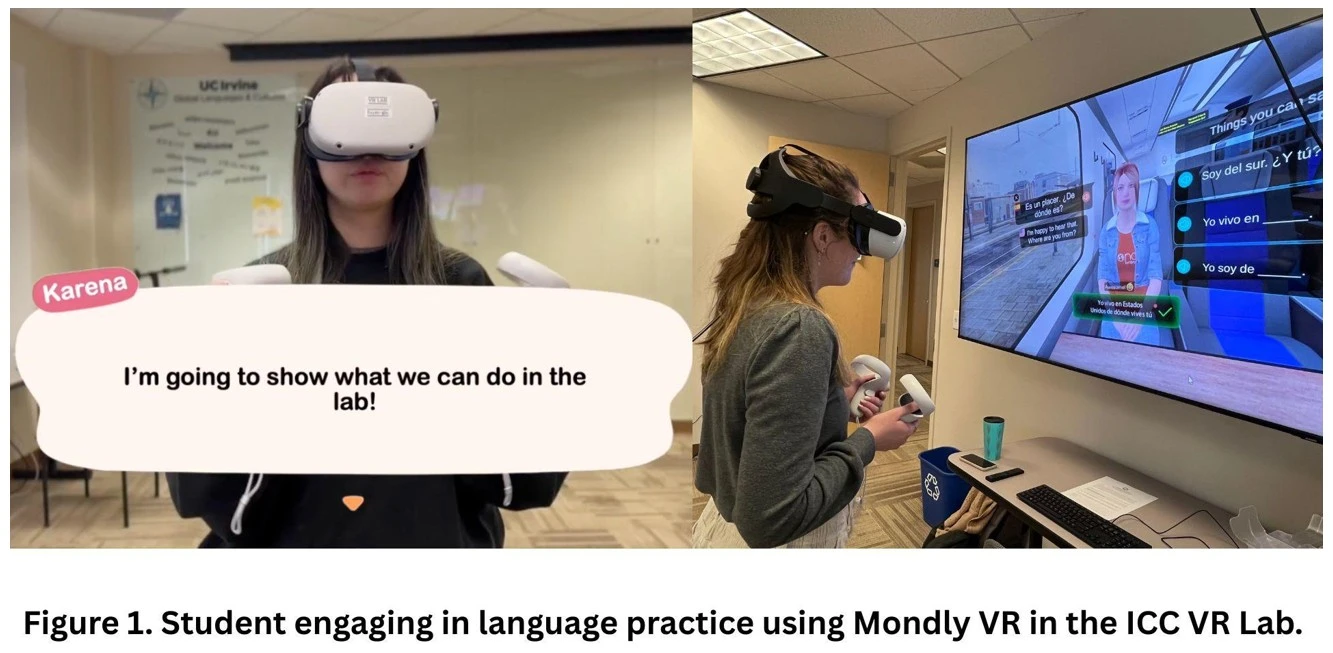
In ICC VR Lab, students engage in short, app-based sessions using Noun Town (https://noun.town/), Mondly (https://www.mondly.com/vr), and Google Earth VR (https://www.google.com/earth/education/tools/geo-vr/). These activities emphasize communication over grammatical precision, inviting learners to simulate everyday exchanges such as airport check-in or navigating a metro system (see Figure 1).
Each session concludes with a bilingual reflection of 150-200 words. Prompts invite students to:
- describe what they practiced and how it felt to use language in context,
- identify new vocabulary and expressions encountered,
- reflect on what aspects of communication (e.g., tone, gesture, or phrasing) felt intuitive or difficult, and
- discuss how the VR experience changed their understanding of real-world language use.
These reflections turn speech into analysis, bridging speaking and writing. Students begin to see writing as interpretation: a way to map linguistic choices, record affective responses, and translate embodied experience into language. In this way, VR functions as a rehearsal space for both verbal fluency and metacognitive awareness, demonstrating how reflection itself becomes a form of writing practice.
“Virtualizing Cultures”: Writing as Design and Dialogue
As mentioned earlier, while the ICC VR Lab focuses on input and reflection, the classroom practice in Virtualizing Cultures extends this work into authorship, transforming VR from a space of language rehearsal into one of multimodal composition and collaborative design. Using Spatial.io (https://www.spatial.io/), ENGAGE (https://engagevr.io/), and Meta Horizon Worlds (https://horizon.meta.com/), students examine how shifting perspective and situated context shape the stories that multicultural writers choose to tell. Writing operates as both process and product—a means of inquiry as well as the final artifact.
The course scaffolds three major genres that integrate VR with writing instruction. Students first compose short ethnographic reflections of 200-300 words after visiting cultural and historical spaces in VR and present on their findings (see Figure 2). These steps blend cultural observation with critical analysis, linking immersive experience to course readings and intercultural theory. Through this process, students begin to recognize how sensory engagement shapes interpretation, and how writing can capture the feeling of presence in a multilingual world.
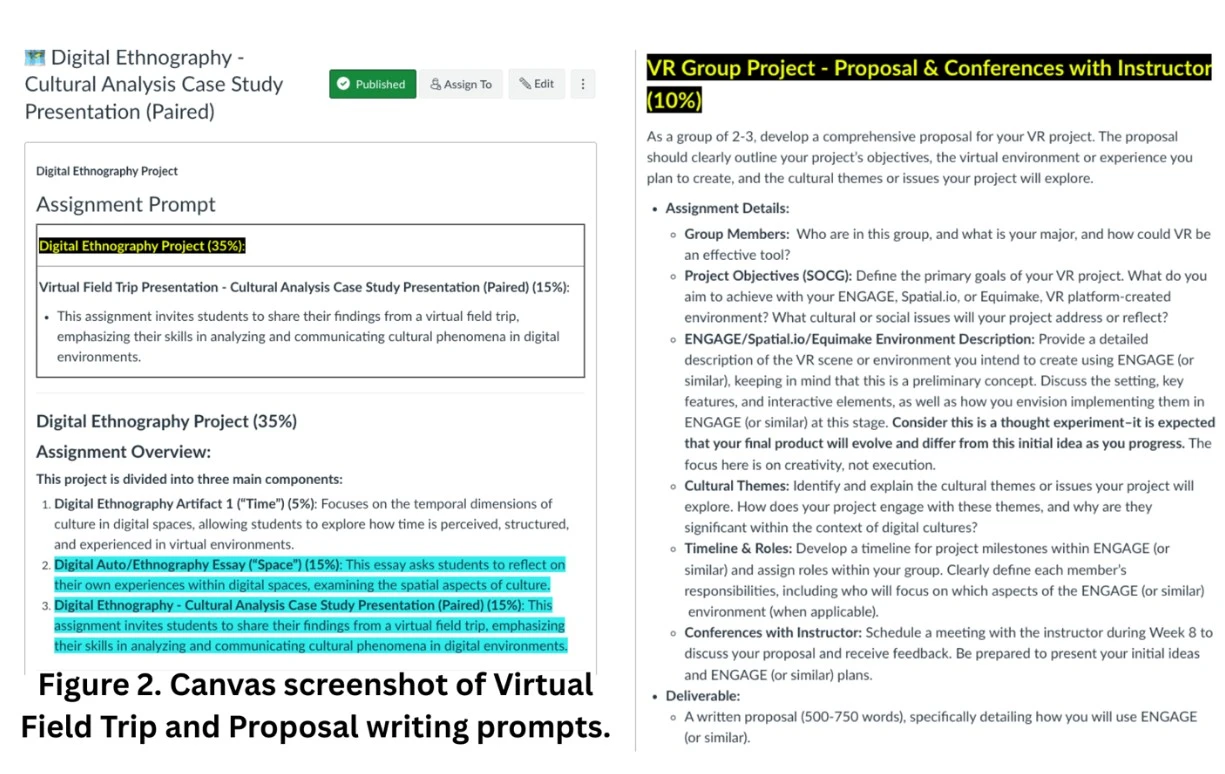
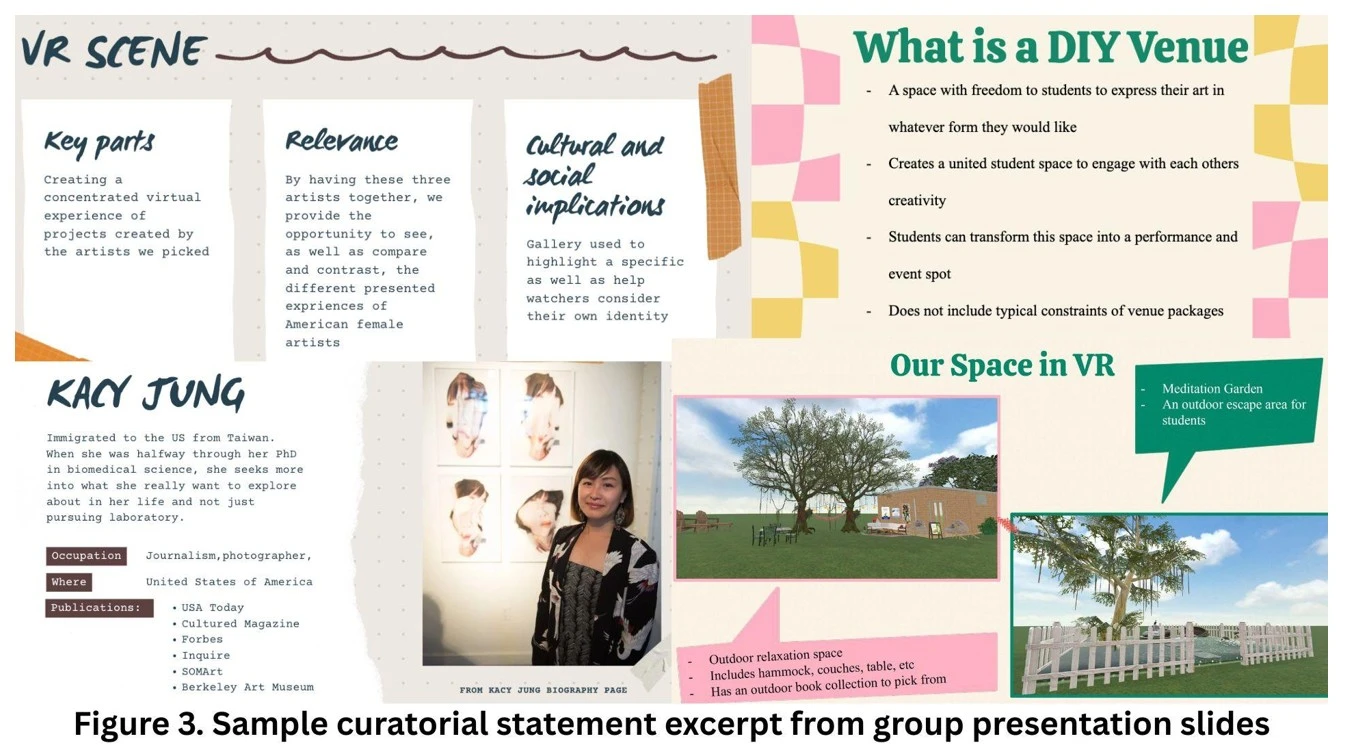
Next, students develop project proposals and curatorial statements of 500-750 words, articulating the rhetorical aims behind their virtual creations (see Figure 2). Each team outlines how spatial layout, visual motifs, and linguistic choices communicate cultural meaning and engage specific audiences. These assignments emphasize writing as an ethical process of representation, prompting students to consider how design conveys identity and belonging (see Figure 3).
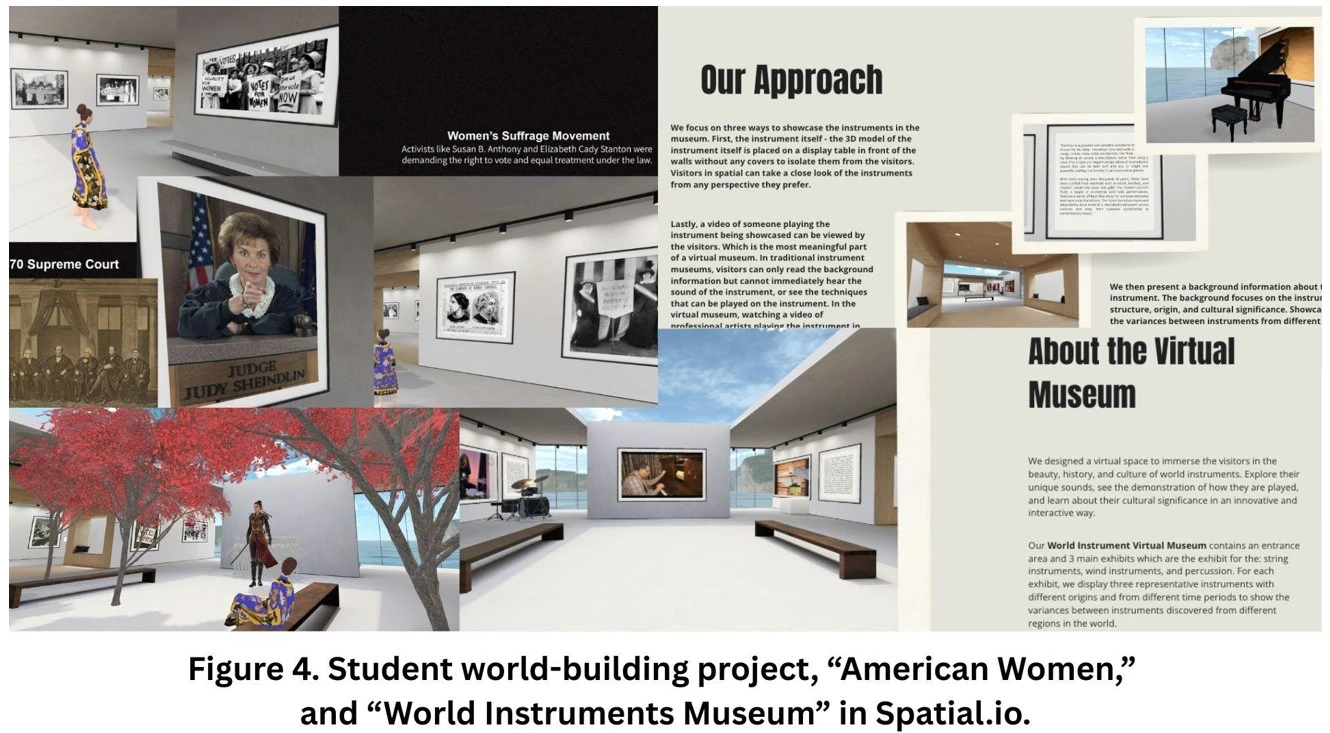
The sequence culminates in a multimodal composition that merges writing, affect, and space. Students collaborate to construct virtual exhibits that integrate multilingual captions, narrative voiceovers, and interactive elements. In one project, “American Women,” a team transformed a gallery into an archive celebrating multicultural female artists, embedding bilingual labels, ambient soundscapes, and guided narration (see Figure 4). Another group’s project, “World Instruments Museum,” invited visitors to move and listen through culture simultaneously, demonstrating how written meaning extends into design and embodied interaction. This kind of multimodal authorship reframes writing as both inquiry and expression. Through these activities, students learn that composing across languages and modes demands attentiveness to both audience and context—habits of mind that sustain effective writing across genres and media.
Reflections, Affordances, and Pedagogical Takeaways
Across both the ICC VR Lab and “Virtualizing Cultures,” students began to view writing as a living practice that connects language with movement and community. Virtual environments lowered barriers to participation and encouraged multilingual learners to write through observation and interaction. Many described “writing with the body,” noting that confidence and rhythm often surfaced before grammatical precision. Based on weekly discussion posts and end-of-unit reflections, these experiences suggest that VR reframes writing as relational and exploratory, transforming hesitation into expression. For students who often felt constrained in traditional classrooms, the avatar-based format offered a sense of safety and agency that fostered creative risk-taking and sustained engagement in their writing.
One example came from a Korean American student who used VR at Gyeongbokgung Palace in South Korea to tell her adoption story. Standing before a digital display of a hanbok, the traditional dress she wore as an infant, she invited peers to move through her family history. “To share this in VR was a new and cool experience,” she reflected during an interview, explaining that immersion helped her translate memory into language and image. Projects like hers show how VR transforms multilingual storytelling into multimodal composition, where students write through sound, space, and gesture as much as through words. Designing within these spaces also foregrounded writing as an ethical practice. Students discussed how to represent communities, whose voices to include, and how design choices might convey respect and inclusion. This resonates with Holmes and Colton’s (2025) framing of ethical design as a practice of flourishing—a process rooted in empathy and prudential judgment rather than prescription. Through such inquiry, multilingual writing becomes not only expressive but socially responsible.
VR introduces distinct affordances for TESOL writing instruction by transforming abstract principles like style and flow into lived experiences that students can observe and shape in real time. These affordances also support translanguaging as learners pair spoken and written forms across languages, while deepening intercultural understanding by allowing them to compose within, rather than about, cultural contexts.
To integrate virtual reality into writing instruction equitably, instructors can:
- Scaffold reflection. Encourage students to maintain bilingual journals or visual logs linking virtual experiences with rhetorical goals.
- Ensure accessibility. Offer free or mobile-based platforms (e.g., Google Earth VR, Spatial.io, or 360° videos) for students with varying resources.
- Integrate design ethics. Guide learners to analyze representation, authorship, and context as they explore virtual or hybrid compositions.
Ultimately, VR serves not as a novelty but as a meeting ground where language, culture, and writing converge. When students write about what they encounter or create within these shared worlds, they begin to view writing as an act of relation and care. Through such acts of multimodal composition, language learning becomes a lived practice of connection—one that extends across cultures and invites responsibility for how stories are told.
References
Canagarajah, S. (2011). Codemeshing in academic writing: Identifying teachable strategies of translanguaging. The Modern Language Journal, 95(3), 401-417. https://www.jstor.org/stable/41262375
Holmes, S., & Colton, J. (2025). Designing ethical constraints to enable flourishing in an online community. In J. Jiang & J. C. K. Tham (Eds.), Designing for social justice: Community-engaged approaches in technical and professional communication (pp. 81-97). Routledge. https://doi.org/10.4324/9781003469995-5
Mills. K. A. Unsworth, L., & Dooley, K. (2025). Virtual and augmented reality text environments support self-directed multimodal reading. Interactive Learning Environements, 33(9), 5460–5479. https://doi.org/10.1080/10494820.2025.2482594
Wei, L., & García, O. (2022). Not a first language but one repertoire: Translanguaging as a decolonizing project. RELC Journal, 53(2), 313-324. https://doi.org/10.1177/00336882221092841
Yancey, K. B. (2004). Made not only in words: Composition in a new key. College Composition and Communication, 56(2), 297-328. https://doi.org/10.2307/4140651
Acknowledgements
All classroom materials, reflections, and images included in this article are original and reproduced with permission for educational purposes.
 Dr. Jung-Hsien Lin is Assistant Director and Lecturer in Global Languages and Cultures at the University of California, Irvine, and Director of the Intercultural Communication VR Lab. Her teaching and research focus on multilingual literacy, intercultural communication, and immersive learning design that integrates virtual reality and generative AI technologies.