
The Multilingual Learners’ Hub: Free Open-Access Resources for Teachers and Families of Multilingual Learners
Clare Kruft, Ph.D., University of Maryland Graduate School, Baltimore (UMBC), Maryland, USA
Multilingual Learners are the fastest growing population in schools within the United States. “Public school enrollment increased between fall 2010 and fall 2021 among students who were:
- Hispanic (from 11.4 million to 14.1 million);
- Asian (from 2.3 million to 2.7 million); and
- of Two or more races (1.2 million to 2.3 million).” (National Center for Education Statistics, 2023)
Many resources have been developed to support the needs and build on the assets of our multilingual families in the United States, but not all resources are easily accessible for overworked educators and for the families themselves. The Multilingual Learners Hub (ML Hub) was developed to address this need for easy access to quality resources that support teachers and families of multilingual learners. Through generous funding from the Kahlert Foundation and the ELEVATE grant through the U.S. Office of English Language Acquisition (OELA), Towson University’s College of Education has created the ML Hub to be an accessible place to find quality support for multilingual learners. This article showcases the ML Hub through two composite vignettes. Vignette One shows how busy teachers can find practical resources to support the instructional needs and showcase the assets of their linguistically and culturally diverse students. Vignette two shows how multilingual families can reduce their cognitive load and overcome obstacles they may face in meeting their survival, educational, linguistic, and social needs within their new country.
Vignette One
Laketa is a new teacher on the fourth-grade team at her school in a demographically diverse system in Maryland. Laketa graduated from an accredited university as an education major, unlike many of her other new colleagues in the district who are conditionally certified until they receive their teaching degree. However, she still faces many challenges as she enters her first year as a teacher with high demands on her time to implement the school system curriculum while still addressing the diverse learning needs of her students, 40% of whom are multilingual learners. A good portion of her evaluation as a teacher will be determined by her students’ achievement on standardized tests, yet Laketa is not exactly sure how she will address her newcomers and other multilingual learners’ needs to comprehend the content while they are also learning a new language. She has high expectations but little time to find ways to support her learners and build on the assets they bring to the classroom to foster inclusive relationships and a safe space for learning with them.
One of her fourth-grade colleagues just attended a professional conference on supporting multilingual learners at their local university, and she introduced Laketa to the Multilingual Learners Hub (ML Hub). The first thing Laketa clicked on was the Introductory Video on the Home Page to see the overview of the site in just a few minutes.
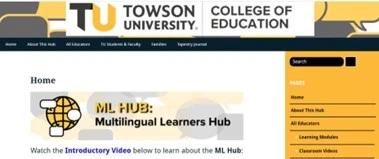
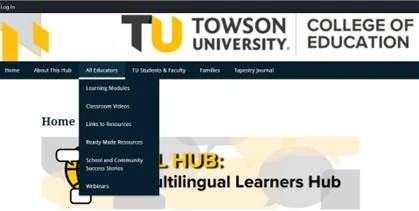
Next, Laketa knew she wanted to click into the All Educators section at the top of the drop-down menu (or on the sidebar). That section included a myriad of resource links in topics that provided practical support for teachers. Everything was focused on useful strategies in short videos, articles, and links to more in-depth information that she could access all online at her own pace.
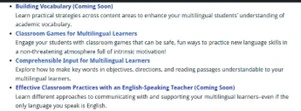
The two sections Laketa decided to concentrate on were the Learning Modules and the Links to Resources. The Learning Modules allowed her to choose from a variety of topics she could use to gather ideas for her own classroom. She saw that many modules were already open, and others were “Coming Soon” to be opened over the next few months. Laketa chose the Comprehensible Input module to go through and took notes on some practices she saw to use right away in her classroom to help her newcomers better understand key concepts and vocabulary. After about two hours exploring the module, she printed out the Certificate of Completion showing she’d engaged in this professional learning with a document she could add her name to and use in her professional development portfolio to show during her teacher evaluation with her principal.
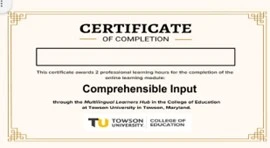
The next section Laketa accessed was the Links to Resources under the All Educators drop-down menu. She wanted to see what was offered and found so many good websites, toolkits, and even digital books in different languages her students could use for independent or home reading to affirm their own culture and affirm their superpowers in knowing and learning more than one language. In fact, their English-only classmates loved that section of the website links, as well to learn some words in different languages! Laketa felt encouraged that she had this new website to help her multilingual learners thrive in her classroom.
Vignette Two
The Hernandez family just arrived from El Salvador. Bella is the mother of three children from 4-12 years old. Her husband and the whole family had many struggles as they made the trip from their native El Salvador through our border. They have just enrolled their children in the local elementary and middle schools. As part of the welcome packet that was translated into Spanish, they saw a link to a website and QR Code they could access through their phone. The elementary school where Bella’s family enrolled had many Latino families, and another mother was in the school office as Bella was waiting to enroll her children. The mother told Bella to check out this website from her welcome packet on her phone. In the Family section Bella could see ideas for where to start with some of the things they might need to help with food, immigration services, and other supports in the area. Bella clicked on the QR code with her phone when they got to their new apartment.
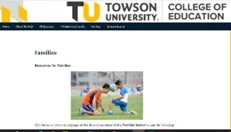
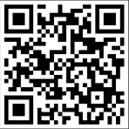
Bella was happy to see that there were lots of resources in the Central part of Maryland where she had arrived to live in Baltimore City. She clicked on the drop-down menu under Families at the top of the page and saw two titles that caught her attention: Fun Learning Games and Community Resources.
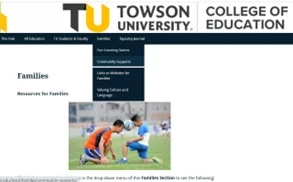
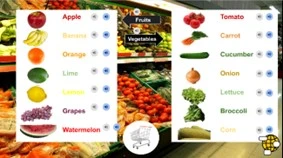
Bella thought the games might help her kids stay entertained, but she realized that they could also help her to learn English she needed to talk with teachers at school or shop at the grocery store. By clicking on the Spanish Learning Game, she saw pictures of things she needed to talk about and heard her familiar Spanish name for the item and how to say it in English. She just needed to click on the sound buttons in the game and practice on her own. Soon, she was much more confident going to get groceries for her family.
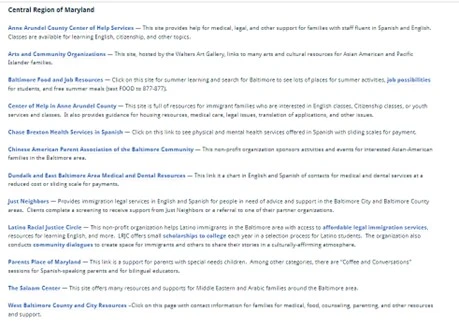
Bella also explored the Community Supports link under the Families section on the ML Hub and saw that there were links to services to help with legal and medical supports for families. She was grateful that the school and the friendly mom there had given her this site.
Conclusion
The ML Hub contains resources that educators can use all over the United States and with family supports for the Maryland area. This ML Hub will continue to grow as other educators and community support agencies from other states work to contribute free, open-access, and practical resources to add to the site. Please feel free to reach out to this author as the contact person for this ML Hub: Dr. Clare Kruft, Towson University, [email protected]. Educators learn best from other educators, so this ML Hub will continue to become a more effective resource by adding the best ideas we can share from our own successful practices and networks to build on the superpowers of our multilingual learners and families.
References
Multilingual Learner Hub. (2024). Towson University. https://wp.towson.edu/tesol/
National Center for Education Statistics. (May 2023). Retrieved from
https://nces.ed.gov/programs/coe/indicator/cge/racial-ethnic-enrollment)
Support for some information shared on the ML hub is provided by the ELEVATE project at Towson University, a project funded under the National Professional Development Program of the United States Department of Education, Office of English Language Acquisition (T365Z210117). The views expressed do not necessarily represent official policies or positions of the United States Department of Education; no official endorsement is intended or should be inferred.