
How to Best Support Multilingual Writers?
Jaime F. Mejia Mayorga, University of Arizona, Tucson, Arizona, USA
How to best support multilingual writers? As a writing instructor, I ask myself this question countless times. Whether in the Second Language Writing (SLW) classroom or the typical composition classroom in U.S. colleges and universities, the reality is that we will inevitably have multilingual writers as our students. International students often use English as an additional language, while domestic students may speak English alongside Spanish or a less-commonly taught language. While there are numerous answers to this question, I would like to share two ideas that I believe are crucial to best supporting multilingual writers. These are not strict directives but rather suggestions for expanding our teaching praxis—what we believe and practice as writing instructors.
Expanding Our Understanding of Writing Instruction by Decolonizing our Understanding of Languages
Writing is a form of language, and therefore, teaching writing is inherently teaching language. This seemingly simple statement carries complex social and historical connotations. If writing is language, it also reflects a hierarchy of literacies, much like the hierarchical value placed on certain languages over others (Blommaert, 2010). These values stem from both historical trends and modern trends in globalization.
In the context of the Americas, these hierarchies trace back to the colonial period, when European powers imposed their languages—English, Spanish, Portuguese, among others—while dismissing and marginalizing Indigenous languages. Ofelia García, in her piece titled “Decolonizing Foreign, Second, Heritage, and First Languages: Implications for Education” (2019), calls for a critical examination of the ways languages are categorized as first, second, foreign, or heritage languages. These distinctions reflect the independence movements in the Americas during the 1820s, when European languages were institutionalized as the "official" or “de-facto official” tongues of nations, while local, Indigenous languages were sidelined. García's discussion highlights how monolingualism, supported by the officialization of the settler languages, became the norm showing how language education reflects the colonial legacy. Despite this, multilingualism has long been, and continues to be, the lived reality for millions of people both in the U.S., in the Americas, and globally, with translanguaging practices—where people fluidly switch between languages—being common in everyday life.
Certainly, this legacy of colonialism, where we value specific behaviors and products regarding language use over others, is still present in our writing classrooms. For example, writing instruction still values the product rather than the process, and still lets monolingual composition take all the space in the classroom. Beyond this, I argue that García’s work sheds light on how the institutionalization of language education has contributed to what Indigenous scholars have termed "ethnostress" (Antone & Hill, 1992). Ethnostress refers to the psychological harm experienced by colonized populations as a result of the imposed colonial structures. Although this concept was initially applied to Indigenous populations, I argue that it extends to anyone in post-colonial nations, where the remnants of colonial practices continue to shape language education. Indeed, not being able to use one’s full linguistic repertoire might cause an elevated psychological harm when learning how to write potentially resulting in traumatic experiences. Understanding how colonialism has infused language with monolingual ideals—and how language and writing instruction have contributed to this—can help us see language education as a tool for healing from ethnostress by overcoming the psychological harm that is caused by the coloniality within our societies and by promoting and celebrating multilingualism.
In this way, writing instruction should move beyond canonical approaches where one single language is celebrated, where products are monolingual, and instead embrace methods that foster healing, well-being, and support the linguistic diversity of multilingual students. By challenging traditional ways of teaching writing, we can create classrooms that support multilingualism as a strength rather than an obstacle, allowing students to bring their full linguistic selves into their academic work.
Supporting Multilingual Writers’ Academic Success Through Instructional Materials
Supporting multilingual writers requires rethinking the way we approach writing instruction, particularly through the use of instructional materials that embrace multilingualism. As instructors, we should adopt an asset-based approach that informs our instructional approach, focusing on the strengths multilingual students bring to the classroom rather than viewing their language diversity as a deficit (Arias, 2018).
One way to do this is by using corpus-informed instructional materials that are designed to reflect the actual language use of multilingual students. Corpus-informed materials, which are based on large collections of written and spoken texts, can provide real-world language models that help multilingual writers improve their writing by exposing them to authentic linguistic patterns.
I have used corpus-informed materials in the writing classroom to expose students to essays other students, similar to them in language proficiency and multilingual prowess, have written. In what follows, I share two corpus-informed materials I have used with my students: a genre-analysis activity and a set of concordance lines.
In the genre-analysis activity, students get access to a set of literacy narrative essays other multilingual students-writers have written and answer guiding questions where they broadly look at the form, language, and use of this specific type of essay, the ‘literacy narrative’ essay. If you assign students to write this type of essay, you could use this activity after you share with them the writing prompt as the materials help them prepare and get familiar with literacy narratives.
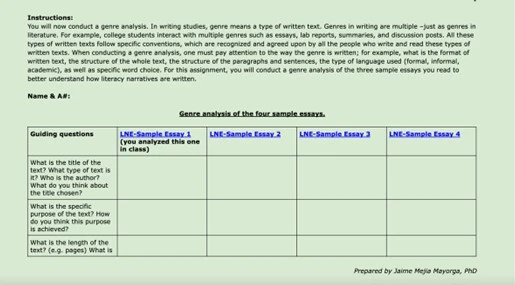
You can access this activity as a Google Doc version by clicking here.
The second corpus-informed material I would like to share is a set of concordance lines based on rhetorical analysis essays. Similarly to the genre-analysis activity, this material was created using a set of essays, or a corpus, that were written by multilingual student-writers. Concordance lines can help students identify patterns and choice in language use, and in this particular case, identify patterns and language choice in rhetorical analysis essays. I used this material after receiving the first draft of students’ rhetorical analysis essays. We used the concordance lines to see what other student-writers had done when writing rhetorical analysis essays. This compare-and-contrast activity motivated students to see what similarities and differences they had when compared to other student-writers as well as to get ideas on how to edit their essays further. As you use these materials, make sure you instigate discussion and encourage participation by asking questions before and after analyzing the concordance lines.
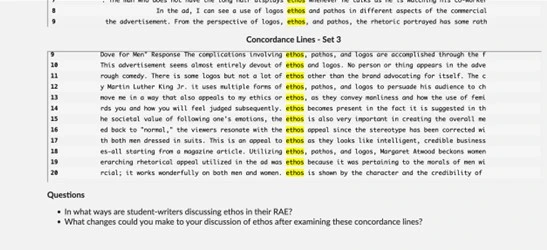
You can access this activity by clicking here.
These instructional materials prepare students to write as they serve as realistic examples of what is expected of them and help them break down many of the intimidating aspects of writing a specific type of essay. Furthermore, they build on their linguistic skills as speakers and users of multiple languages given that these materials have them analyze language choice and language use. It is surprising to see how positively students react to these materials as well as how useful they consider them when engaging with their writing assignments. In fact, research has shown how beneficial corpus-informed materials are for multilingual writers in developing genre awareness and extending their linguistic and rhetorical choices (Staples et al., 2024).
If you are interested in using corpus-informed materials to support multilingual writers, please click here to access a website with additional corpus-informed materials. I designed this website when I taught a class composed of multilingual writers. These corpus-informed materials could be used to enrich your genre-based instruction or as supporting instructional materials.
Additionally, using instructional materials that embrace multilingualism — and by purposefully choosing the amount of content to be covered in a writing class and scaffolding learning by breaking down complex concepts into more manageable parts—can help multilingual writers better engage with writing tasks without becoming overwhelmed. It might also require the simplification of our assessment practices by using simplified rubrics and other assessment activities.
Ultimately, these strategies aim to create a learning environment that acknowledges the value of linguistic diversity and fosters multilingualism as an academic asset. By designing instructional materials and approaches that are inclusive of multilingual learners, we not only support their academic success but also challenge the colonial mindset that has long shaped language and writing education.
Conclusion
Supporting multilingual writers requires a fundamental shift in how we view language and writing instruction. By decolonizing our understanding of language, we acknowledge the historical and cultural forces that have shaped linguistic hierarchies and recognize the need for healing from the psychological harm caused by these structures. Embracing multilingualism as a strength, rather than a challenge, allows students to bring their full linguistic identities into the academic space. Additionally, rethinking instructional design through the use of simplified strategies and corpus-informed materials helps create an inclusive and supportive environment for multilingual students. These approaches not only foster academic success but also challenge the colonial legacy that continues to influence education. As writing instructors, our responsibility is to expand our praxis to recognize and nurture the rich linguistic diversity that multilingual writers bring, enabling them to thrive in both their writing and academic journeys.
Acknowledgment
I extend my gratitude to Nina Conrad, Anh Dang, Shelley Staples, and Hui Wang for generously sharing original corpus-informed materials, which I adapted for the literacy narrative. I also thank the SLW Interest Section editors for their valuable feedback and support. Lastly, I am grateful to my peers and mentors in the Second Language Acquisition and Teaching program and across the University of Arizona for their support and encouragement. Muchas gracias.
References
Antone, B., & Hill, D. (1992). Ethnostress: The disruption of the Aboriginal spirit. Tribal Sovereignty Associates. https://firstlightlearningjourney.net/wp-content/uploads/2019/11/Ethnostress.pdf
Arias, B. (2022). Turning Toward Asset-Based Pedagogies (pp. 1–11). Center for Applied Linguistics. https://www.cal.org/publications/turning-toward-asset-based-pedagogies/
Blommaert, J. (2010). The sociolinguistics of globalization. Cambridge University Press.
García, O. (2019). Decolonizing foreign, second, heritage, and first languages: Implications for education. In D. Macedo (Ed.), Decolonizing foreign language education: The misteaching of English and other imperial languages (pp. 152–167). Routledge.
Staples, S., Conrad, N., Dang, A., & Wang, H. (2024). Building language and genre awareness through learner corpus data in a second language writing course. International Journal of Learner Corpus Research, 10(1), 146-182. https://doi.org/10.1075/ijlcr.00043.sta
 Jaime F. Mejia Mayorga is an educator, applied linguist, and language education specialist. He holds a Ph.D. in Second Language Acquisition and Teaching from the University of Arizona. His professional experience includes teaching English as a Foreign/Second/Additional Language, working with pre-service and in-service teachers of English, teaching academic writing, and administering academic programs. Currently, he works at the University of Arizona's Office of General Education as the Liaison for Online and International Campuses. He is interested in working with and for historically underserved communities, multilingual and multicultural education, transnational higher education, and social justice and equity.