
News Report: ESP Assessment: Language Assessment Literacy for Practitioners
Jie Shi, National University of Electro-Communications, Tokyo (UEC), Tokyo, Japan
On the invitation of the research lab of the National University of Electro-Communications, Tokyo (UEC), Dr. Shahid Abrar-ul-Hassan presented a professional development session on language assessment literacy (LAL) in ESP teaching. This session was jointly hosted by the Japan Association of College English Teachers (JACET), Kanto Chapter ESP SIG. The session was chaired by Professor Jie Shi, who leads the UEC research lab, in collaboration with JACET Kanto Chapter ESP SIG President Professor Shinichi Hashimoto. Professor Shi has been serving in leadership roles with JACET as well as in TESOL International Association’s’ ESP-IS. This session on LAL was attended by faculty, graduate students, and members of JACET Kanto Chapter in the region. A limited time recording of the session was made available to JACET Kanto Chapter membership for wider outreach.
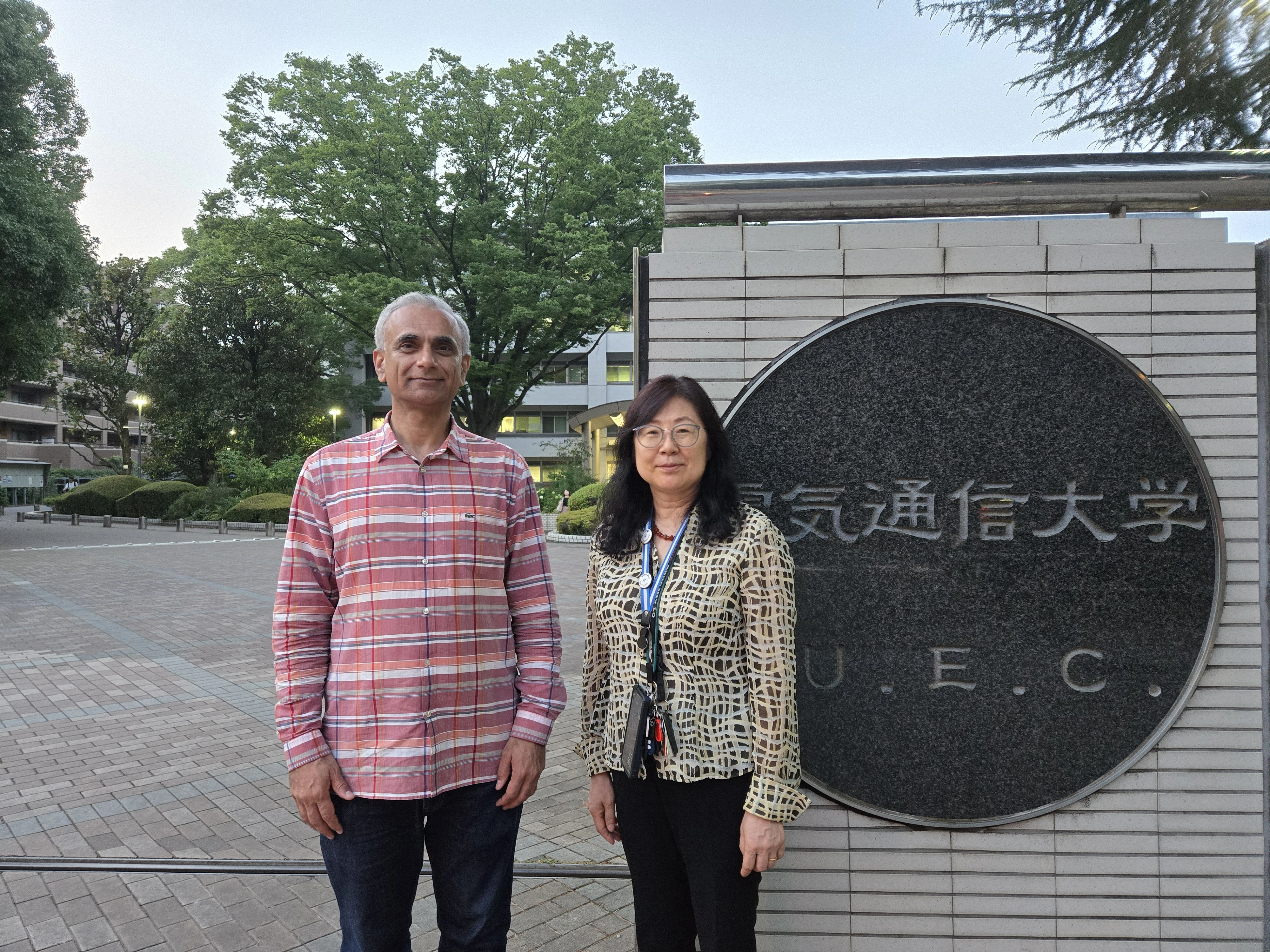
Jie Shi and Shahid Abrar-ul-Hassan at the National University of Electro-Communications, Tokyo

Shahid Abrar-ul-Hassan, Kevin Knight, Jie Shi, and Shinichi Hashimoto in Tokyo
Having been engaged with critical assessment scholarship on ESP assessment over the years, Dr. Abrar-ul-Hassan highlighted the importance of LAL for ESP programs involving all stakeholders. He mentioned that often LAL is associated with practitioners whereas assessment literacy of other stakeholders, such as students and program leaders, has been a key factor in assessment practices in ESP programs. He mentioned that ESP/EAP programs are needs-driven with an objective to prepare students for effective communication in disciplinary discourse practices (Abrar-ul-Hassan & Fazal, 2018; Hyland, 2016). Assessment in these programs is primarily criterion-referenced and instructor-led, which utilizes a range of approaches and procedures. Thus, the role of language assessment literacy (LAL) of practitioners is crucial for the effectiveness of learner-centered language programs. The growing scholarship on LAL requires contributions from diverse teaching contexts to capture the complexities of policies, practices, and multimodal literacies. This session was research-informed and presented a contextualized study of EAP educators’ LAL in a Canadian context. The key findings of this study were, “Instructors’ graduate or academic studies did not seem to provide adequate training on LAL, and their teaching practice, being a member of peer community, was a dominant source of LAL.” This session also included highlights of the Special Issue on LAL of System (2023), which Dr. Abrar-ul-Hassan co-edited. This special issue has been published and could be accessed through this weblink: https://www.sciencedirect.com/special-issue/10M8QSDH4NK
References
Abrar‐Ul‐Hassan, S., & Fazel, I. (2018). English for specific purposes. The TESOL Encyclopedia of English Language Teaching, 1-14.
Abrar-ul-Hassan, S., & Nassaji, H. (Eds.). (2023). Language assessment literacy. Special issue. System .
Hyland, K. (2016). Methods and methodologies in second language writing research. System, 59, 116-125.
 SHI Jie is a professor at the National University of Electro-Communications (UEC) in Tokyo. She is an English teacher in TESOL and an action researcher in ESP/EAP in EFL context, Sociolinguistics, AI-Assisted Machine Translation, and Cognitive Education. She is also an Adjunct Professor of EAP at the Graduate School of Science at the Tokyo Institute of Technology. She is currently a member of and an advisor for the ESP SIG Kanto Chapter of JACET and is affiliated with several domestic and international associations including TESOL International and the Asia Association of ESP for which she has served as a representative of EAP of ESPIS and a vice-president respectively.