
Students as ChatGPT Prompt Engineers – A Sample Email Writing Activity
Cynthia DeRoma, Yale University, New Haven, Connecticut, USA
In The Hitchhiker’s Guide to the Galaxy, Douglas Adams presents a supercomputer that took 7.5 million years to calculate that the number 42 was the “answer to the ultimate question of life, the universe, and everything” (1979). Nevertheless, the twist is that no one knew what that ultimate question was, rendering the answer useless.
OpenAI’s ChatGPT can give us answers in much less time, and students are using it in ways instructors are not even aware of. However, are our students any better at asking questions to a supercomputer than Adams’s characters? Snow (2023) reports on companies now hiring “prompt engineers,” described as “people with the skills, background and practice to talk to so-called large-language AI systems effectively,” suggesting that this has become a highly desirable skill in a resume.
I will share an email-writing activity in which I have used a two-triangle heuristic based on rhetoric and politeness theory (Brown & Levinson, 1987) as a framework to model and practice effective ChatGPT prompting, as well as to evaluate responses. I hope to help ITAs and L2 students continue to make well-informed, ethical use of this tool.
Motivation
One of the reasons I got interested in prompt engineering was that, once ChatGPT became widespread, I started getting emails from students with contents like (1) and (2):
(1) I regret to inform you that due to a high workload, which includes managing two courses and working on two proposal submissions, I won't be able to attend your classes this week. I apologize for any inconvenience this may cause.
(2) I hope this email finds you well. I am writing to inform you that I am not feeling well today, and regrettably, I won't be able to attend our class. I plan to be back in good health for our next scheduled class on Wednesday. I appreciate your understanding and look forward to seeing you then.
Thank you for your consideration.
The overly formal style in these samples, which had been aided by generative AI, was starkly different from what I used to get pre-ChatGPT, with characteristics of impersonal, boiler-plate corporate messaging. As such, they did not fit the stylistic expectations of their purpose which was to be excused from my class.
What does “Engineering” Mean Here?
I call “engineering” a process that
(3) a. is goal-oriented – the creator has a strong sense of what is to be accomplished as a result of the process.
b. follows clear specifications – based on (3a), there must be specific instructions.
c. may require multiple iterations – the product can constantly be improved upon by tweaking (3b) based on how well it fulfills (3a).
Framework Part 1: The Rhetorical Triangle
(4) has a version of a triangle built upon Aristotle’s three interconnected rhetorical appeals, simplified in (5a)-(5d).
The Rhetorical Triangle
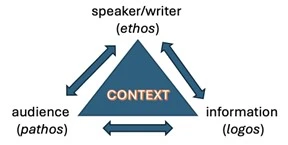
(5) a. Context – (5b) to (5d) depend on the context in which the communication happens
b. Ethos – how the speaker or writer presents themself (friendly, authoritative, vulnerable, etc.)
c. Pathos – appeal to the audience’s expectations, emotions, or values
d. Logos – how much information is given and how
In crafting a message to fulfill a goal, the first step is to determine what the context demands and then decide on the length, tone, style, and word choices that suit the desired balance of ethos, pathos, and logos.
Framework Part 2: The Politeness Triangle
Based on Brown & Levinson (1987), context can also be analyzed based on (6), whose elements are briefly summarized in (7).
(6) The Politeness Triangle
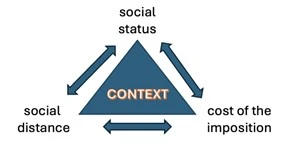
(7) a. Context – guides the considerations in (7b) to (7d)
b. Social status – the speaker/writer’s and audience’s place in a hierarchy based on the culture of a group (e.g., society, workplace)
c. Social distance – the difference in status between the speaker/writer and the audience (e.g., student-professor, professor-dean, worker-boss relationships)
d. Cost of the imposition – what the communication or any requests it contains may cost the audience (e.g., money, time, reputation, feelings), including time to hear or read your message and decode it
Back to Emails
With the rhetorical and politeness triangles in mind, students looked at (1) and (2) to analyze if they fit the context and purpose for which they were written. We then worked on thinking about better ChatGPT 3.5 (the free version at the time) prompts. (8) is an example of a first attempt, with excerpts from the overly long (5 paragraphs and 172 words) bot’s response in (9).
(8) Write an email to my English instructor. We are not very close, but she is approachable. I want to sound committed but not formal. I can’t come to class this week because I have a lot of work to do: I’m taking two courses and working on two proposal submissions. I’m not supposed to miss classes.
(9) I hope this email finds you well. (…) I genuinely value your class and the insights it provides, so missing out is a bit of a disappointment for me. (…) I want to ensure I stay on track despite this brief deviation from the norm. (…)
Students first noticed that the length of the email would impose an inadequate time cost on the recipient. They also commented that the business-like formal tone did not match the kind of relationship students and instructors have in our institution, and that there was an awkward pathos appeal in trying to flatter the recipient.
For a second iteration, the prompt was
(10) Make it shorter and don’t use I hope this email finds you well. I don’t need to flatter her.
The response was still too long and had a slightly flattering tone (“I understand the importance of attendance and will ensure to catch up on any missed material or assignments promptly.”). To address that, the next prompt, in (11), clarified the context.
(11) Can you make it shorter? Missing class is not a big problem.
Although the next version, in (12), was more appropriate in length and tone, students noticed an ethos problem: the kind of language used differed from what they thought they would produce.
(12) Just a heads up that I won’t be in class this week due to a heavy workload – managing two courses and working on two proposals is quite the balancing act.
I’ll catch up on any missed material promptly. Thanks for your understanding.
As a result, students decided to focus on their own selves (ethos) and wrote (13), which generated (14).
(13) I’m an English student from China.
(14) Quick note to say I can’t make it to class this week. Got a lot on my plate with two courses and two proposals.
I’ll catch up on what I miss. Thanks for understanding.
The response in (14) was syntactically simpler, including a fragment (“quick note to say…”) and null subject (“got a lot…”), which are not elements that that group of students felt represented their style. They observed that the prompt did not specify what being “an English student from China” meant in terms of language use. We decided to instruct it to avoid idiomatic expressions, like “got a lot on my plate.”
We were finally satisfied with the response in (15), which seemed to fit the rhetorical context and strike the right balance between being concise (respecting the reader’s time) and appropriate to the social status of and social distance between the participants.
(15) I wanted to let you know I won’t be able to make it to class this week. I’m dealing with a heavy workload – managing two courses and working on two proposals.
I’ll make sure to catch up on anything I miss. Thank you for understanding.
After all the iterations, we combined instructions to write the prompt in (16), giving us the response in (17), which we deemed more acceptable than the previous versions.
(16) I'm a student from China. Write an email to my English instructor to say I can’t come to class this week because I have a lot of work: I’m taking two courses and working on two proposal submissions. We are not very close, but she is approachable. I want to sound committed but not formal. I’m not supposed to miss classes. Make it short (under 100 words). Don’t use I hope this email finds you well. Don't use flattering language. Don't use idioms.
(17) I hope you are well. I need to inform you that I cannot attend class this week. I am overwhelmed with work, as I am taking two courses and working on two proposal submissions. I understand the importance of attending classes and will catch up on all missed work.
Thank you for understanding.
Final Thoughts
After this process, we concluded that creating the right prompt can take time, given that it may take multiple attempts, each one requiring careful reflection of the goals, rhetorical situation, and relationship between participants. Because AI-generated text is only as good as the instructions given, I encourage students to use the definition of engineering outlined in (3) to include the elements in (18) in their prompts and revisions.
(18) a. Goal of the message (e.g., request, apologize, persuade, inform, etc.)
b. Specifications – use the triangles in (4) and (6) to answer these questions:
Who are you and what image of yourself do you want to project?
Who is the audience and what are their expectations?
What should the language of the message look like?
What is your and your audience’s social status?
What is the social distance between you and your audience?
What costs does your message impose?
c. Multiple iterations – try modifications to the specifications to generate different possibilities
References
Adams, D. (1979) The hitchhiker’s guide to the galaxy. Pan Books.
Brown, P., & Levinson, S. C. (1987). Politeness: Some universals in language usage. Cambridge University Press.
Coy, P. (2023, May) A.I. could actually be a boon to education. The New York Times. https://www.nytimes.com/2023/05/03/opinion/chatgpt-ai-khan-academy.html
Snow, J. (2023, April 12) ChatGPT can give great answers. But only if you know how to ask the right question. The Wall Street Journal. https://www.wsj.com/articles/chatgpt-ask-the-right-question-12d0f035
 Cynthia DeRoma is a senior lector in the English Language Program, housed at the Center for Language Study at Yale University. She works with ITAs and other graduate students on all aspects of communication.